Fast growth used to mean hitting $100M in five years.
That was considered hypergrowth.
That era is over.
Today, AI companies are hitting $100M in 12 months or less.
Lovable: $100M ARR in 8 months. $200M ARR in 12 months.
Cursor: $0 to $100M ARR in 12 months. $1 billion ARR in 24 months.
Genspark: $0 to $100M ARR in 9 months.
Midjourney: $0 to $200M ARR in 2 years
That’s warp speed.
Meanwhile, thousands of AI startups with solid products, real funding, and great teams are growing 100-300% per year. Impressive by traditional standards, but not enough to define a category in the AI era.
The uncomfortable truth: if you're not on pace for $100M ARR within 12 months of PMF, someone else could dominate your market.
But here's what most founders don't realize: this window is closing.
We've seen it before. When the App Stores launched in 2008, users eagerly tried new apps. By 2015, 49% of US smartphone users downloaded zero new apps per month.
The companies that captured categories during the excitement window (Instagram, Uber, WhatsApp) became entrenched defaults. Everyone else fought for scraps.
We're in the AI excitement window right now.
Users are actively seeking AI tools.
Friction to try something new is at a historic low.
But it won't last.
In 18 months, AI fatigue sets in.
The companies that become the obvious choice during this window become nearly impossible to displace, not because they'll always be best, but because alternatives will only be slightly better.
Right now, great AI apps have the opportunity to completely disrupt industries and wow users with a different approach to solving problems.
Cursor becomes "the AI code editor."
Midjourney becomes "how I create images."
Lovable becomes "how non-technical founders build apps."
You have 18 months to become the obvious choice in your market and hit warp speed.
Maybe less.

Here’s how.
How to Unlock Warp Speed
I studied every AI company that hit $100M ARR in under 18 months. Different markets. Different products. Different teams. But the same four questions kept determining who won:
- Did users prefer them over alternatives? The winners didn't just acquire users; they made switching back feel frustrating. Users tried them once and couldn't go back.
- Did users get value immediately? The winners didn't rely on onboarding or tutorials. Users experienced the transformation in 60 seconds or less.
- Could they scale revenue without scaling headcount? The winners didn't hire armies of salespeople and support reps. The product and AI did the work.
- Were they solving a problem the market was desperate to fix? The winners didn't create demand. They unlocked demand that already existed.
Four forces. Miss one, you stall. Nail all four and you become the category leader.
I call it the WARP Framework.
- W – Win Preference. Users try you once and can't go back.
- A – Activate Instantly. Users get to value in 60 seconds or less.
- R – Repeatable Leverage. You scale revenue without scaling headcount.
- P – Pervasive Pain. You're solving a problem the market is desperate to fix.
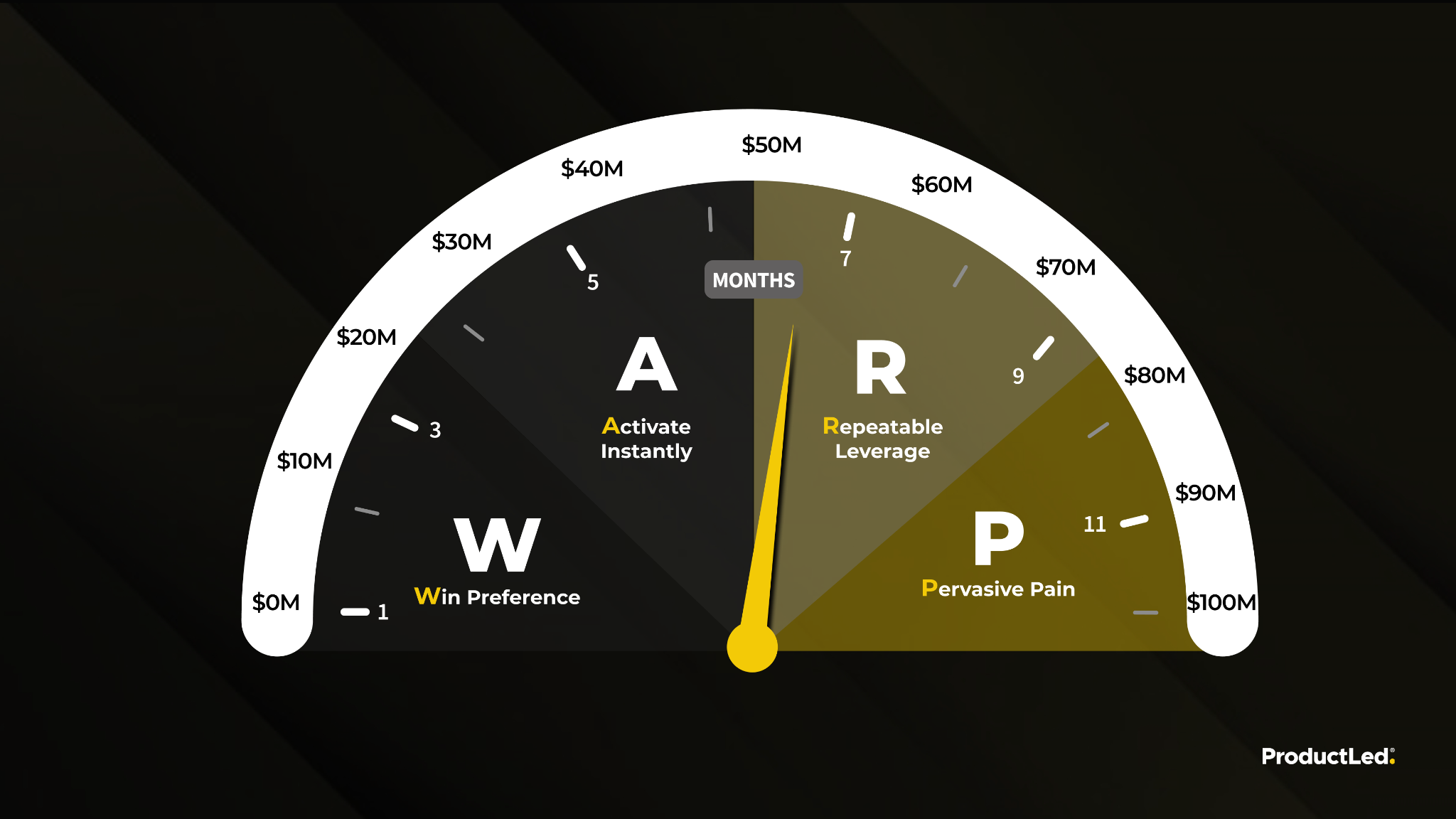
You need all four WARP forces working together:
The letters spell WARP, but you diagnose them in reverse, starting with P.
Because if the pain isn't pervasive, nothing else matters.
Before I break down each part of the WARP framework, click on the image below to find your WARP score 👇

P: Pervasive Pain. Find Fast-Moving Waters.
When David Okuniev (ProductLed 100 Interview) launched Typeform in 2012, he didn't have a marketing budget. He didn't have a sales team. He had a beautiful form builder in a world of ugly forms.
He shared the form builder with a few people and got 8,000 signups in the first month. He was shocked.
They had solved a pervasive problem that everyone felt, but no one realized how bad it was. Once people saw what forms could look like, they couldn't unsee it.
That's pervasive pain. They solved a problem the market was desperate to fix.
For companies like Lovable, Cursor, Gamma, or Midjourney, the pervasive pain was massive before they existed:
- Prototyping was too slow.
- Coding was too tedious.
- Creating presentation decks was too time-consuming.
- Visual creation was too constrained.
These weren't feature requests. They were widespread frustrations with massive audiences. The demand already existed, and these companies just unlocked it.
What Makes Pain Pervasive
There are three criteria:
- Widespread. To hit $100M in 12 months, you need a massive addressable market feeling this pain right now. Millions of people have this problem, not thousands.
- Frequent. The problem happens regularly, not occasionally. Daily friction creates daily opportunities to switch.
- Openly complained about. Users aren't suffering in silence. They're venting on Twitter, writing blog posts, and begging for alternatives. The pain is visible.
When all three exist, demand doesn't need to be created. It's waiting.
How to Find Your Pervasive Pain
Every market has friction that users have accepted as "just how it works."
That's your opportunity.
Pervasive pain isn’t always what users complain about. It shows up in workarounds, wasted time, and emotional fatigue.
💡Step 1: List the Pains in Your Market
Write down every friction point your users face.
| Pain Source | Questions to Ask |
|---|---|
| Workarounds | Where have users built manual processes to compensate for broken tools? |
| Time theft | What tasks consume hours that should take minutes? |
| Forced tradeoffs | Where must users choose between speed, quality, cost, or control? |
| Emotional fatigue | What do users dread doing but do anyway? |
| Expert dependency | What requires specialists that shouldn't? |
| Workflows | How many steps are there in their workflow to get the job done? |
Start broad. Don't filter yet; get everything on the table.
💡Step 2: Find the Evidence
For each pain on your list, go find proof it's real.
| Source | What You're Looking For |
|---|---|
| User interviews | Do users describe this pain unprompted? Do they light up when you mention it? |
| G2, Capterra, Reddit | Are strangers complaining about this without being asked? |
| Support tickets | Is this what users ask for help with most? |
| User sessions | Do users hesitate, backtrack, or abandon here? |
| Competitor reviews | Does the same complaint appear across every product in the category? |
| Sales calls | Do prospects bring this up before you do? |
Patrick Thompson, founder of Clarify.ai, spent the first six months of his startup doing nothing but customer interviews. He didn’t write code or create an MVP. He just had conversations.
His advisor, Justin Wilcox, realized that building was actually a procrastination technique. Every time Patrick wanted to write software, Justin asked: "How many customer interviews have you done this week?"
For six months, they treated their startup like a science experiment instead of a hackathon.
The result?
When they finally built, execution was absurdly fast. They shipped an MVP in three months. It was, by Patrick's own admission, "the sh**tiest thing they ever built," but because the problem validation was so precise, that messy MVP landed their first enterprise contract immediately.
Twelve months later, Amplitude acquired them for tens of millions of dollars.
Most founders waste years building the wrong thing efficiently. Patrick spent six months ensuring he built the right thing once.
→ Listen to the full interview with Patrick Thompson
If you can't find compelling evidence for a pain through interviews, reviews, or complaints, it's not a pervasive pain.
💡Step 3: Pinpoint Your Pervasive Pain
For each pain with evidence, check all three boxes:
All three checked? You've found your pervasive pain. Build here.
Missing one?
| Missing | What It Means |
|---|---|
| ❌ Widespread | Niche pain. You'll cap out early. Fine for a lifestyle business. |
| ❌ Frequent | Users won't pay enough to solve it. Find a pain they hit more often. |
| ❌ Loud | Pain is real but invisible. You'll have to educate the market—harder path. |
Missing two or more? Keep looking.
Run the Pervasive Pain Checklist
Ask yourself:
“Are we solving a problem the market is desperate to fix?”
😍 Yes—it's widespread, frequent, and people are already complaining. → You've found your pervasive pain.
😐 Partially—it's missing one of the three. → Real pain, but expect a slower path or lower ceiling.
😶 No → Keep looking.
If you're at partial or no, you have two choices:
- Find a more pervasive pain to tackle
- Solve your current pain and accept you won't hit warp speed
Assuming you pass the test, you've found fast-moving waters. Congrats!
Now you need to win.
W: Win Preference. Make the Old Way Feel Outdated.
Winning preference isn't about better features. It's about creating a transformation so dramatic that the old way feels obsolete. It means building something users instantly prefer.
Preference is what happens when users don’t just like your product. They lose tolerance for the alternative.
The problem is that most founders think PMF is the finish line when it's the starting line.
Product-market fit means users want what you're selling.
Preference-market fit means users have tried alternatives and chosen you.
Obvious choice means the market stops comparing - you’re the top choice.
For example, one of our AI clients hit $10M ARR in under 12 months. That's faster than 99% of SaaS companies will ever grow. And while they have strong PMF (users are signing up, revenue is growing), users aren't staying and recommending the solution. Which means they haven't won preference… yet.
And if you don't win preference, you never become the category leader.
They could grind to $20M to $30M through brute-force acquisition. But grinding isn't how you define a category in the long run. Especially when a competitor could come in, win preference, and blow past them in 12 months or less.
The companies that become the obvious choice get there by winning preference before the window closes:
- Cursor: From typing every line of code to AI completing your thoughts.
- Lovable: From hiring developers and waiting months to build a prototype to describing your app and watching it appear.
- Midjourney: From browsing stock photos or hiring designers to describing what you want and watching it materialize.
- Gamma: From spending hours editing slides to sharing a rough outline and having your presentation designed in 60 seconds.
Developers didn’t switch to Cursor because it had slightly better autocomplete. They switched because they tried it once and couldn’t go back.
That's preference.
How to Win Preference
You don’t win preference by shipping a better product.
You win it by stacking three things in order, each one amplifying the next.
Preference = Transformation × Approach × Defaults

Miss one, and the experience collapses back to “nice, but optional.”
💡Step 1: Define Your "From → To" Transformation
Preference begins with a clear From → To shift.
Not what your product does, but what changes for the user.
Write one sentence that captures the shift your product creates. For example:
- From typing every line of code to having AI complete your thoughts (Cursor)
- From hiring developers and waiting months to describing your app and watching it appear (Lovable)
- From editing slides for hours to pasting an outline and getting a finished deck (Gamma)
If your “To” doesn’t make your “From” feel outdated, you don’t have a transformation. You have a marginal upgrade. This is where most companies stop.
💡Step 2: Craft an Approach That Replaces the Old Workflow
A real approach doesn’t optimize the existing workflow. It replaces it.
Here’s what that looks like in practice:
| Product | Transformation (From → To) | Old Workflow (Accepted Pain) | New Workflow (Replacement) | What Changes |
|---|---|---|---|---|
| Lovable | From hiring developers and waiting months → to describing your app and watching it appear | Spec → hire developers → build → review → revise → deploy (6 steps) | Describe app → deploy (2 steps) | Time: months → minutes Expertise: developers → none Cost: $10k–$100k → near-zero Steps: 6 → 2 (−4 eliminated) Experience: waiting → momentum |
| Cursor | From typing every line of code → to having AI complete your thoughts | Search files → recall context → type code → debug (4 steps) | Think → accept suggestion (2 steps) | Time: manual typing → instant intent Expertise: deep codebase memory → AI context Cost: lower output → higher leverage per dev Steps: 4 → 2 (−2 eliminated) Experience: cognitive drag → flow |
| Gamma | From editing slides for hours → to pasting an outline and getting a finished deck | Draft → format → redesign → review → revise (5 steps) | Prompt → review outline → done (3 steps) | Time: days → minutes Expertise: design skills → basic outlining Cost: designers & revisions → negligible Steps: 5 → 3 (−2 eliminated) Experience: dread → relief |
In every case, the new approach:
The old workflow doesn’t improve. It becomes obsolete.
That’s the bar.
If your approach still asks users to tolerate the same pain, just less of it, you haven’t earned preference. You’ve made the old system more bearable.
And bearable never leads to warp speed.
💡Step 3: Lock in Opinionated Defaults
Every decision you make for users is friction you remove.
Lovable decides: Which framework? Which database? How to deploy? Users just describe what they want.
Cursor decides: How should AI help? When should it intervene? AI just works as you type. No configuration.
Linear decides: How to structure workflows? What fields to add?
If users have to make decisions before experiencing value, you're creating friction. The best products make the right choice for 80% of users and hide the option to change. When that’s true, switching back doesn’t feel like a downgrade. It feels like self-sabotage.
And that leads to one unavoidable test…
The "Can't Go Back" Test
To know if you’ve won preference, ask 10 power users:
“If you had to go back to how you did this before, how would you feel?"
😍 "I literally can't imagine going back!" → You've won preference.
😐"I'd be annoyed, but I'd manage." → Preference is weak. Revisit your approach.
😶"It wouldn't be that different." → You're a commodity. Go back to identifying the pervasive pain in your market.
If you're hearing "I'd manage," you have two choices:
- Sharpen your approach until users can't imagine the alternative
- Accept you won't hit warp speed
Assuming you pass the test, you've built something users prefer.
But if new users don't come to that conclusion in the first 60 seconds, it doesn’t matter.
A: Activate Instantly. Engineer Instant Magic.
Preference only matters if users feel it fast. You can build something users prefer and still lose.
Why?
Because preference is invisible until it’s experienced. If a new user doesn't feel real value in the first 60 seconds, your product is competing against impatience, distractions, and five alternatives already open in other tabs.
Warp-speed companies don’t rely on onboarding to explain value.
They design the product so value happens immediately.
- Midjourney didn't build onboarding for image generation. They designed it so your first prompt produces a stunning result in seconds.
- Lovable didn't create a tutorial for app building. They made it so you describe what you want and watch it appear.
- Cursor didn't add tooltips explaining AI features. They made AI assistance happen automatically as you type.
Instead of teaching users how to do things, the product does things for users. This is the single biggest shift right now: AI enables products to do the work, not guide the work.
What “Activation” Actually Means
We talk to a lot of founders with different views on what activation really is, so let’s be specific.
Activation is not:
- Finishing onboarding
- Clicking through tutorials
- Completing setup steps
Activation is the first moment a user feels the transformation you promised. We call this moment your First Strike at ProductLed.
If you can’t point to it precisely, odds are your company isn’t good at activating users.
How to Activate Users Instantly
Instant activation doesn’t happen because onboarding is good. It happens because the product removes what used to block success.
The fastest-activating products do three things in order:
- Identify the real blockers to success.
- Use AI + product design to bypass those blockers.
- Make the interface disappear.
💡Step 1: Identify What's Actually Blocking Activation
Users don't fail to activate because they're lazy. They fail because success requires things they don't yet have.
Every blocker falls into three categories:
| Blocker Type | What It Means | Examples |
|---|---|---|
| Knowledge gaps | What users need to understand to succeed | What “good” looks like, what decisions matter, what inputs produce the best result |
| Skill gaps | What users need to execute well | Design, coding, writing, structuring information |
| Product gaps | What users need to do inside the product | Configure settings, choose options, connect tools, build workflows |
Here's how these show up in warp-speed products:
| Product | Knowledge Gap | Skill Gap | Product Gap |
|---|---|---|---|
| Gamma | How to structure a compelling narrative | Design taste and layout skills | Formatting, layout, revisions |
| Lovable | How software systems fit together | Full-stack engineering | Tooling, deployment, debugging |
| Cursor | How a large codebase works | Fluent coding speed and accuracy | File navigation, context switching |
Most products try to teach users to overcome these gaps.
Warp-speed products remove the need entirely.
💡Step 2: Use AI Agents to Bypass the Gaps
Instead of asking users to:
An AI agent can handle all three.
Here’s how that plays out in practice:
| Product | Knowledge Gap | Skill Gap | Product Gap | What the User Does |
|---|---|---|---|---|
| Gamma | Agent knows what a strong presentation looks like | Agent applies design and winning layout automatically | Agent handles structure, formatting, and revisions | Paste an outline |
| Lovable | Agent understands app architecture | Agent writes full-stack code | Agent deploys and debugs the app | Describe the app |
| Cursor | Agent understands the entire codebase | Agent writes correct code at speed | Agent removes file hopping and context switching | Think and type |
The user is no longer doing the heavy-lifting - AI agents are.
Here's an onboarding flow we’ve designed for one of our AI clients in the sales space that helps salespeople book more meetings - this is how you activate users instantly and prepare for warp speed:
| Step | What Happens | User Effort |
|---|---|---|
| 1 | Sign up with work email | One click |
| 2 | AI scrapes company → understands ICP | Zero |
| 3 | AI finds 100 high-fit prospects | Zero |
| 4 | Connect email | One click |
| 5 | AI generates personalized sequence | Zero |
| 6 | Review and click “Send” | 30 seconds |
| 7 | Next morning: ping when someone books | Value delivered |
Notice the multiple "Zero" rows. That's the major shift. The user clicks twice, reviews once, and wakes up to a booked meeting. AI did everything else.
Ask yourself:
- What work are users currently doing that an AI agent could do for them?
- Where do users get stuck that an agent could resolve automatically?
- What expertise does our product require that an agent could provide?
The companies winning right now are turning "how do I do X?" into "X is done."
💡Step 3: Let Users Direct, Not Operate
The breakthrough isn't just AI doing work. It's that users don't have to learn anything before getting value. Think about the problem of getting where you need to go.
You could drive a car. It’ll take a few months of practice to get your licence. It still requires skill, attention, and knowing the rules, but most people can do it.
You could book a self-driving car. All you have to do is open an app, type your destination, and arrive. It requires no training or skill. But it has the same outcome.
That's the shift happening in software (and transportation) right now.
| Old Interface | New Interface |
|---|---|
| Navigate menus to find features | Type what you want |
| Configure settings before starting | Start immediately, adjust as you go |
| Click through multi-step workflows | Describe the outcome, get the outcome |
| Edit by finding the right tool | Type “make it shorter” or just talk to it |
Most software today is still a car. Users learn, then operate, then get value. Warp-speed products are self-driving. Users state their destination and arrive.
The question isn't "do we have a text box?" It's: can users get value before they understand how your product works?
But here’s the real test.
The Instant Activation Test
Here’s how to know if you’ve mastered activation: Ask yourself:
Do users gain a new capability in 60 seconds or less?
Look at what the best AI products deliver:
| Product | The New Capability |
|---|---|
| Gamma | Turn raw thinking into a polished presentation - without being a designer |
| Lovable | Build and deploy real software -without being an engineer |
| Cursor | Express intent and have working code written - without typing everything |
Notice the pattern of "without being" and "without doing." These products don't just remove friction. They give ordinary users superpowers that used to require years of training or expensive specialists.
Now fill in your own:
[Your Product] lets users [new capability]—without [being X or doing Y].
If you can't complete that sentence in a way that makes someone say "wait, really?" you haven't nailed activation yet.
Here’s a simple way you can score yourself:
😍New capability in under 60 seconds → You've nailed activation.
😐New capability, but still slow → Get users to value faster and delegate more to AI agents.
😶No clear new capability → Go back to W. You haven't defined a transformation worth activating.
That's why warp-speed products spread. Users don't tell others "this is faster." They say, "You won't believe what I can do now."
Assuming you pass, users are gaining superpowers in seconds.
Now you need to scale that without adding more people.
R: Repeatable Leverage. Scale Without Headcount.
Here's the uncomfortable truth about warp speed: if you solve problems by adding people, you'll never get there.
To get $100M ARR in 12 months, you're adding roughly $8M in new revenue every month. And that's if growth is linear, which we both know it won't be. In reality, the final month may need to generate $25M or more on its own.
Now imagine trying to onboard, support, and sell that volume manually. You cannot hire, train, and coordinate people fast enough to keep up. The math simply does not work. You either collapse under the operational weight of your own growth, or you miss the window entirely while you are still recruiting.
Most companies hit a ceiling and think, "We need more people."
Warp-speed companies think, "We need to fix the product."
That instinct is everything.
Midjourney hit $200M in ARR with just 40 employees, with AI handling everything else.
That's repeatable leverage. Once you set it up, it solves the problem again and again without adding headcount.
What Makes Leverage Repeatable
There are three criteria to consider here:
When all three exist, you can scale at warp speed. Without them, growth becomes a hiring problem, and hiring problems kill velocity.
How to Build Repeatable Leverage
The fastest-scaling companies do three things in order:
- Identify where humans are doing the product's job
- Deploy AI agents and product fixes to eliminate that work
- Design the product to sell itself
💡Step 1: Identify Where Humans Are Doing the Product's Job
List every place your team manually intervenes in the user journey:
| Human Intervention | Current State | Could Be |
|---|---|---|
| User confused during onboarding | Customer Success handles it | AI agent + better UX |
| User doesn't know what to do next | CSM sends check-in email | In-app guidance + AI recommendations |
| User asks “how do I...” | Support answers it | AI assistant + contextual help |
| User's output isn't working | Support troubleshoots | AI diagnoses and fixes automatically |
| User wants to integrate tools | Solutions engineer helps | Self-serve integrations + API docs |
| User ready to upgrade | Sales closes it | Self-serve upgrade flow |
When we run this audit with clients, they're often surprised by how much of their headcount is compensating for product gaps.
Every manual intervention is a sign that your product hasn't finished the job.
💡Step 2: Deploy AI Agents and Product Fixes
Running at scale requires combining two forces:
AI Agents handle tasks that used to require human judgment:
- Customer support questions
- Onboarding assistance
- Technical troubleshooting
Product handles getting users to value and upgrading:
- In-app guidance
- Self-serve billing and upgrades
- Automated expansion triggers
Neither alone is enough. AI agents without a good product create a chatbot band-aid over a broken experience. A good product without AI agents leaves gaps that still require humans. Together, they create a business that scales without proportionally scaling headcount.
Fixing these gaps doesn't just reduce costs. It improves the user experience.
The product responds instantly, at all hours of the day, without waiting for a human.
💡Step 3: Design the Product to Sell Itself
This is the ultimate leverage. Effortless Annual Recurring Revenue (ARR).
The best AI companies don't have salespeople convincing users to upgrade. They have products that make upgrading obvious.
| Company | How the Product Sells Itself |
|---|---|
| Cursor | Free tier gives you a taste of AI-assisted coding. Power users hit limits and upgrade because they can't go back to typing everything. |
| Midjourney | Limited free generations. Once you've created something stunning, you subscribe to keep creating. |
| Gamma | Free presentations get you hooked. Premium features unlock when you need custom branding or longer decks. |
Design your free tier so that:
- Users experience genuine value (not a crippled demo).
- Natural usage creates moments where paid features become obviously valuable.
- Upgrading is self-serve and instant.
If users need to talk to sales to upgrade, you're leaving growth on the table. Every sales-assisted conversion is a sign that your product hasn't finished the job.
This is the exact problem we solve at ProductLed. We help AI companies design products that sell themselves so they can hit warp speed without building a sales army.
Now, do you pass the test?
The Repeatable Leverage Test
Here's how to know if you've built leverage that scales.
Ask yourself:
If 10,000 users signed up tomorrow, could you activate, convert, and keep them without adding more headcount?
Score yourself:
😍Yes to all three (activate, convert, keep) → You've built repeatable leverage. You're ready for warp speed.
😐Yes to one or two → Partial leverage. If you can activate but not convert, your product isn't selling itself. If you can convert but not keep, your product isn't delivering ongoing value. Each missing piece is a ceiling on your growth.
😶No → You're building a services business disguised as a product. Go back to step 1.
One final gut check: When something breaks at scale, does your team reach for headcount or reach for the product?
That instinct is the difference between companies that plateau and companies that warp. But instinct alone isn't enough. You also need speed.
None of this matters if your team moves like a slug.
Warp-speed companies ship multiple times per week. Not because speed is a virtue, but because the window demands it. As Elon Musk puts it, execution is the ultimate differentiator. When the market is moving this fast, slow iteration means someone else captures preference while you're still planning your next sprint.
If your team can't ship fast, fix that before anything else. No framework survives slow execution.
Assuming you pass, you've built a business designed for speed.
Now let's put it all together.
Conclusion: What Warp Speed Actually Is
Warp speed isn't about working harder, raising more money, or hiring faster. It's about building a company where everything compounds.
Here’s what happens when all four forces work together:
Pervasive Pain means you don't create demand, you unlock it. The market is already desperate.
Win Preference means users try you once and can't go back. They tell others. The old way feels broken.
Activate Instantly means users feel that preference in 60 seconds. They gain superpowers. They say, "You won't believe what I can do now.”
Repeatable Leverage means you scale to meet that demand without drowning in hiring. The product and AI agents do the heavy lifting.
Each force feeds the next.
That's how Cursor went from $0 to $1B ARR in 24 months with a small team.
That's how Lovable hit $200M ARR in under a year.
That's how Midjourney became the default for AI images .
These companies didn't just grow fast. They warped.
💡Ready to hit warp speed?
If you're an AI founder trying to become the obvious choice before the window closes, let's talk. I take every initial call myself.
Note: You must have ARR over $3M and a fantastic product. There’s no amount of GTM engineering we can do to scale a mediocre product to warp speed.
Bonus: Find Your WARP Score
Use this to diagnose where you stand and where you're stuck. Click the image below to take the assessment (3 min) 👇