
Building a product that works is hard.
Building a product that becomes the default choice in its market is even harder.
Netlify’s rise offers a useful blueprint for founders who want more than incremental differentiation. The core lesson is not a single tactic. It is a way of thinking: start with a clear worldview about where the market is heading, reverse-engineer what must be true for that future to exist, then execute with focus long enough for the market to catch up.
Below are the core ideas behind how Netlify approached product, ecosystem, category creation, and what that same approach suggests for the next wave of AI-driven software.
Why Netlify Became the “Obvious Choice”
Becoming the obvious choice rarely comes from a clever positioning statement.
It comes from building something that fits the direction of the market so well that alternatives start to feel like extra work.
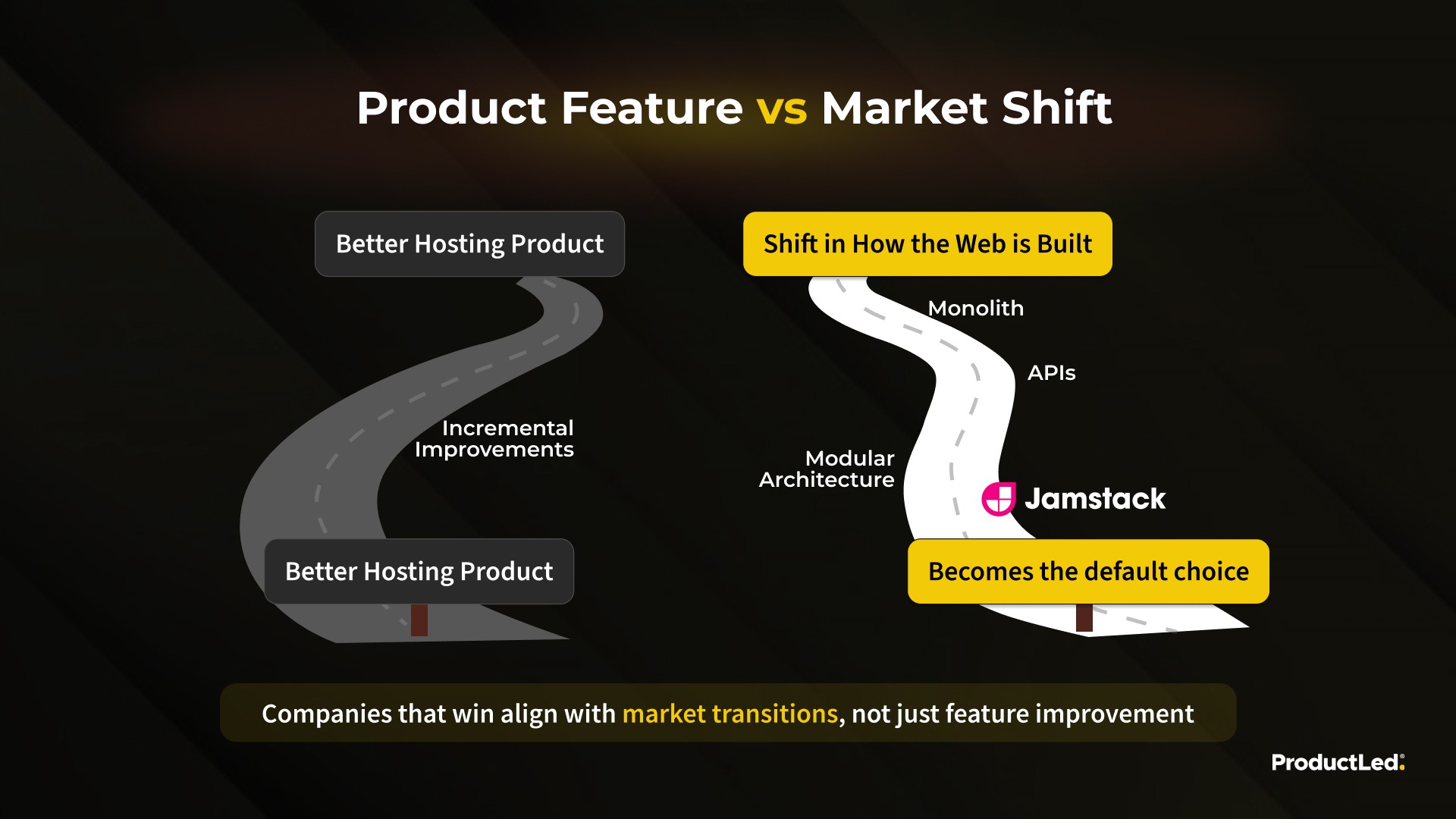
Netlify’s advantage came from treating the company as part of a broader shift in how the web would be built, not as “a better hosting product.” That framing shaped everything:
- What they built first
- Who they targeted first
- What they encouraged others to build
- How they told the story to different audiences
A useful mental model here is: if your product depends on a market transition, your main job is to accelerate and organize that transition.
Netlify’s Mission: Escape the Monolith
The original bet was architectural.
The web had become dominated by monolithic applications, and that direction created compounding pain: slower performance, weaker security posture, and scalability headaches. The alternative was to distribute the runtime and decouple concerns so teams could mix and match best-in-class components.
The catch was timing.
Early on, many of the supporting pieces did not exist in “headless” or modular forms. Commerce, CMS, and other core services still largely assumed monolithic deployment patterns. That meant the platform could not immediately serve typical enterprise use cases without heavy self-architecture.
So the early strategy was not “sell to enterprises anyway.” It was to lean into developers and the ecosystem, because the ecosystem had to grow up around the new architecture for the thesis to become real.
In other words, bottom-up was not a preference. It was a constraint.
When PLG Works: Start With the “Magic Moment”
A practical filter for product-led growth showed up repeatedly: the user has to reach a “magic moment” quickly.
If a product only becomes valuable after a department-wide rollout, heavy configuration, or broad organizational adoption, then a purely product-led motion will struggle. The individual user cannot easily self-serve their way to value.
That does not mean the product is bad. It means the growth motion is mismatched.
So before choosing PLG, the more fundamental questions are:
- What problem are you actually solving?
- What is required for the solution to succeed?
- Can an individual user experience value fast, without advanced context?
For Netlify, the answer was yes. Developers could deploy and experience the workflow benefits quickly, even while the broader ecosystem was still maturing.
Pick a Motion First: Hybrid Comes Later
Many founders want the flexibility of doing both product-led and sales-led at the same time.
The issue is focus.
Early-stage startups have limited hours, limited headcount, and limited capacity for parallel go-to-market strategies. Trying to do two motions at once often produces two half-built engines.

A better approach is sequencing:
- Choose the motion that matches how value is first experienced.
- Build competence and momentum in that motion.
- Add the second motion later, once the company has traction and resources.
A useful diagnostic is coherence between adoption and value.
If your product is currently discovered through small experiments, but the real value only appears at full enterprise adoption, you have a gap to close. You either adjust the product so individual adoption creates clearer value, or you adjust the motion so adoption matches where value is realized.
Netlify’s early coherence was clear. Developers were both the adopters and the design partners, and their bottom-up pull could eventually carry the product into companies.
The Worldview Advantage: Context Before Product
One of the most transferable lessons is the amount of time spent on context.
Many startups race from problem to solution and then sprint into building. Netlify spent significant time mapping the world they believed was coming.
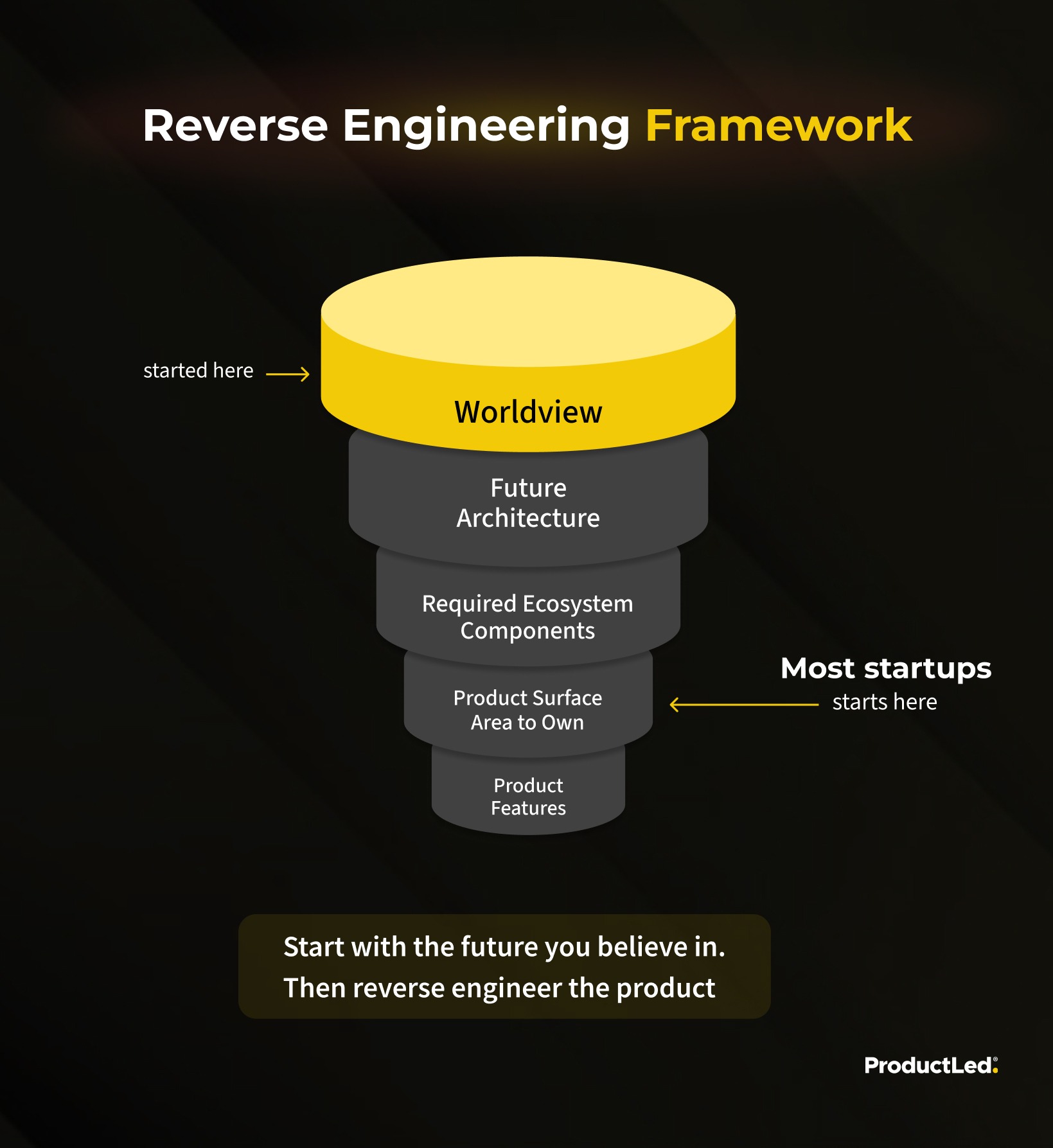
That worldview included trends like:
- Git replacing FTP as a standard workflow
- JavaScript maturing, and the browser becoming a more capable runtime
- APIs becoming the glue for a more modular web
Once the future-state picture was clear, the next step was reverse engineering:
- If this architecture becomes the default, what components must exist?
- What should be built by others in the ecosystem?
- What is the critical surface area this company should own?
This prevented a common trap: trying to build everything.
It would have been possible to build commerce or CMS directly, but that would have created “a product,” not an architectural shift. The more leveraged position was enabling the workflow that makes modular architectures usable and beneficial in practice.
That is where Netlify could create durable value: abstracting away deployment complexity, making decoupled architectures fast, secure, and operationally simple.
Storytelling That Wins: Small Story vs. Big Story
The narrative mattered, but the key nuance is that there was not one narrative.
Different audiences needed different levels of story:
- A developer with an immediate deployment problem needs a short, practical explanation.
- Investors, partners, and recruits need the larger market thesis and why it matters.
This also prevented Netlify from being boxed into a commodity category.
If the story had been “we are a hosting company,” it would have sounded like a mature market with a race-to-the-bottom dynamic. If it had been “we are a CDN,” it would have sounded crowded and difficult to monetize.
The winning story connected the product to a fast-growing shift in how the web would be built. That created room for:
- A new category narrative
- A clearer “why now”
- A larger opportunity frame
Bootstrapping to meaningful proof points before raising also helped. It is easier to sell a new category when reality already shows signs it is working.
Category Creation: Why Jamstack Mattered
Category creation only works when it benefits people other than you.
Jamstack succeeded as a term because it gave the ecosystem a shared language for a set of emerging best practices: JavaScript, APIs, markup, and the workflows that supported decoupled web development.
The goal was not to make the category synonymous with Netlify. The goal was to help disparate tools and builders see themselves as part of the same movement.
That matters because ecosystems do not scale on isolated products. They scale when participants can coordinate.
A shared category name:
- Makes it easier for developers to explain what they are doing
- Helps new products attach to an understood pattern
- Creates a broader wave of attention that no single company could generate alone
It is also hard, because you are effectively carrying two brands: your product and the category. In many startups that would dilute efforts. Here it was necessary, because the company depended on the category becoming real.
Ecosystem Fuel: Directories, OSS, and Deploy Previews
Once the category frame existed, the next step was practical enablement.
Category narratives need infrastructure: resources, defaults, and tools that make the “new way” easier than the old way.
Some of the ecosystem tactics that helped win developer mindshare:
- Creating public resources like directories of site generators, which attracted the maintainers and early builders who shaped adoption.
- Making open source deployment frictionless, including simple deploy buttons and free hosting for OSS.
- Building workflows that felt magical at the time, like deploy previews and automated builds, so the product could demonstrate value with minimal setup.
A key detail is audience timing.
The early majority is not where new workflows start. The earliest adopters are the people already experimenting and building the underlying tools. Winning them first makes it easier for the next concentric circles to follow.
The First 20: Targeting Influential Early Adopters
A surprisingly concrete approach showed up: start with a list of 20.
Once the worldview was clear, it was possible to identify the most influential people already aligned with that future. The point was not influencer marketing in the modern sense. It was finding the “choir,” the people who already believed the shift was necessary.
Those early adopters served multiple roles:
- Design partners for the product
- Validators of the thesis
- Connectors into communities and open source
- Future employees, advisors, and angels in some cases
Then expansion happened in concentric circles.
If you are building something that needs bottom-up adoption, this is a strong reminder that “developers” is not a target segment. Specific communities and specific early movers are.
The Next Shift: Agents, Dynamic Web, and AX
The same worldview-first approach applies to AI.
The prediction is not just that more code will be generated. It is that digital experiences become more dynamic, more personalized, and more produced on the fly.
That implies two shifts:
- The volume of digital executions increases dramatically. More pages, more variants, more experiments, more personalized experiences.
- The new “user” becomes the agent. Products that previously optimized developer experience will increasingly need to optimize agent experience.
If agents become more autonomous, they still need to operate inside real-world constraints: authentication, APIs, environments, legacy systems, production reliability.
So “agent experience” becomes an infrastructure challenge as much as a UI challenge. The platform that supports agents well becomes the default substrate for building with them.
The underlying pattern is familiar: abstraction tends to create more builders, not fewer. As software becomes easier to produce, expectations rise and the amount of software produced increases.
Resources
- 🚀 Netlify: https://www.netlify.com/
- 💼 Chris Bach on LinkedIn: https://www.linkedin.com/in/chrisbach/
- 💼 Wes Bush on LinkedIn: https://www.linkedin.com/in/wesbush/
- 💼 Esben Friis-Jensen on LinkedIn: https://www.linkedin.com/in/esbenfriisjensen/
- 🧠 ProductLed Newsletter: https://www.productled.com/newsletter
Want to build your own product-led success story?
Netlify’s story reinforces a few fundamentals that apply in almost any category:
- Get crisp on the worldview, then reverse-engineer what must be built.
- Choose a go-to-market motion you can execute with focus.
- Make the first value moment fast and obvious.
- Invest in the ecosystem when your success depends on it.
If you are ready to build a product-led growth engine that fits your market and your product, ProductLed has resources to help:
- Book a Free Growth Session to get personalized advice on your biggest PLG challenges
- Join the ProductLed MBA™ and learn the proven frameworks that top product-led companies use to scale
- Download the ProductLed Playbook for free resources packed with PLG strategies you can implement today
- Subscribe to Our Newsletter for weekly insights on building smarter, not harder