Most founders missed what happened in 2025.
While everyone obsessed over which AI model to use, a handful of companies rewrote the entire rulebook for how software scales.
The results? Borderline absurd.
Cursor went from zero to $500M ARR in under 24 months. They hit $200M before hiring their first enterprise sales rep.
Lovable reached $100M ARR in 8 months, making it the fastest any software company has ever achieved this milestone.
Look at Brex's list of the 50 fastest-growing software companies. Every single one has a product-led motion.
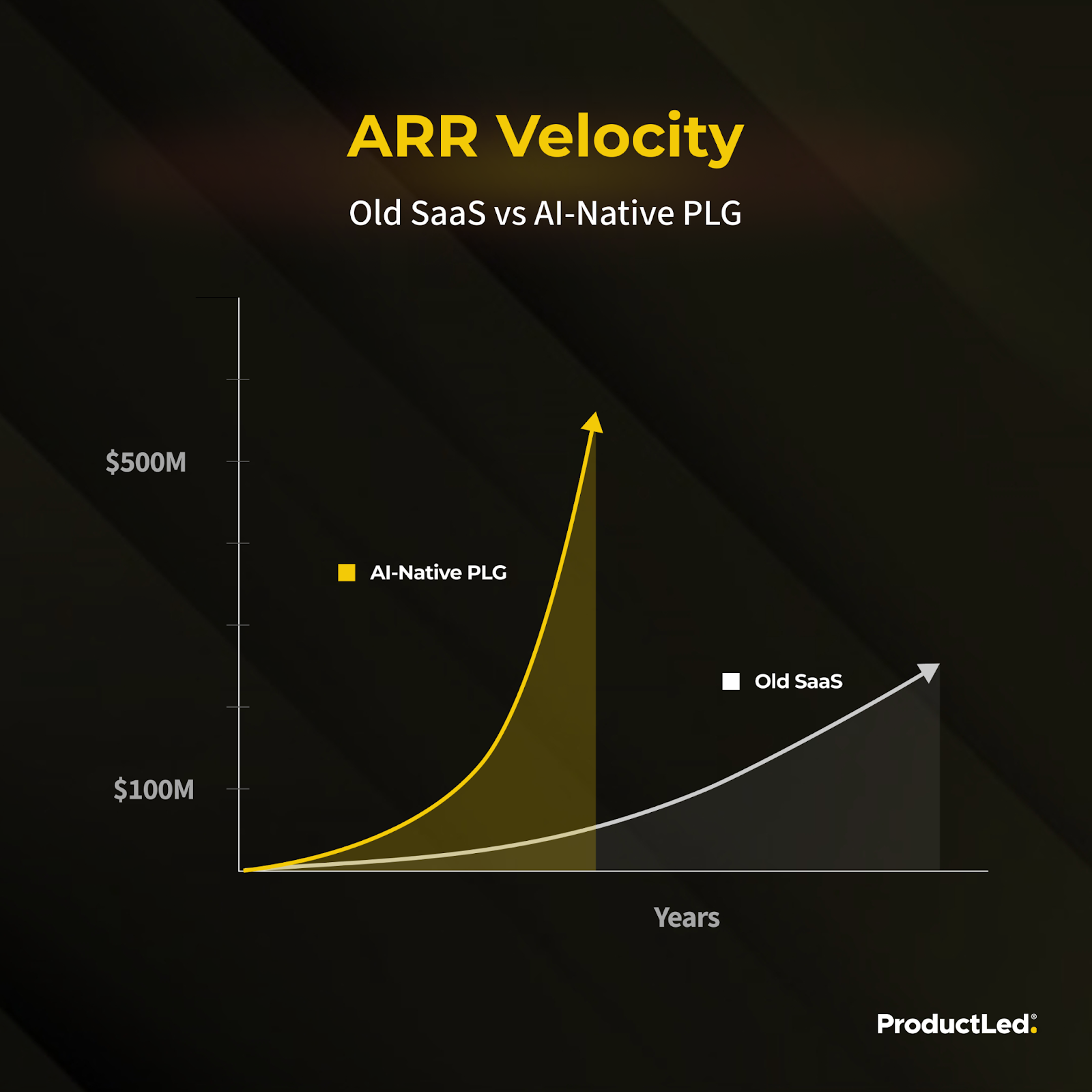
This isn't a trend. It's the new baseline.
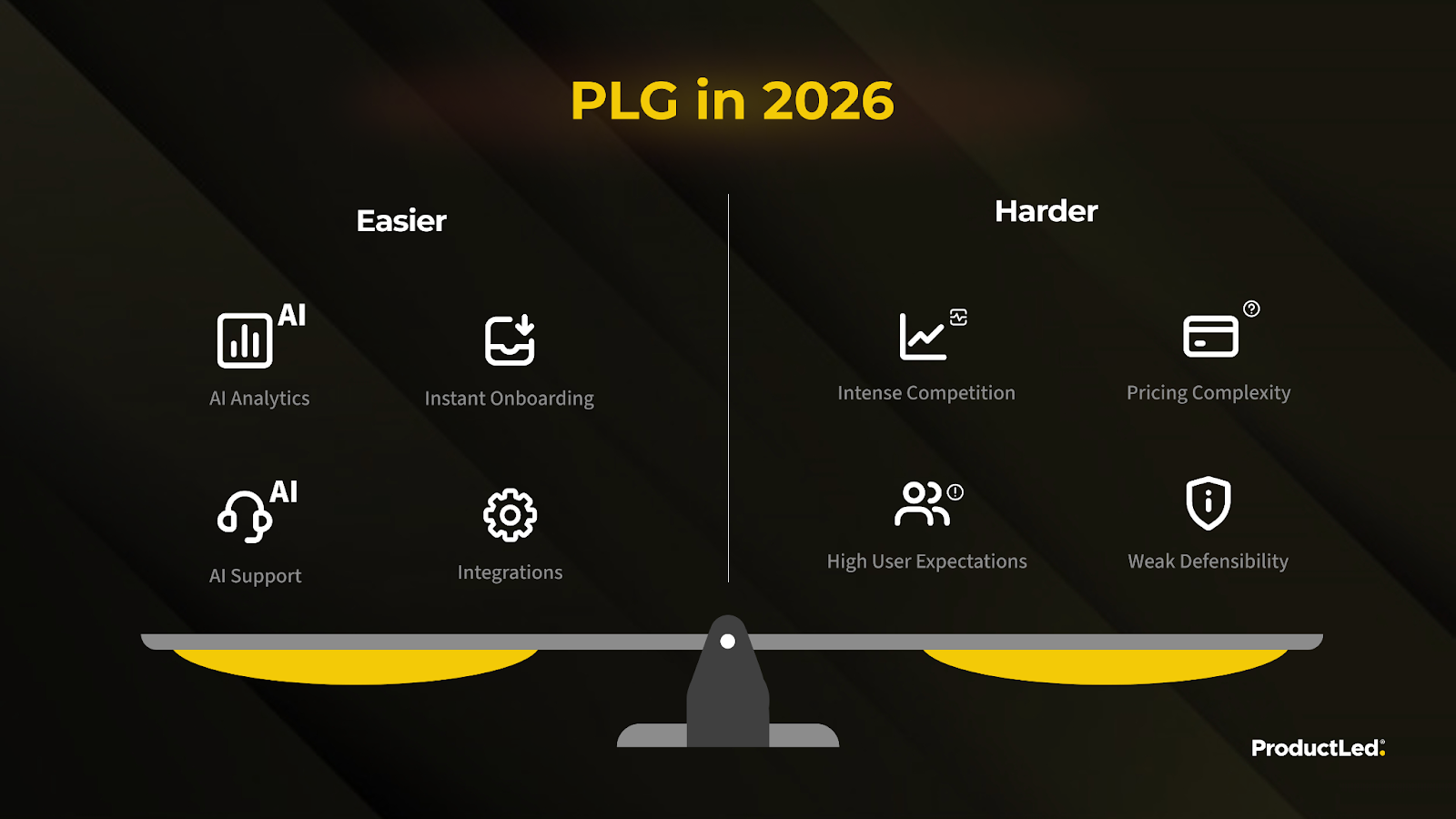
But here's what's tricky: PLG is simultaneously getting easier to execute and harder to get right. If you don't understand both sides of that equation, 2026 is going to hurt.
What I Got Right (and Spectacularly Wrong) Last Year
Let me start with my 2025 predictions scorecard.
What Actually Happened:
AI agents everywhere — Nailed it. From onboarding to support to sales qualification, AI agents became table stakes faster than anyone expected.
AI-driven personalized onboarding — Absolutely delivered. Gamma's real-time presentation generation is still my favorite example of onboarding that feels magical.
Founder-led brands exploded — More founders built personal brands than ever before. The downside? Most did it poorly: endless AI tool posts with zero substance.
Usage-based pricing took off — This was true, but way messier than I anticipated.
GTM became competitive advantage — Yes, but with a twist: if your product was legitimately 10x better, it spread like wildfire. That "wow" window only lasted 12-18 months before competitors caught up.
Where I Completely Missed:
Bold customer lifetime value plays — I thought we'd see more "all-in-one" solutions and private equity consolidation. The exact opposite happened. Single-point AI solutions with 10x better experiences crushed it. Cursor, Lovable, and Perplexity all dominated by being the best at one thing.
Vertical SaaS dominance — I predicted more companies hitting $10M+. Instead, we saw winner-takes-all markets at $100M+ scale. If you had the best AI tool in your vertical, you didn't just win. You obliterated the competition in under two years.
The Wake-Up Call: What Brex's Data Really Means
Brex's list of the 50 fastest-growing software vendors should either terrify you or light a fire under you.
This isn't survey data or sentiment. This is actual spend data from 35,000+ customers.
The pattern is unmistakable: AI-native companies scale through PLG motions.
Even more telling: Menlo Ventures' 2025 State of AI report found that 27% of all AI application spend comes through PLG.
That's 4x the rate of traditional SaaS at 7%.
Translation: If you're building an AI product without a PLG motion, you're choosing the hardest possible path.
Why PLG is Getting Easier
Let's start with the good news. Several things are making PLG more accessible:
AI tools help you see your gaps. Modern product analytics powered by AI make it easier to identify friction points and predict which users are ready to upgrade. You don't need a data science PhD anymore.
Integrations let users skip your UI. Nobody wants to learn your interface. They want the job done. Tools like Claude and ChatGPT are opening connectors that let users access your product without logging in. This could be massive in 2026.
AI onboarding makes activation instant. Ask users what they want to accomplish, AI configures the experience immediately. No more 10-step walkthroughs. Time-to-value is now measured in seconds, not days. Traditional product adoption tools like Pendo and Appcues are going to feel serious headwinds.
AI support actually works now. Tools like Fin resolve 90%+ of support tickets without human intervention. This dramatically reduces the cost of serving free users.
Why PLG is Getting Harder
Now for the uncomfortable truth: PLG in 2026 is not PLG in 2020.
User expectations are insane. Users expect your tool to work like magic on day one. Anything less feels broken. The "wow" experience that took Cursor and Lovable to $100M+ ARR?
That's the new baseline expectation.
Building is easy, defensibility is hard. AI makes product development cheap. That means everyone can build. Your moat isn't your code anymore. It's your GTM, your data, your workflow integration, and your brand.
Breakout success doesn't guarantee you keep it.
Pricing is a complete minefield. AI products have real COGS. Every prompt, every generation, every API call costs money. The old SaaS playbook of "generous free tier forever" doesn't work when free users burn cash.
Companies are scrambling to figure out credit-based pricing, but most are creating Frankenstein systems that confuse users.
The new free model playbook looks like this:
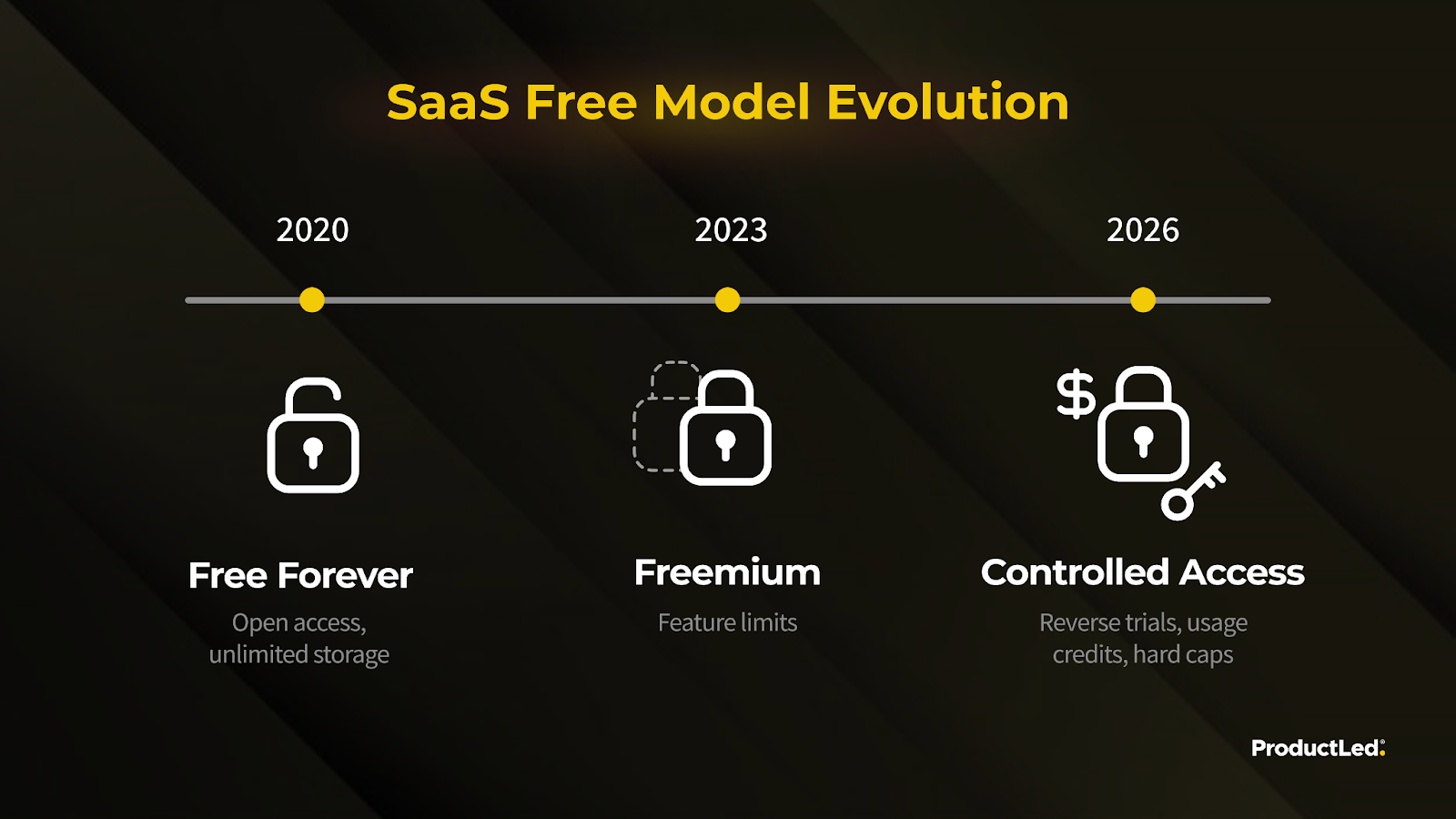
- Reverse trials: Full access for 7-14 days, then paywall
- Credit-based: X number of actions before hitting limits
- Heavily limited free tiers: Restricted functionality with hard caps
Free isn't dead. But indefinite access with full features? That's gone.
Competition is brutal. Winner-takes-all dynamics are happening faster than ever. If you're not the best in your category, you're invisible. Second place in AI tools means you don't exist.
My 2026 PLG Predictions
Based on what we're seeing with clients and market signals, here's what I'm betting on:
Product-Led Sales Becomes the Default
Pure PLG hits a ceiling. Pure sales-led is too slow. The future is hybrid.
Even ChatGPT and Claude make most of their revenue through PLG, then layer enterprise sales on top. Cursor reached $200M ARR before hiring any sales reps. Now they're building a sales team for enterprise.
What this means for you: If you don't have a PLG foundation, your sales cycle will be painfully long. If you only have PLG, you'll leave enterprise money on the table.
PLG Talent Will Be Hot (and Actually Screened Better)
Remember 2020 when every company wanted a "Head of PLG" but nobody knew how to screen for the role?
That's changing. Companies are getting smarter about what PLG actually requires:
- Solid understanding of free models, onboarding, pricing, data, and strategy
- Ability to drive self-serve revenue
- End-to-end ownership, not just lifecycle emails
Expect new titles like "GM of Self-Serve Revenue," "Head of Product-Led AI," and "PLG Operations."
The ProductLed MBA is seeing record enrollment because companies finally know how to evaluate PLG capabilities.
The "User" in PLG is Changing from Human to Agent
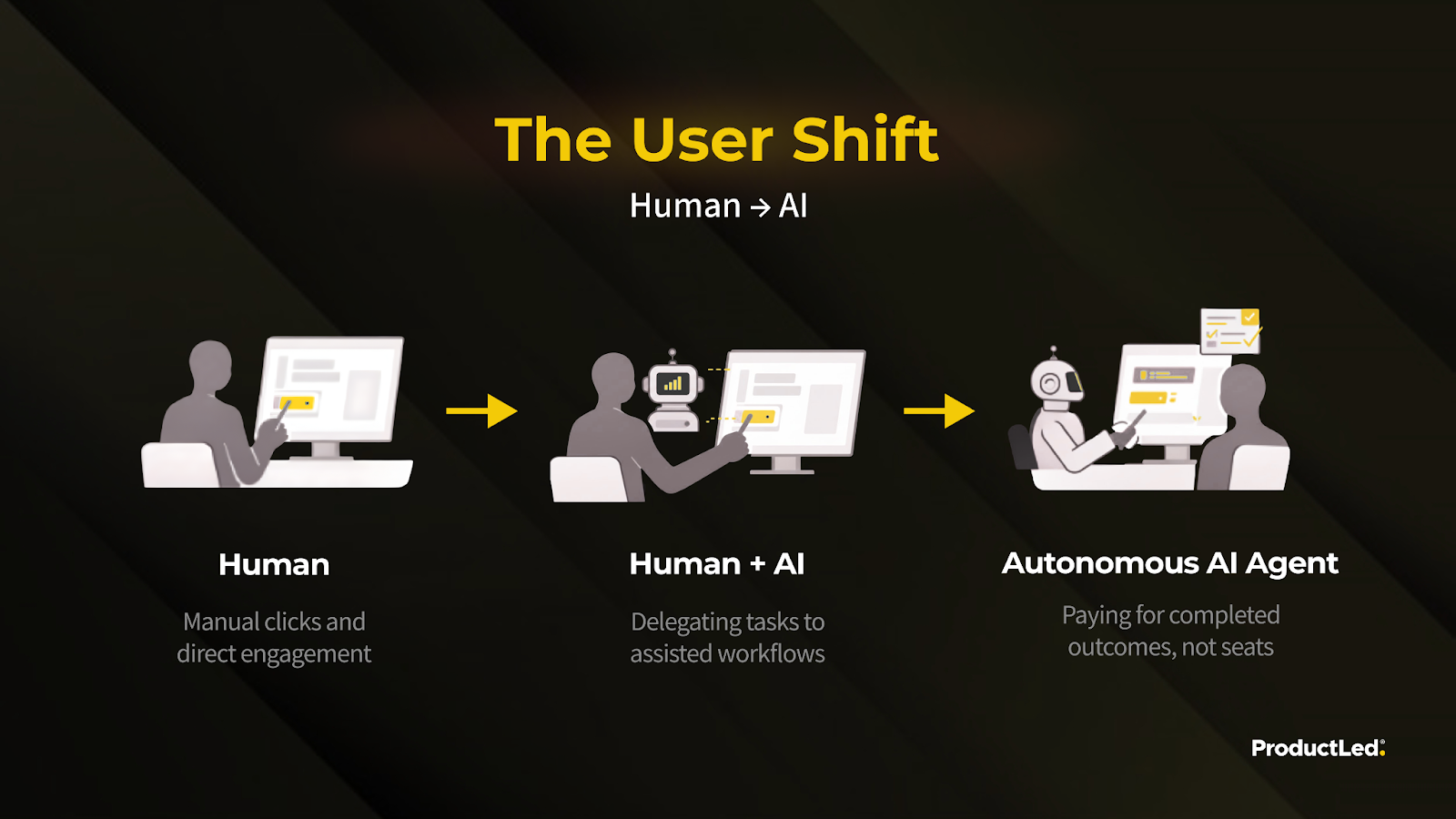
Here's what's actually different: In traditional PLG, you optimize for a human clicking through your product. In AI-native products, you're increasingly optimizing for an agent completing a job on behalf of a human.
Look at Cursor and Lovable. Developers aren't just using these tools, they're delegating entire workflows to them. Write this function. Refactor this file. Ship this feature. The developer reviews and approves, but the agent does the work.
This fundamentally changes how you think about:
Activation metrics — Traditional "aha moments" are click-based: "User created their first project!" But what matters now is the first time a user successfully delegates a complete task to an agent and trusts the output.
Pricing models — You're not charging for seats or storage anymore. You're charging for work completed. That's why pricing is shifting from per-seat to per-task (WaaS) or per-outcome (RaaS).
Product design — The UI becomes less important. What matters is how well your agent understands context, handles edge cases, and integrates into existing workflows. Cursor's 'product' is barely visible, living inside VS Code.
Support needs — When agents do the work, support shifts from "how do I use this feature?" to "why did the agent do X?" and "how do I trust this output?" Documentation matters less; transparency and control matter more.
Free Models Will Evolve (Again)
VC funding is propping up generous free plans right now. That won't last forever.
What's coming:
- Time-boxed free trials, not unlimited access
- Usage caps that force conversion
- Smarter gating based on value delivered, not features
The goal isn't generosity. It's conversion.
UI-Less PLG Will Scale
Some of the fastest-growing products in the next 3-5 years will have no traditional UI at all: just APIs, CLI tools, or AI agents plugged into existing workflows.
They'll still be "PLG" because adoption is self-serve and bottom-up. But the "product" won't be a web app.
Examples already happening:
- Cursor's main canvas is VS Code, not a web app
- AI SDRs run in Slack/email, not dashboards
- Voice AI sits inside call centers, not separate tools
Pricing Moves from "Per Seat" to "Per Outcome"
The shift is happening in three stages:
- SaaS – Pay per seat (classic model)
- WaaS (Work as a Service) – Pay for tasks done (content generated, tickets resolved)
- RaaS (Results as a Service) – Pay for outcomes (qualified leads, resolved issues, closed deals)
Most AI-native products will land on WaaS in 2026. RaaS only works when outcomes are clearly measurable and attributable.
Examples:
- AI design tools charge per image generated (WaaS)
- Fin charges per resolution, not per conversation (RaaS)
- AI SDRs charge per qualified meeting (RaaS)
LLM Connectors Become a Major Growth Lever
ChatGPT and Claude will open their connectors to way more companies. This means users can access your product without logging in.
Imagine: A user asks ChatGPT, "Create a task for this in [YourProduct]," and it just works. No login. No context-switching.
This could be the biggest PLG unlock of 2026.
Massive Churn Hits
2024-2025 saw explosive land-and-expand. But 2026 is when the music stops for many AI companies hitting their first major renewal cycles.
Companies that scaled from $0 to $100M ARR in 12 months will face a harsh reality check.
What separates survivors from casualties:
- Did they deliver real ROI or just "wow" demos?
- Is usage sticky or were users just experimenting?
- Can they prove they're infrastructure, not a toy?
The "ChatGPT wrapper" companies will get exposed. The ones solving actual workflow problems will compound.
Many AI companies benefit from curious buyers who sign up, use the product once, and never come back. Or they use Lovable or similar apps, don't create anything useful, and churn.
"Time to Value" Gets Redefined to Under 60 Seconds
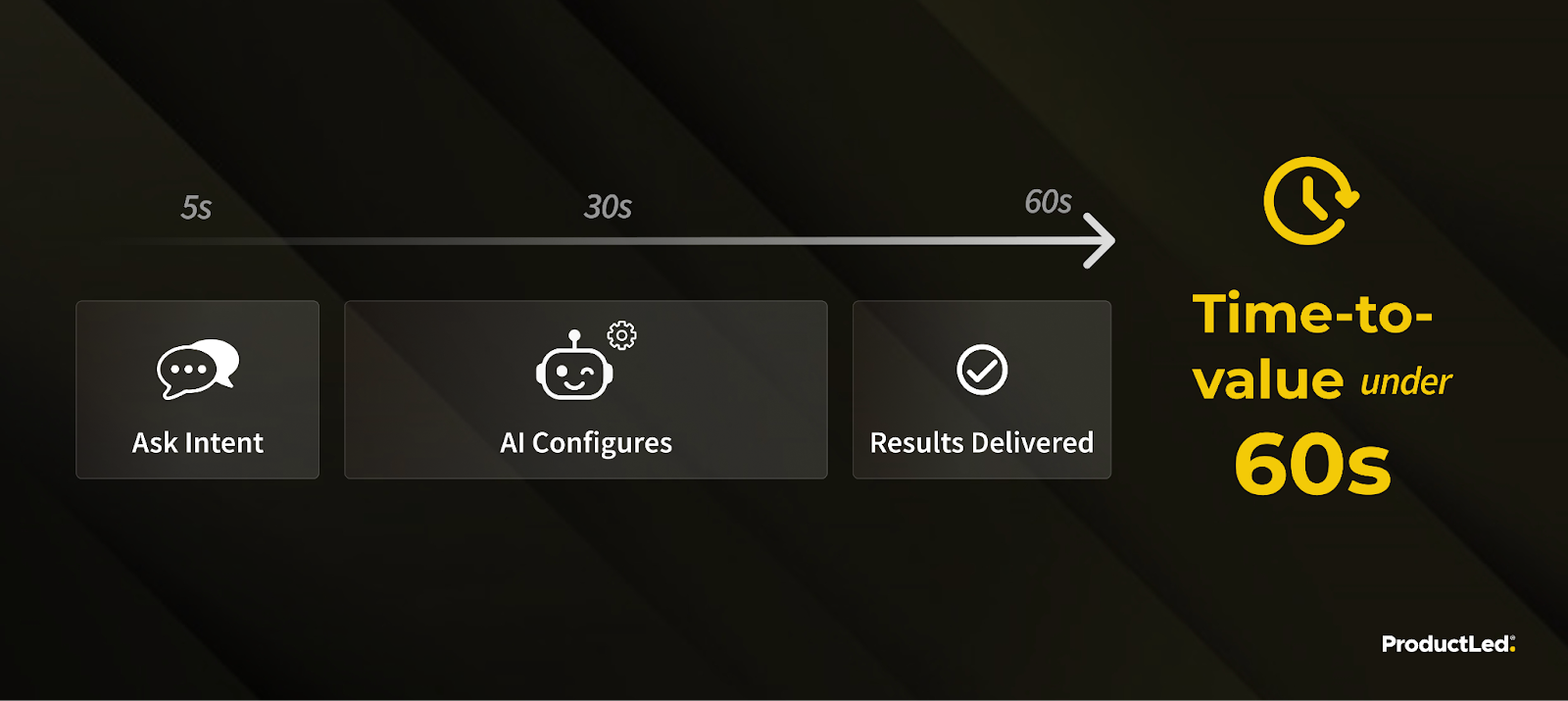
The old PLG playbook aimed for "value in the first session." That's already obsolete.
In 2026, the bar is: Can a user get value in under 60 seconds?
Ask what they want → AI sets it up → They see results. No tutorials. No onboarding flows. No "Let's get started!" screens.
Examples already doing this:
- Perplexity: Ask question → Get answer (10 seconds)
- Cursor: Open file → Start coding with AI (15 seconds)
- Gamma: Describe presentation → Watch it build in real-time (30 seconds)
If your product takes 5+ minutes to deliver value, you're losing to someone who does it in 30 seconds.
The PLG Playbook Gets Rewritten in Real-Time (And Most Companies Can't Keep Up Alone)
Here's the brutal truth: The PLG playbook that worked 18 months ago is already obsolete.
Companies that try to "figure it out as they go" are burning months and millions testing strategies that the market has already validated or invalidated.
The companies winning in 2026 aren't the ones with the biggest R&D budgets. They're the ones who know what to do right now because they're plugged into what's actually working.
This is exactly what we do at ProductLed.
We've worked with 400+ companies generating over $1B in self-serve revenue. We see the patterns before they become public knowledge. We know which pricing models are converting, which onboarding flows are activating, and which AI implementations are delivering ROI because we're in the trenches with dozens of product-led companies testing them right now.
Here's what's different in 2026:
The playbook is being rewritten weekly, not yearly. What worked in Q1 might be obsolete by Q3. You need to be learning from dozens of companies simultaneously, not just your own experiments.
The cost of being wrong is higher than ever. In traditional SaaS, a bad pricing experiment cost you 10% of conversions. In AI-native PLG, a bad free model can burn hundreds of thousands in COGS before you realize it's broken.
The winners will have two options:
Build internal PLG capabilities fast — Join ProductLed MBA to learn the frameworks that are working right now, not what worked 3 years ago. Our curriculum updates in real-time as the market evolves because we're constantly implementing these strategies with clients.
Partner with experts who live this daily — Work with us directly through our PLG consulting. We bring the entire rewritten playbook with updated frameworks, current best practices, and strategies we're seeing work across dozens of AI-native companies, then implement them in your business.
The companies that scale to $100M+ in 2026 won't be the ones who "figured it out alone." They'll be the ones who moved fast with proven frameworks.
So here's the question: Do you want to learn from your own expensive mistakes, or from everyone else's?
What You Should Do Right Now
Here's your action plan for 2026:
Audit Your PLG Capabilities
Can you:
- Get a new user to value in under 5 minutes?
- Identify which users are ready to upgrade without guessing?
- Let users try your product without friction?
- Support free users without burning cash?
If the answer to any of these is "no," you have work to do.
Rethink Your Free Model
Ask yourself:
- What's the COGS of a free user?
- What's our "aha" moment? Can users hit it before we run out of patience or money?
- Should we time-box free access or cap usage?
Prepare for Product-Led Sales
Even if you're pure PLG today, start thinking about:
- Which signals indicate enterprise readiness?
- How would a sales team layer on top of PLG?
- What does "sales-assisted PLG" look like for you?
Invest in PLG Talent
Hire or train people who can:
- Build AI agents and automations
- Understand data fluently, not just "ran one A/B test"
- Own outcomes, not just campaigns
Screen candidates by asking: "What's one workflow you've automated using AI?"
Build for Outcomes, Not Clicks
Stop asking users to learn your tool. Let AI use the tool for them.
Shift from: "We'll help you do XYZ"
To: "We'll do XYZ for you"
Double Down on Your Moat
Your code isn't defensible anymore. But these are:
- Proprietary data and workflow lock-in
- Brand and community
- Speed of iteration
- Domain-specific AI, not generic
The Bottom Line
AI is the rocket. PLG is the fuel.
Together, they create hypergrowth. But only if your product is at least 4x better than the alternatives.
The playbook is being rewritten in real-time. The companies that adapt fast will dominate. The ones that cling to 2020 PLG tactics will plateau.
2026 will separate the pretenders from the contenders.
The question is: Which one are you?
Want help building your PLG motion?
We're the #1 PLG consultancy and we've helped 400+ companies generate over $1B in self-serve revenue. Book a free strategy call to see how we can help you scale.
Not ready for consulting yet? Join 5,000+ PLG practitioners in ProductLed MBA, the only program teaching you how to actually do PLG, not just talk about it.
The teams that win the next phase of PLG run the fundamentals harder than anyone, and those fundamentals are in Product-Led Growth: How to Build a Product That Sells Itself.