TL;DR: The best products used to grow by removing friction. Now they grow by removing work. PLG 1.0 products make users do everything (Builders). PLG 2.0 products let AI do the heavy lifting while users refine (Editors). PLG 3.0 products let AI agents handle the entire workflow while users just approve (Reviewers). Companies running PLG 2.0 right now — like Cursor ($2B+ ARR), Lovable ($200M ARR in 12 months), and Harvey AI ($190M ARR) — are growing faster than anything we've seen before. The force behind all of it: your market's Time to Value keeps halving every few years.
Shutterstock had product-led growth (PLG) figured out.
Users could browse millions of images, filter by keyword, preview in high resolution, license with one click, and download instantly. They stripped friction out of every step.
For 15 years, their PLG motion printed money.
Then AI image generators showed up. Users stopped browsing entirely. They typed what they wanted and got it.
Shutterstock didn't fail at execution. The entire category was disrupted.
They're not alone. Google Slides gives you a clean canvas to build presentations, while Gamma gives you a finished deck from a single prompt.
Stack Overflow was the fastest way to find coding solutions. Now, Cursor writes the code before you've finished describing the problem. Westlaw helped lawyers search case law faster. Now Harvey AI drafts the legal brief.
Every one of those old-guard companies had great PLG. Frictionless signups, smooth onboarding, and clean user flows. None of that mattered when a competitor showed up and eliminated the need for a flow in the first place.
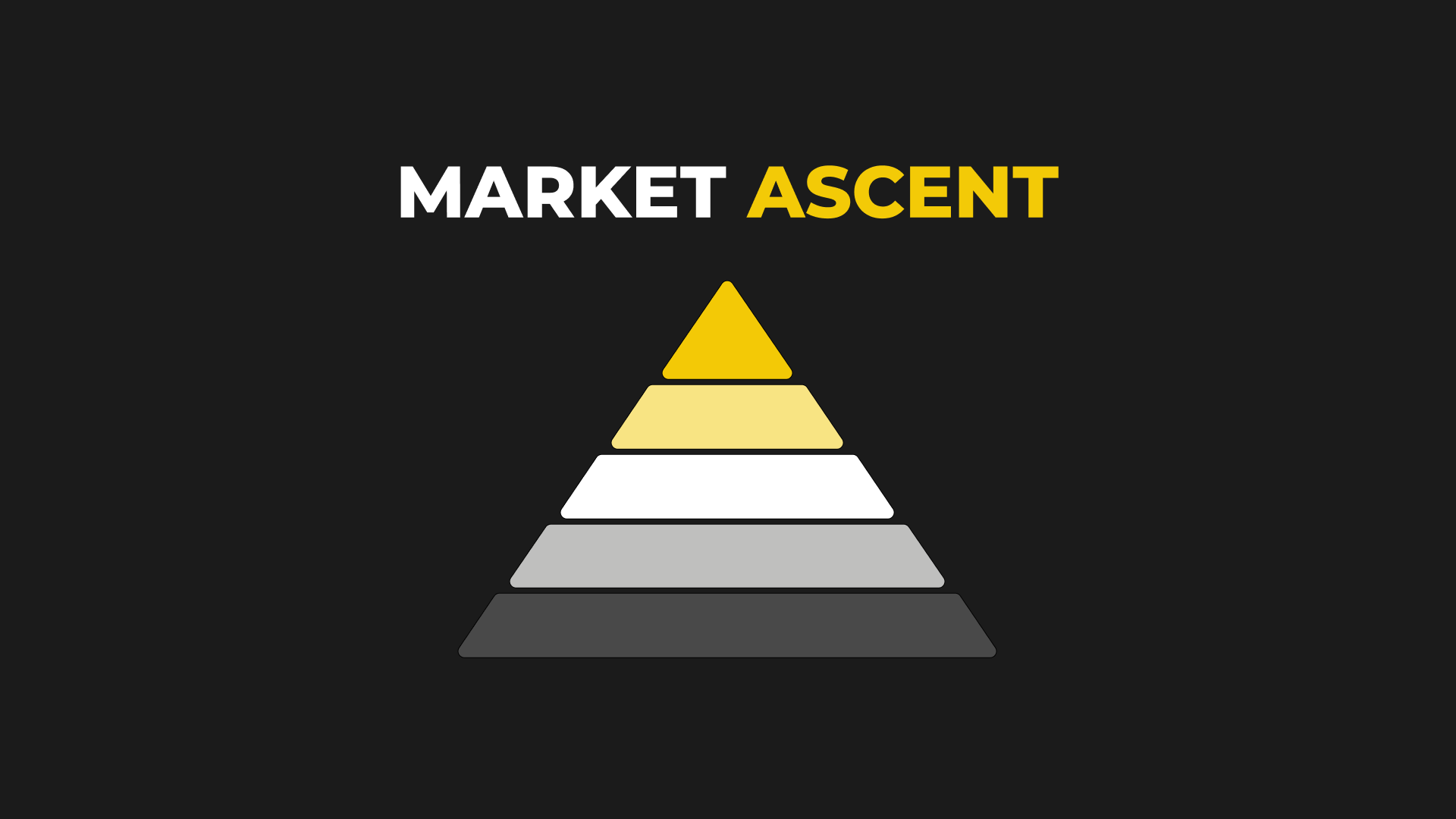
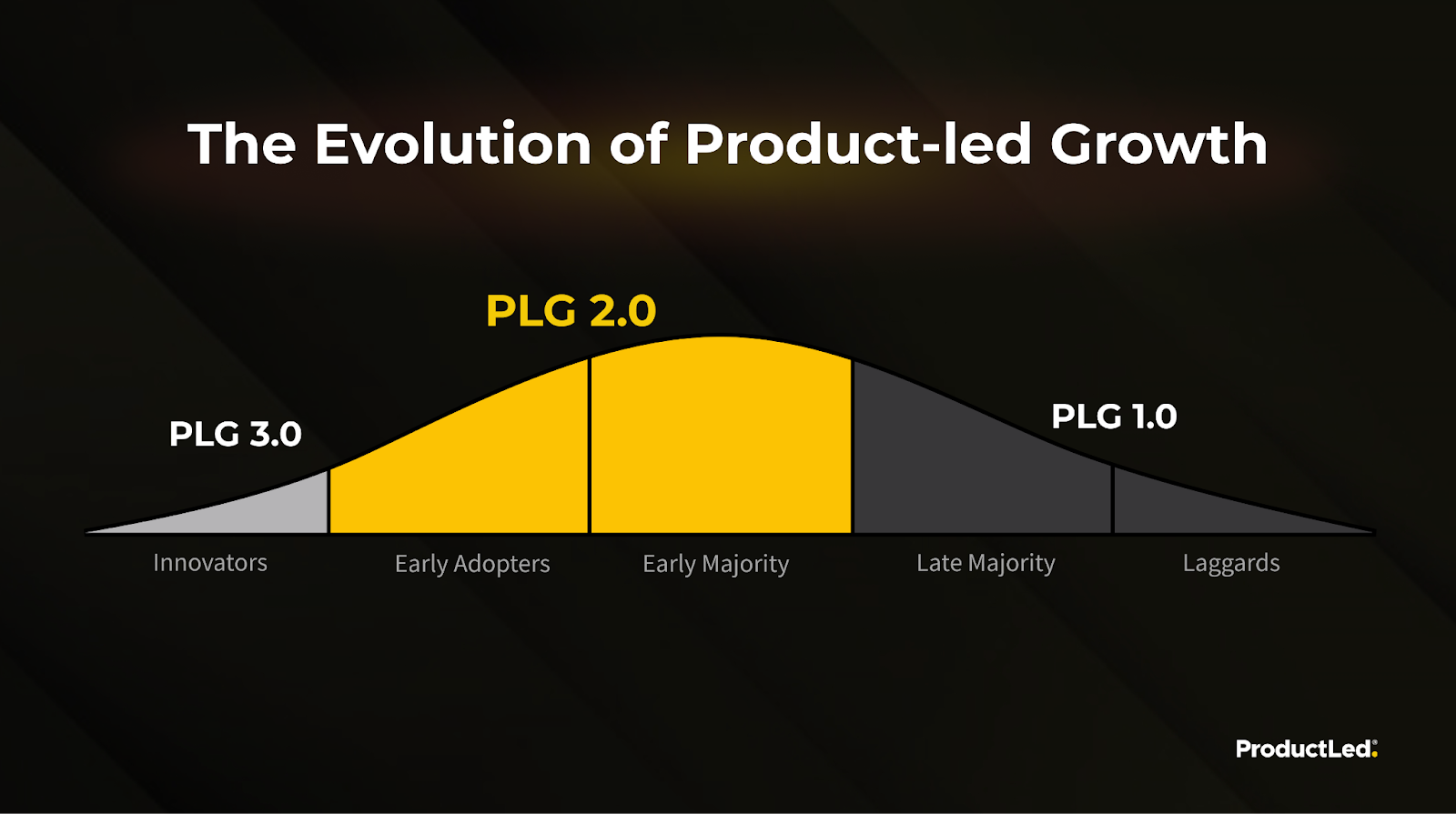
That's what the image below is showing. PLG is evolving, and like any software, it has versions. Where your company sits on that curve determines whether you're leading your market or about to be left behind.
The Three Versions of Product-Led Growth
The old PLG playbook isn't dead. Every fast-growing AI company runs a product-led motion. What's changing is which version you're building and who your product is actually built for.
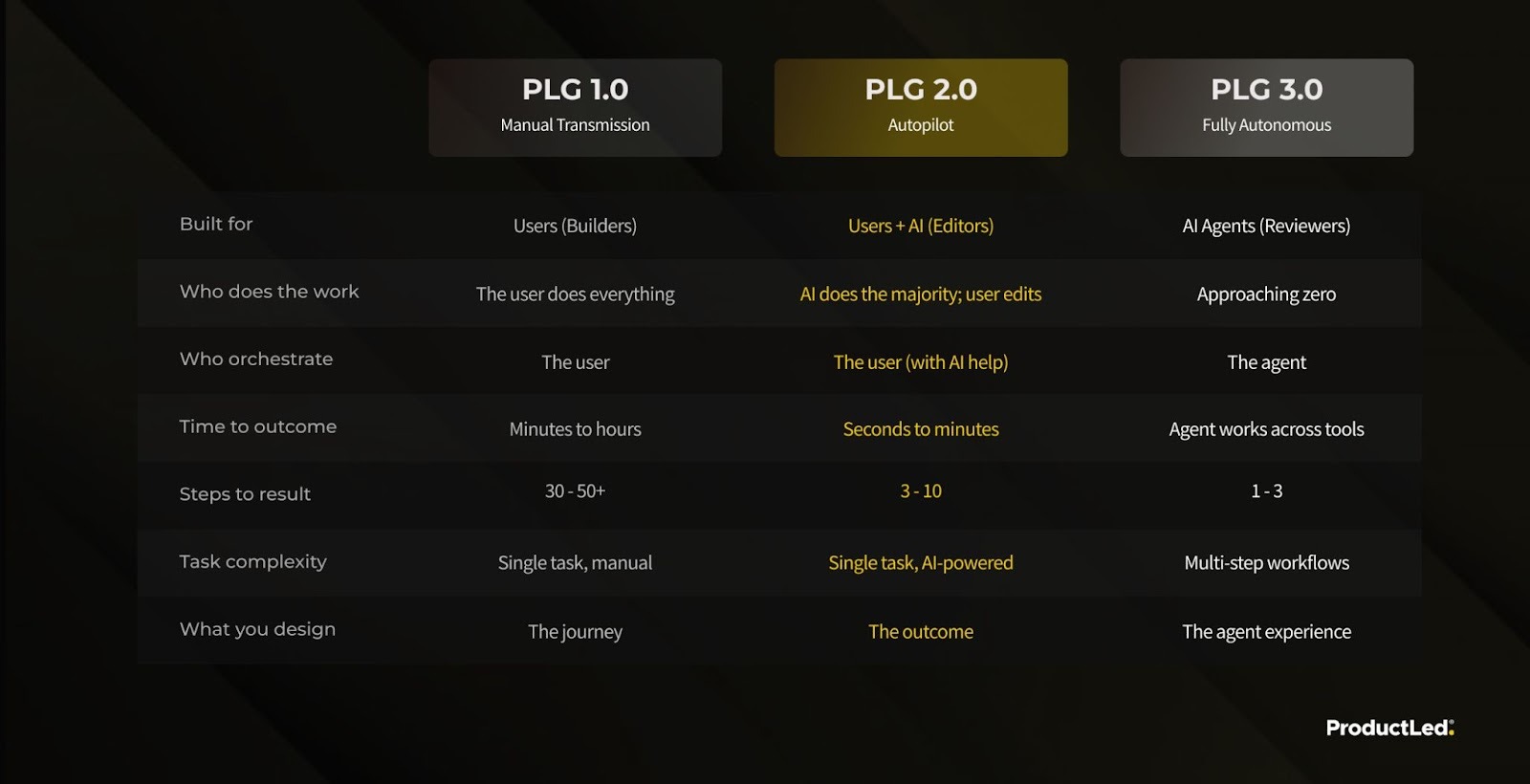
PLG 1.0: Products built for users. The user does all the work. Your user is a Builder.
PLG 2.0: Products built for users, powered by AI. AI does the majority of the work. Your user is an Editor.
PLG 3.0: Products built for AI agents. The human just reviews. Your user is a Reviewer.
Builders create from scratch. They need expertise, technical skill, and time. Editors describe what they want and refine what AI produces. Reviewers state an intent and evaluate the output.
Think of it like driving a car. A Builder is driving a manual transmission. You're shifting gears, navigating, doing everything yourself. An Editor has autopilot. The car handles most of the driving, but you set the destination and take over when needed. A Reviewer is in a fully autonomous vehicle. You get in, the car already knows where you're going, and it takes you there.
The best products are upgrading how a user gets from point A to point B.
Take a simple task like preparing a board deck, for example.
As a Builder (PLG 1.0), you fire up Google Slides. You gather the financials, pipeline data, and team updates yourself. You build each slide from scratch, format it, and spend hours getting it right.
As an Editor (PLG 2.0), you still gather the data and think through the outline, but then you fire up Gamma or Canva. As long as you have a solid outline — boom — you have a polished board deck. The creation is fast. The prep work still takes a while.
As a Reviewer (PLG 3.0), you have an AI Chief of Staff. It knows when your board meeting is. It gathers financials from your accounting tool, pipeline data from your CRM, and team updates from Slack days before you'd have started. It assembles a first draft, presents it to you as if you were a board member, and asks you to critique it. It even has recommendations for what you should do next. Your only job is to evaluate and approve.
Each version unlocks a larger market than the last because each one strips away everything except judgment. Builders need expertise, which caps your Total Addressable Market (TAM) at the talent pool. Editors just need an opinion, which means almost anyone can become a potential user. Reviewers only need to evaluate output, which means your product can serve people it couldn't before.
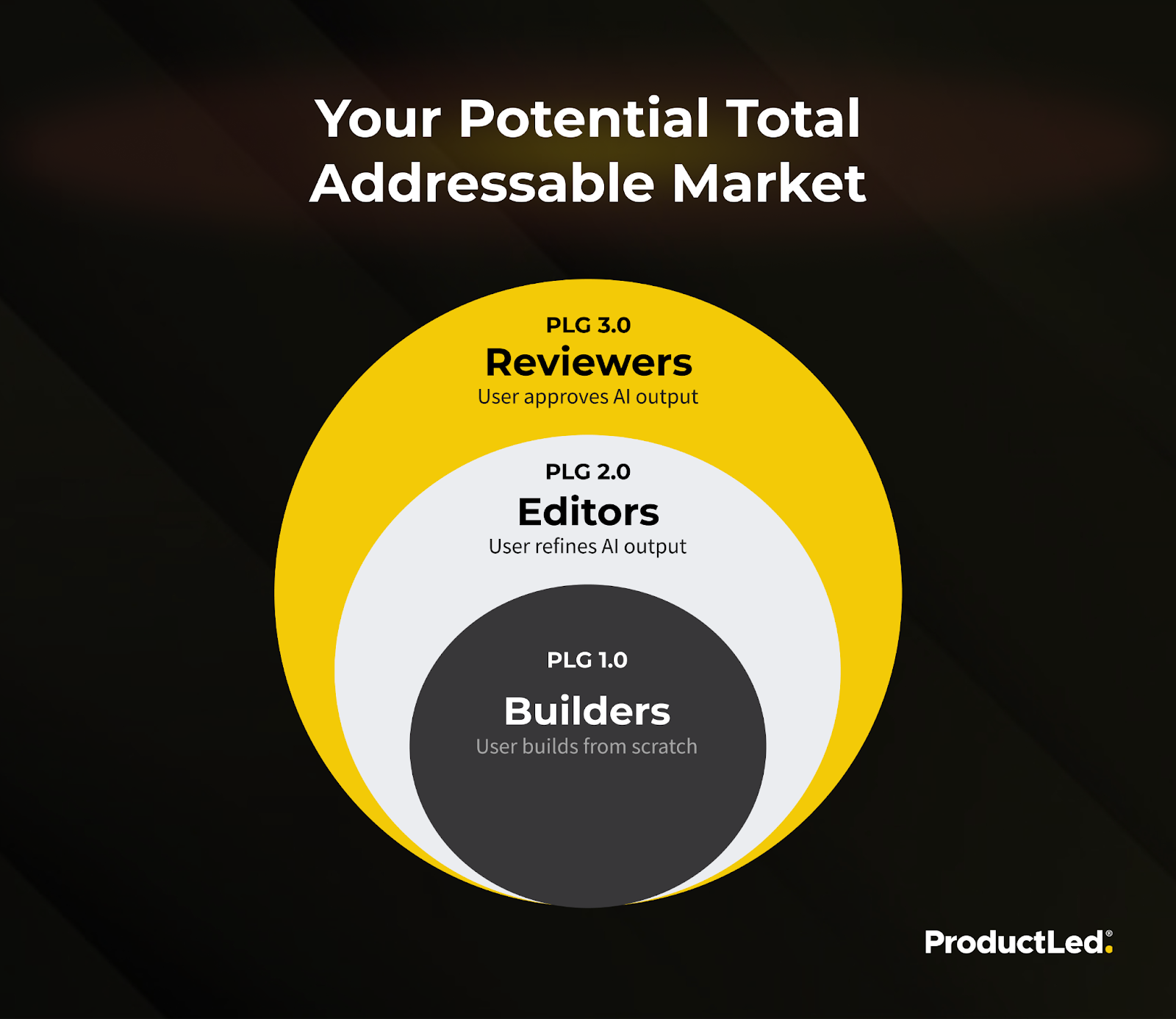
Take Claude Code. It's not a better coding tool for developers. That's just a Builder tool competing for the same builder market share. Instead, it turns anyone who can describe what they want into someone who ships software. The TAM isn't "developers." It's "everyone with a software problem." That's a fundamentally different market size on the same infrastructure.
That's why PLG 2.0 companies are growing faster than anything we've seen. They're not just getting more customers. They're reaching people who never could have used the product before.
That’s how they’re growing their TAM.
Where Does Your Industry Sit?
PLG 1.0 isn't dead.
It's still very much alive in industries that are catching up to PLG in general: healthcare, insurance, government tech. If that's your category, PLG 1.0 might be exactly where you need to start. You're in the late majority, and that's a legitimate place to be.
But if you're in a fast-moving category such as dev tools, AI coding, anything where your buyers already use Cursor or Perplexity daily and you're still running PLG 1.0? You're toast. Your competitors have already upgraded, and your users are comparing your experience to theirs every single day.
Most of SaaS is in PLG 2.0 territory right now. And some companies are even further ahead — Chris Bach, co-founder of Netlify, recently shared on the ProductLed Podcast that the majority of new signups on their development platform are now AI agents. They're already optimizing for PLG 3.0.
PLG 1.0: The User Experience Era

| Your user | A Builder who creates from scratch and needs expertise |
|---|---|
| Who does the work | The user does all the work. |
| Time to Value | Minutes to hours. |
| Steps to value | 30 to 50+ |
| Where on the adoption curve | Late Majority / Laggards |
The goal of PLG 1.0 is to shorten the path from signup to value. Companies do this with better onboarding, fewer clicks, and guided activation.
This spawned an entire ecosystem of tools, including Pendo, Appcues, UserGuiding, Userflow, and WalkMe. All are built to guide users through the dozens of steps from signing up to getting value. They all focused on user adoption because adoption was the bottleneck.
It’s genuinely valuable work. But fundamentally, it’s a Band-Aid. The user still had to do all the work. The tools just made the work less confusing.
Your users are Builders. They need domain expertise to get value. They need to learn your interface, configure their setup, and actively create the output. That caps your TAM at people with the skill and patience to build.
There is nothing wrong with being here if you’re in an industry that is typically a technology laggard (i.e., healthcare, government, etc).
PLG 1.0 fundamentals still matter. But if you’re in a fast-moving industry, most of tech is already implementing PLG 2.0, and if you don’t update your approach, you’re toast.
PLG 2.0: The Output Experience Era
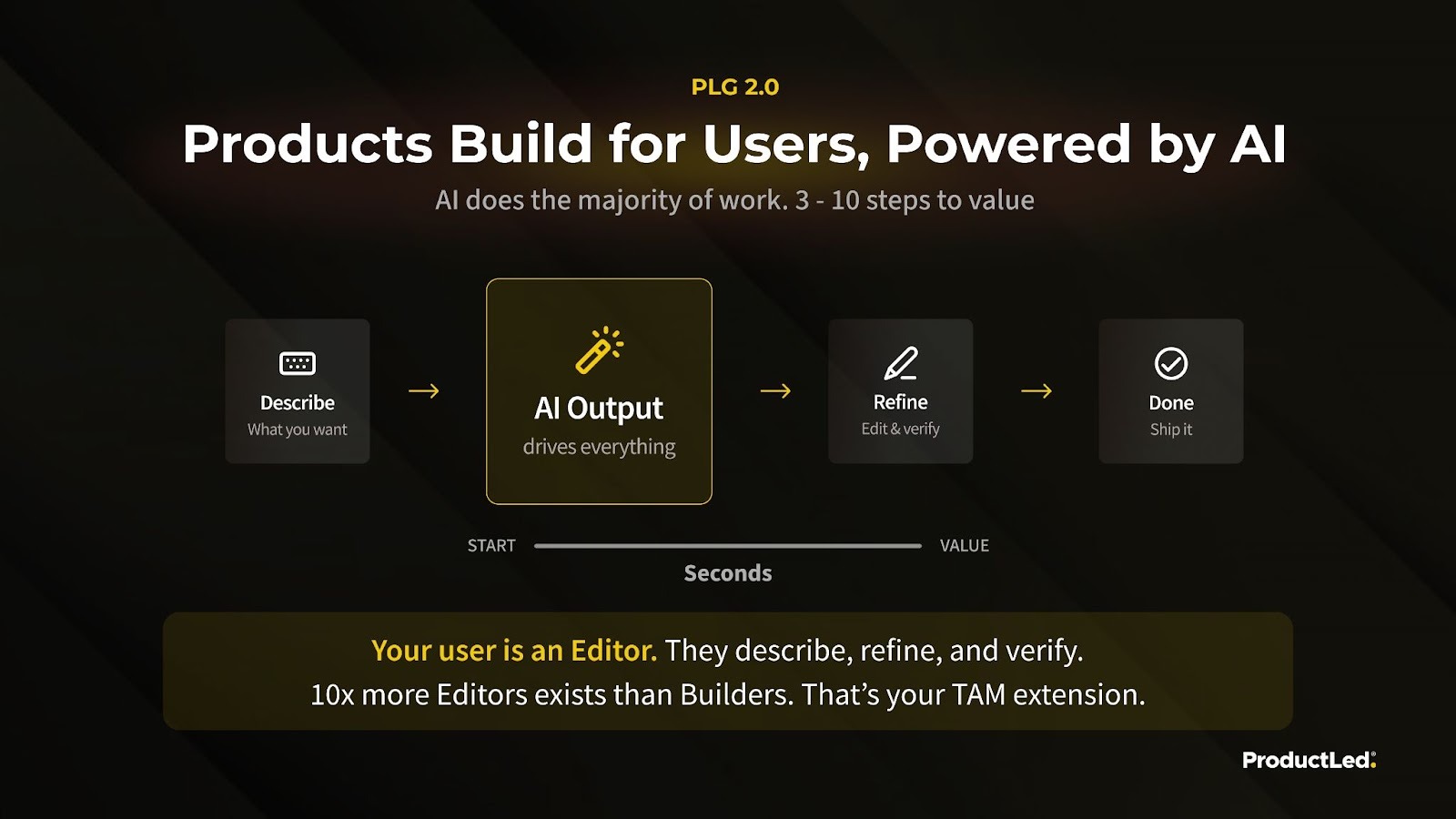
| Primary user | An Editor who prompts, refines, and verifies |
|---|---|
| Who does the work | AI does the majority of the work to get users to value |
| Time to Value | Seconds to minutes |
| Steps to value | 3 to 10 |
| Where on the adoption curve | Early Adopters / Early Majority |
PLG 2.0 is where AI performs most of the work, and the user's role shifts from building to editing.
Instead of guiding users through steps to reach value, the product leads with an AI-generated output that the user refines.
PLG 2.0 doesn't ask "how do we reduce the steps to value." It asks, "How do we collapse a user’s time to value?"
AI-native products start with an output and ask the user to refine it. The value isn't at the end of the onboarding flow. You often get to value in 60 seconds or less.
But let me be precise.
PLG 2.0 doesn't eliminate the user. It shifts their role from Builder to Editor. You still describe what you want, review the output, refine it, and verify it. With Gamma, you still outline what you want to communicate and review the presentation. With Cursor, you still describe the feature and review the code. The heavy lifting of creation, technical execution, and domain expertise is handled by AI. Your job moves from construction to curation.
Why does this drive such extreme growth? Because there are 10x as many Editors as Builders. A founder who can't code can describe an app to Lovable and ship it with no developer needed. They went from "I have an idea" to "I have a product." That person was completely locked out before. Now they're a user.
PLG 2.0 unlocks an entirely new TAM who couldn't use the old tools.
The Numbers Tell the Story
| Company | Category | Old Way | New Way | Result | Source |
|---|---|---|---|---|---|
| Cursor | Dev Tools | Hours/days of manual coding | Describe intent → working code | $2B+ in 3 yrs | Bloomberg/TechCrunch |
| Lovable | App Dev | Weeks to ship with a developer | Describe app → it's built | $200M - 4 months | TechCrunch |
| Harvey AI | Legal | Days of research & doc review | Ask → drafts a brief in minutes | $190M - 3 yrs | |
| Perplexity | Research | Hours Googling, 10+ tabs | Ask → sourced answer in seconds | ~$200M - 3 yrs | TechCrunch |
| Ramp | Finance | 8 to 12-day expense lifecycle | Takes minutes to get your expenses approved | $1B+ in 5 yrs | PR Newswire |
| Gamma | Presentations | Hours building a deck | One prompt → full presentation | $100M in 3 yrs | Yahoo Finance |
| Genspark | Knowledge Work | Days of busy work | State intent → finished deliverables | $200M in 11 months |
None of these are flukes. They share one pattern: winning preference.
What Winning Preference Is
Winning Preference is the moment a user experiences a product and immediately knows the old way of doing things is obsolete. It is not a gradual comparison. It is an instant, irreversible shift in the user's perception of every competing product.
Once someone touches a PLG 2.0 product, they don't run a feature comparison or negotiate pricing. They just can’t go back. The old way feels outdated.
I started using Gamma, and within five minutes, I knew I was never opening Google Slides again. It wasn't a decision. The old way felt broken the moment I experienced the new way.
That instant shift in preference is what separates steady growth from breakout growth. It's not just product-market fit. It's product-market lock-in at first touch.
The Biggest Mistake
Founders see this and think, "We need to add AI." So they slap a chatbot in the sidebar. An "AI assistant" that auto-completes a single field.
That's not PLG 2.0. That's PLG 1.0 with a chatbot stapled to it. The user still does 90% of the work. The workflow didn't change.
For PLG 2.0, the output must be good enough to win preference on first touch. The way companies do that? The homepage is the product itself.
Look at how ChatGPT, Claude, and Lovable open. The product is right there. You can start getting value before you've created an account. Activation isn't step five of the onboarding. Activation is the first touchpoint.
That's the fundamental shift. In PLG 1.0, you design the journey with signup flows, onboarding steps, and activation sequences. In PLG 2.0, you design the outcome. The journey disappears. All that matters is whether the first output is good enough for the user to never look back.
PLG 3.0: The Agent Experience Era
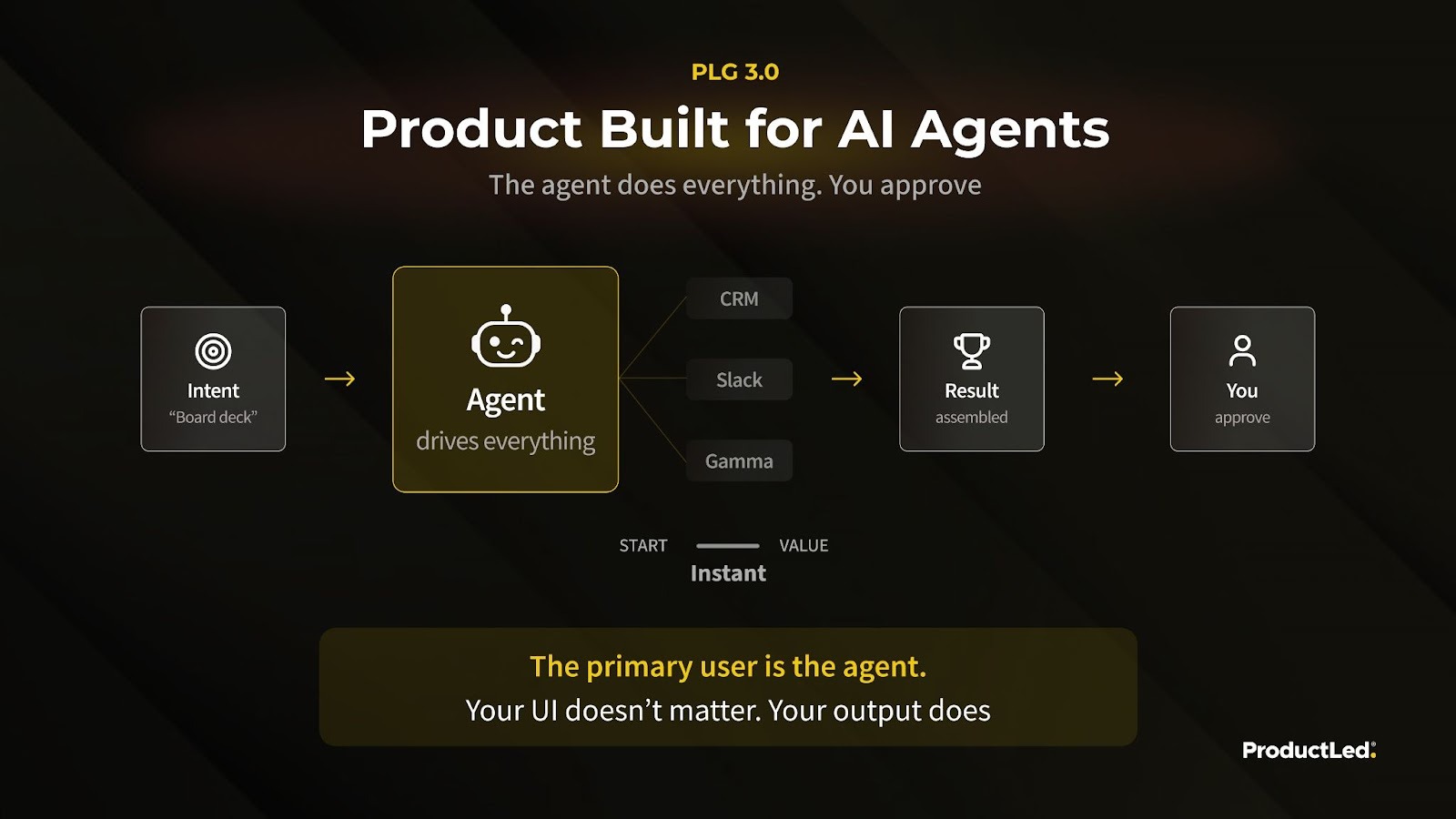
| Primary user | An AI agent that works across multiple products |
|---|---|
| Who does the work | You review and approve the results |
| Time to Value | Approaching zero |
| Steps to value | 1 to 3 |
| Where on the adoption curve | Innovators |
The biggest difference between PLG 2.0 and 3.0 is one question: who is the orchestrator?
In PLG 2.0, you are. You can use a dozen AI tools (Cursor for code, Gamma for decks, Harvey for legal), but you're the one deciding which tool to open, what to ask for, and how to connect the pieces. You're driving with autopilot. The car is smart, but you're still picking the route.
In PLG 3.0, the agent is the orchestrator. You just tell it where you want to end up. It figures out the fastest route, picks the tools, does the work across your entire stack, and hands you the result. It’s fully autonomous.
This is already starting. Right now, tools like MCP connectors let you use Claude to work across products in a single conversation. But you're still initiating. That's advanced autopilot, and you're the orchestrator with better tools. The line into PLG 3.0 is crossed when the agent takes over that role entirely. The majority of new signups on Netlify's platform are now agents, not humans. They didn't hear about Netlify from a friend. The agent evaluated it and chose it. You can learn more about it from Chris Bach, co-founder of Netlify, on the ProductLed Podcast,
Nobody has PLG 3.0 fully figured out yet. Which is why we’re actively studying the innovators on the ProductLed Podcast.
So — three versions of PLG, three types of users, three different eras. What's the one thing driving all of them?
Time-to-Value. Every version exists because the previous one was too slow. PLG 1.0 shortened the path from signup to value. PLG 2.0 collapsed the path entirely by handing users an AI-generated output. PLG 3.0 eliminates the path entirely. The value shows up before you even ask for it.
The Halving Principle™
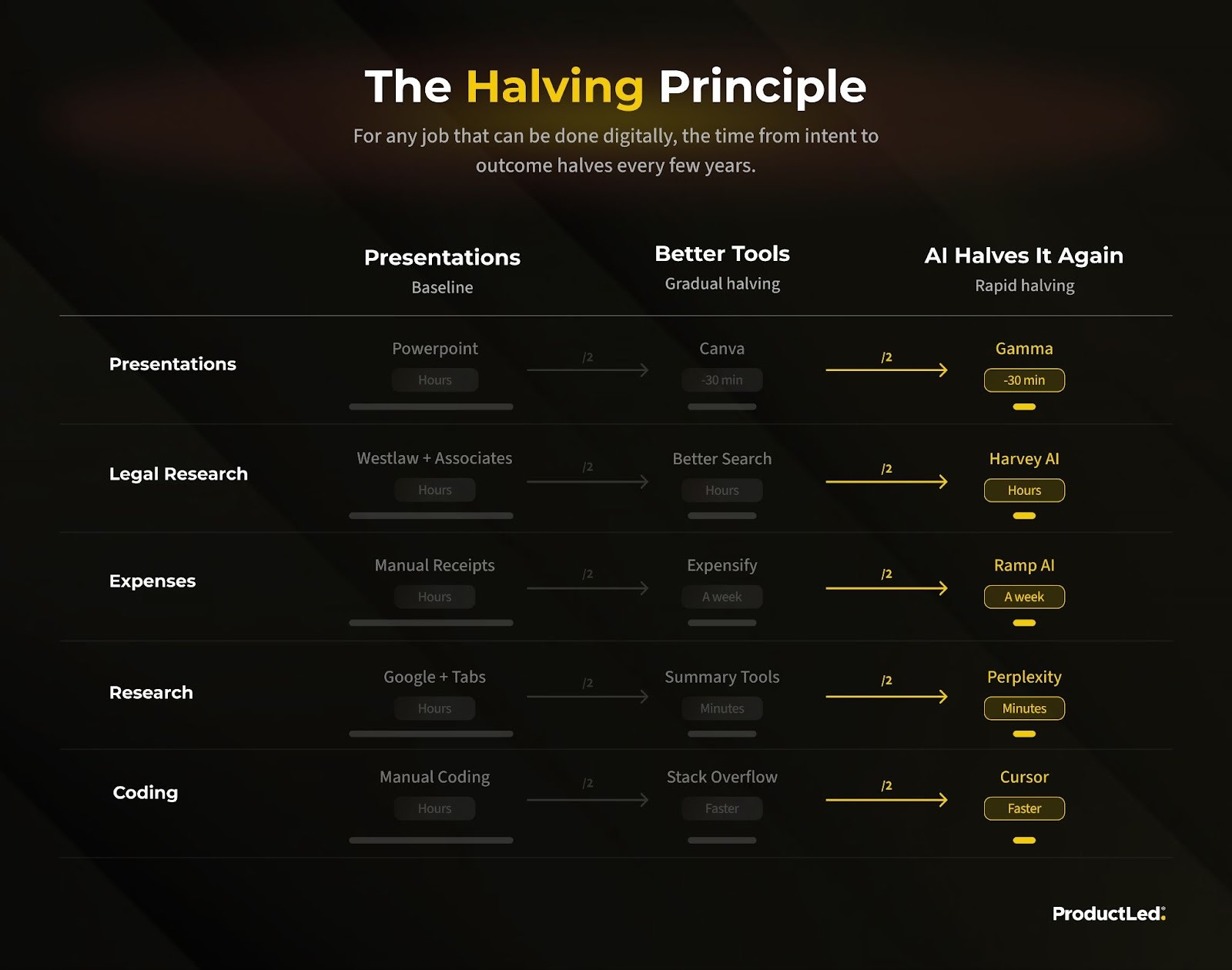
The Halving Principle™ is the observation that for any job that can be done digitally, the time from intent to outcome halves every few years. Better tools halve it gradually. AI halves it rapidly. And each halving raises your users' expectations for every other product they use.
Look at what happened to presentations.
Building a deck in PowerPoint took 4 to 6 hours. Canva brought that down to 30 to 60 minutes. Same era (PLG 1.0) just faster. Then Gamma showed up and collapsed it to 60 seconds. That wasn't a faster version of PLG 1.0. That was PLG 2.0. The entire workflow changed. And PLG 3.0? The agent builds your deck before your meeting is even on your mind. Time-to-Value: zero.
That pattern isn't unique to presentations. It's happening in legal (Westlaw → Harvey), coding (Stack Overflow → Cursor), research (Google → Perplexity), and every other category where AI can do the work faster than a human can learn the tool.
Here's what this actually feels like. After using Lovable to build a prototype in minutes, I went to create a scorecard with Scoreapp. Completely different product category. But I immediately felt it — clicking through screen after screen, configuring settings, waiting for a result. It felt unbearably slow. Not because Scoreapp had gotten worse. Because Lovable had rewired my expectations for how fast any product should deliver value.
That's the Halving Principle in action. Your users aren't comparing you to your competitors. They're comparing you to the last AI-native product they touched — in any category. And the gap between what they experienced there and what they experience in your product is growing every month.
People put up with your product's friction only because there's no AI-native alternative yet. The Halving Principle™ doesn't care about your product roadmap. The clock is halving whether you're ready or not.
Which Version Are You Actually Running?
Open your product right now and start a stopwatch.
How long until a brand-new user sees a real output? Not a dashboard, not a welcome screen, not a configuration wizard, but something they'd actually pay for?
That number is your Time-to-Value.
Now halve it. Can your product deliver that?
Someone in your market is building toward it this quarter. And when they ship it, your users won't complain. They'll leave.
So which version are you running?
The Playbook Is Being Rewritten
Many industries are still running PLG 1.0. That's fine. The fundamentals still matter, and the ProductLed System™ was built to help companies at every stage. But those industries are the late majority on the adoption curve. The window is narrowing.
Early adopters and the early majority are learning PLG 2.0 right now. Innovators are building for 3.0. The question isn't which era is "right." It's the era your market is about to demand.
We built the PLG 1.0 playbook.
We're building the 2.0 playbook with founders right now.
That's what Warp Week is for.
Your users are already experiencing PLG 2.0 products in other parts of their work. They use Perplexity for research and Cursor for code. They already know what fast looks like.
Every month, their tolerance for your product's friction shrinks.
The Halving Principle™ doesn't care about your product roadmap. The clock is halving whether you're ready or not.
PLG keeps evolving, but the fundamentals don't. They're all in Product-Led Growth: How to Build a Product That Sells Itself, rewritten for the AI era in the second edition.
Frequently Asked Questions
Is product-led growth dead? No. PLG is more relevant than ever. Every fast-growing AI company runs a product-led motion. What's outdated is PLG 1.0 — the version focused solely on reducing friction in multi-step onboarding flows. PLG 2.0, where AI does most of the work and users edit rather than build, is the fastest-growing segment from 2025 to 2026.
What is PLG 2.0? PLG 2.0 is a product-led growth strategy where AI performs the majority of the work and the user's role shifts from building to editing. Instead of guiding users through steps to reach value, the product leads with an AI-generated output that the user refines. Companies like Cursor ($2B+ ARR), Lovable ($200M ARR), and Harvey AI ($190M ARR) are examples.
What is the difference between PLG 1.0, 2.0, and 3.0? PLG 1.0 builds products for users who do all the work (Builders). PLG 2.0 builds products where AI does the majority of the work (Editors). PLG 3.0 builds products for AI agents that orchestrate across multiple tools, where the human just reviews the output (Reviewers). Each era expands the TAM by roughly 10x.
What is The Halving Principle™? The Halving Principle™ is the observation that for any job that can be done digitally, the time from intent to outcome halves every few years. Better tools halve it gradually. AI halves it overnight. Building a presentation went from hours (PowerPoint) to 30 minutes (Canva) to 60 seconds (Gamma).
What is Winning Preference? Winning Preference is the moment a user experiences a PLG 2.0 product and immediately knows the old way is obsolete. It's an instant, irreversible shift — not a gradual comparison. This moment drives breakout growth rates like Lovable's $100M ARR in 8 months.
How do I know which PLG era my company is in? Open your product. Start a stopwatch. How long until a brand-new user sees a real output they'd pay for? If it takes minutes to hours with 30+ steps, you're in PLG 1.0. If AI generates a useful output in seconds and the user refines it across 3-10 steps, you're in PLG 2.0. If an AI agent can use your product without a human in the loop, you're approaching PLG 3.0.
Does PLG 2.0 only apply to creative and generative AI tools? No. PLG 2.0 applies across categories: legal research (Harvey AI), expense management (Ramp), software development (Cursor), and general research (Perplexity) are all PLG 2.0 companies in non-creative verticals. Any product where AI can collapse the workflow and deliver a useful output before the user would have finished configuring the old tool qualifies.
Wes Bush is the founder of ProductLed, where he has helped over 400 companies build product-led businesses. He is the bestselling author of Product-Led Growth and The Product-Led Playbook. His frameworks have been implemented by companies ranging from early-stage startups to Fortune 500 enterprises.