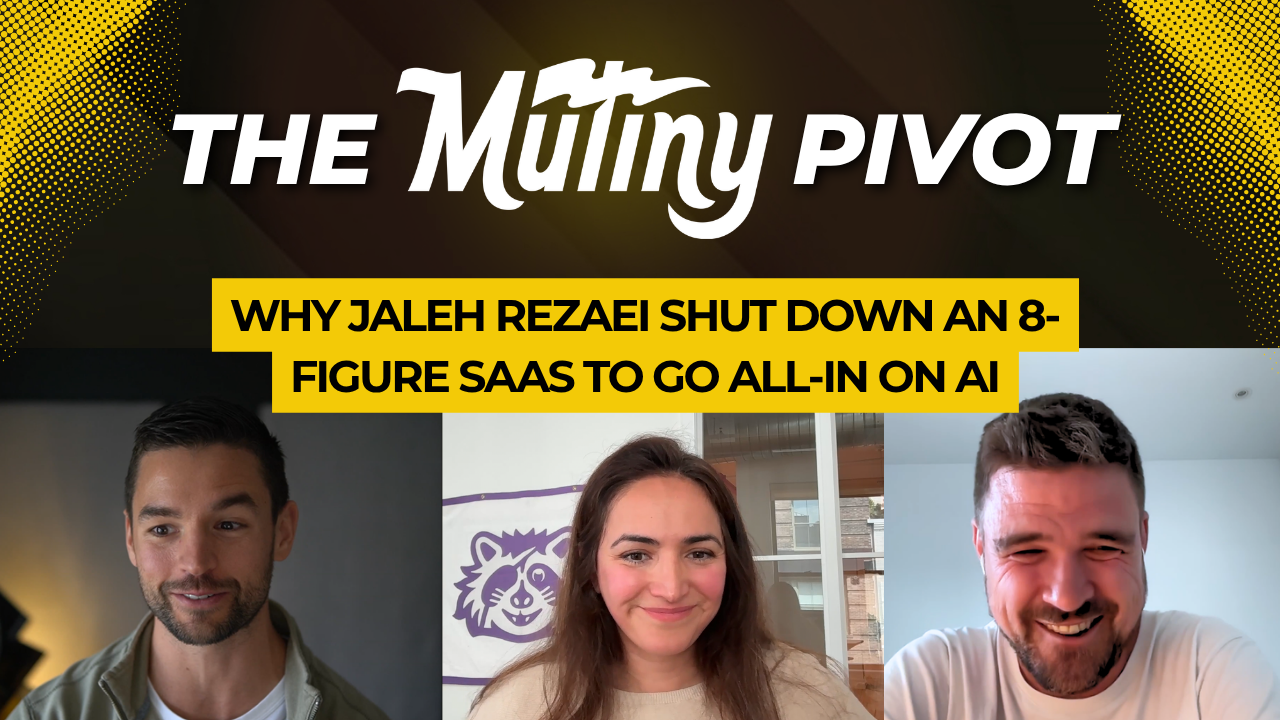
Most founders spend years trying to reach eight figures in ARR.
Very few get there and then choose to dismantle most of what they built.
That is what made Mutiny’s pivot so striking. After growing a SaaS business to more than eight figures in ARR, Jaleh Rezaei and her team made the call to walk away from much of the original product and rebuild around AI agents.
The decision was not driven by panic. It came from a clear view of where the market was heading and an even clearer view of what was slowing the company down.
At the center of the story is a simple idea: when a market changes this quickly, the biggest risk is moving too slowly.
Why She Left 8-Figure ARR Behind
The core problem was trying to run two different companies inside one business.
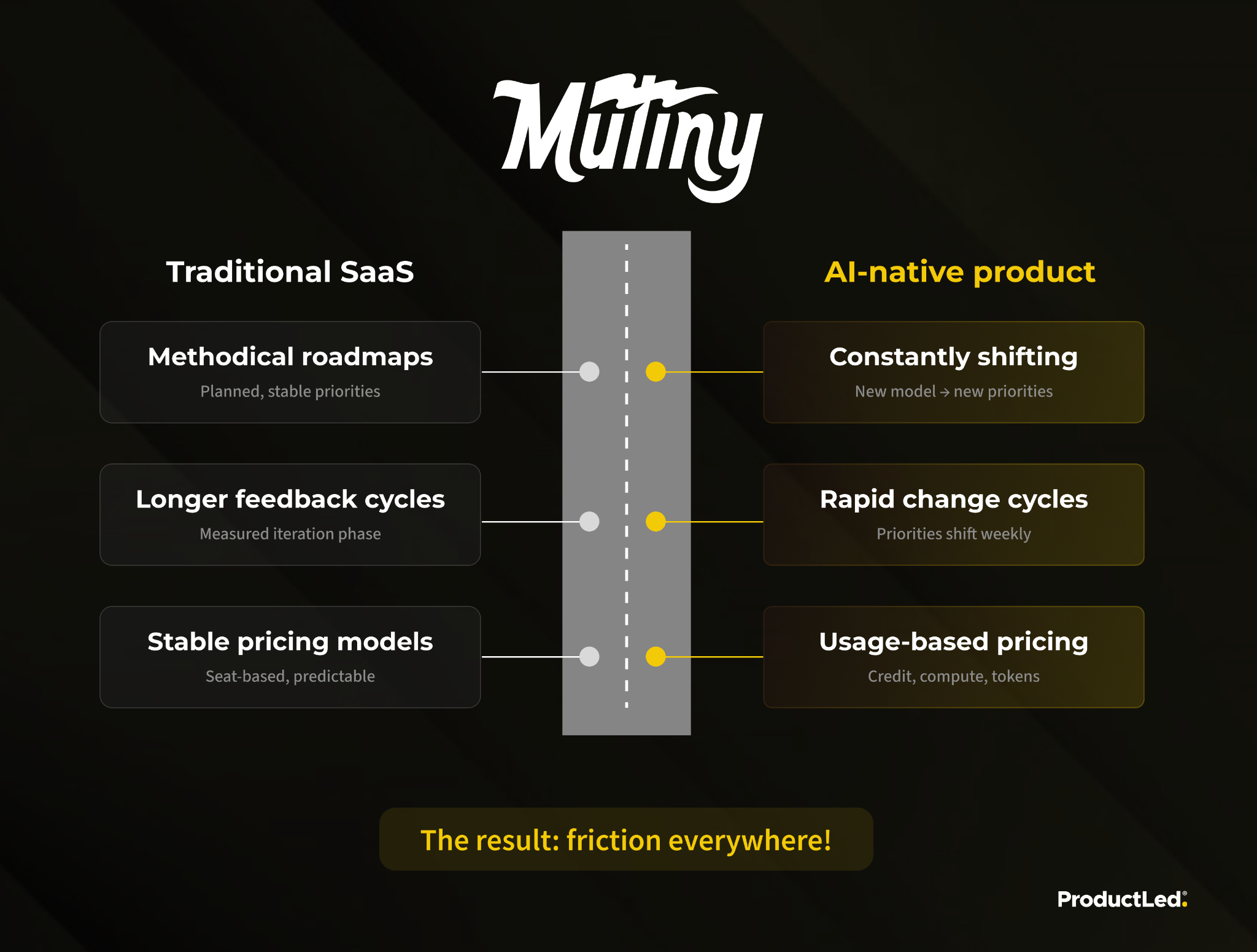
On one side was a traditional SaaS product. That kind of business rewards methodical roadmaps, longer feedback cycles, and pricing models that stay relatively stable over time.
On the other side was an AI-native product. That world changes constantly. A new model release can instantly unlock a feature customers want right now, which means priorities can shift multiple times a week. Pricing also behaves differently because AI products are tied to usage, credits, and compute in ways that do not map cleanly to classic SaaS packaging.
Trying to combine both created friction everywhere. Product decisions became compromises. Pricing became muddled. Roadmaps started serving the middle instead of serving either business well.
The deeper insight was that the original mission had not changed. Mutiny still wanted to remove the dependencies that slow down go-to-market teams. AI simply became the more powerful way to do that.
The Gut Check Behind a High-Stakes Pivot
The hard part was not recognizing the opportunity. The hard part was finding the conviction to act on it before the rest of the market forced the issue.
Jaleh’s test was speed.
If the team was working at full intensity but still moving slower than the market demanded, something structural was wrong. That became the signal. A startup cannot afford to be in its own way, especially when competitors are building toward the same goal with fewer constraints.
"You'll never regret moving as fast as you can. And that is just about the only thing you can control is making sure that you are moving as fast as possible against the thing that you think matters the most." - Jaleh Rezaei
That mindset also shaped her advice to other founders facing the same kind of decision. The question is not whether the pivot will feel comfortable. The question is whether the company is moving as fast as possible toward what matters most.
That is one of the few variables founders actually control.
There is also a useful leadership lesson here. Big strategic shifts rarely come with perfect precedent. Sometimes the conviction comes from seeing that every alternative still leaves slower, more diluted, and less likely to win.
Reframing the Pivot as Mission, Not Failure
Walking away from a successful product can feel like admitting defeat. That is especially true when the company has already cleared many of the milestones founders are told matter: fundraising, enterprise customers, meaningful revenue, and market credibility.
But this pivot only looks like failure if the product is the mission.
For Mutiny, the mission was broader. The goal was to transform go-to-market execution by helping teams move faster and operate with fewer bottlenecks. When viewed from that angle, the website personalization product was one chapter, not the finish line.
A helpful framing question emerged: if the company were starting from scratch today, what would it build to solve that mission?
The answer was not the old product. It was AI infrastructure that could learn from data, automate work, and improve over time.
That kind of first-principles thinking matters because it helps founders separate emotional attachment from strategic truth.
The First 90 Days of the Transition
A big pivot is not just a product decision. It is an operating model decision.
One of the strongest ideas from this conversation is that product-market fit tends to require a certain company shape. Small teams. Tight feedback loops. Shared context. High contact with customers. Fast decision-making.
That is very different from how larger SaaS organizations are typically set up.
So Mutiny shrank the team, moved toward a smaller in-person configuration, and rebuilt around speed. The point was not austerity for its own sake. The point was to create the conditions where everyone had direct exposure to customers, product issues, and market feedback.
That changed the quality of decision-making immediately. When sales, onboarding, product, and customer conversations are all flowing through a smaller group, the company does not have to work so hard to manufacture alignment. Shared context does most of the work.
For founders, this is a good reminder that org design is strategic. If the structure slows learning, it will slow product-market fit too.
How Mutiny Migrated Customers Gracefully
One of the most impressive parts of the transition was how deliberately the customer migration was handled.
Instead of forcing customers through a messy handoff, the team first mapped what each account was using, audited the market for replacement partners, and negotiated a migration path that protected pricing, terms, and functionality. In many cases, customers received equal or better capabilities, plus white-glove support to make the move as painless as possible.
Just as important, these conversations happened directly and respectfully. There was no faceless mass email trying to explain away a major transition.
That matters because trust is built in moments like this.
Customers generally understand that markets change and companies evolve. What they remember is whether they were treated like a ticket number or like a partner.
The broader lesson is simple: scary transitions become more manageable when they are paired with thoughtful execution.
Building a Team for Startup Intensity Again
Once the company committed to the new direction, it also had to reset expectations around how the team would operate.
The new version of Mutiny was built for intensity. In-person work, long hours, and a very high bar for pace came with the territory. That is not the right environment for everyone, and Jaleh was direct about that.
This was less about glorifying hustle and more about matching the team to the market moment. AI is reshuffling categories quickly. If a startup wants to win in that environment, it needs a team that actively wants that level of challenge.
An important nuance here is that these decisions were not framed as moral judgments. People want different things at different stages of life, and that is fine. But startups do better when they are honest about the intensity required instead of pretending every environment fits every person.
What Founders Must Stop Delegating Pre-PMF
One of the clearest operating principles from the episode is that founders should stop over-delegating before product-market fit.
In a scaled company, delegation is efficient. In a pre-PMF company, too much delegation can be dangerous.
That is because the founder needs the raw inputs, not just the summary. Sales calls reveal where positioning is weak. Onboarding shows where the product still needs hand-holding. Pricing conversations reveal whether the packaging makes sense for the buyer. Support tickets expose friction that a dashboard may flatten into a number.
When that information is filtered too heavily, the founder reacts more slowly and with less confidence.
Direct contact creates sharper instincts. It also makes course corrections faster.
The same principle showed up in customer obsession. Rather than hiding behind process, the team pushed real-time signals into Slack and responded quickly when something broke or confused a user. That kind of founder-led responsiveness is rare, which is exactly why it stands out.
Why the New Mutiny Had to Be Product-Led
The move from sales-led to product-led was a natural fit for the new product.
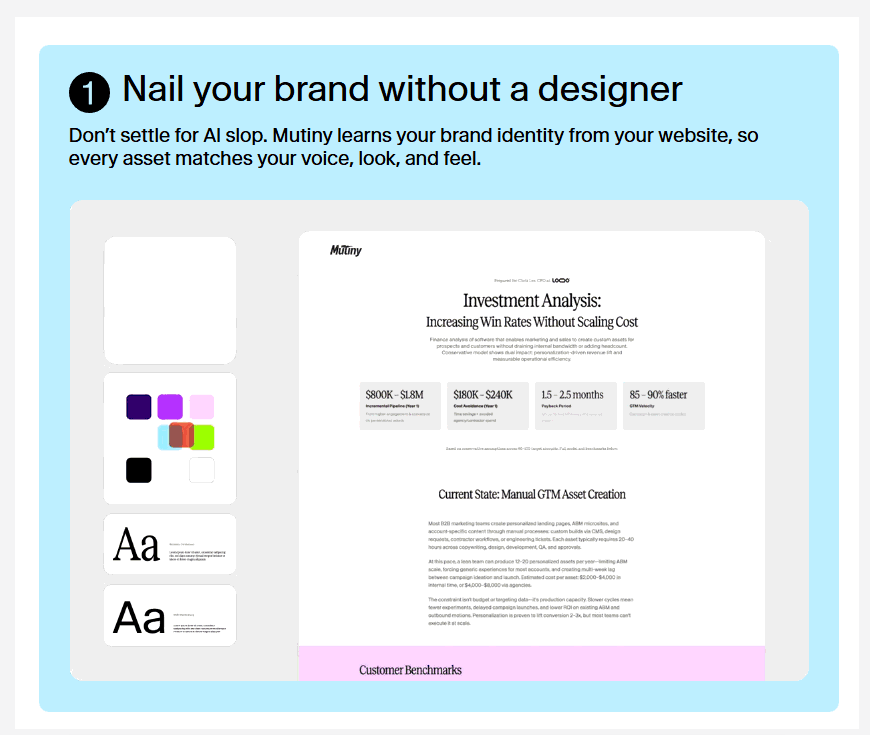
AI products benefit from being experienced, not explained. When users can immediately see an agent generate something useful and high quality, belief happens much faster. That reduces the amount of persuasion needed in the sales process.
There was also a product advantage. Self-serve exposes weaknesses much faster than a heavily supported onboarding motion. If users cannot get value without hand-holding, the product still has work to do.
That makes PLG a forcing function for quality.
For Mutiny, the self-serve motion also improved the sales-led funnel. Prospects could try the product earlier, understand the value faster, and enter sales conversations with real context. That tends to shorten sales cycles because the discussion shifts from “does this work?” to “how do we roll this out?”
In AI especially, showing beats telling.
What a Real AI Moat Looks Like
A lot of AI workflows will become commodities. Basic data movement is an obvious example. If every model can connect to the same systems and perform the same rote tasks, that layer gets thinner over time.
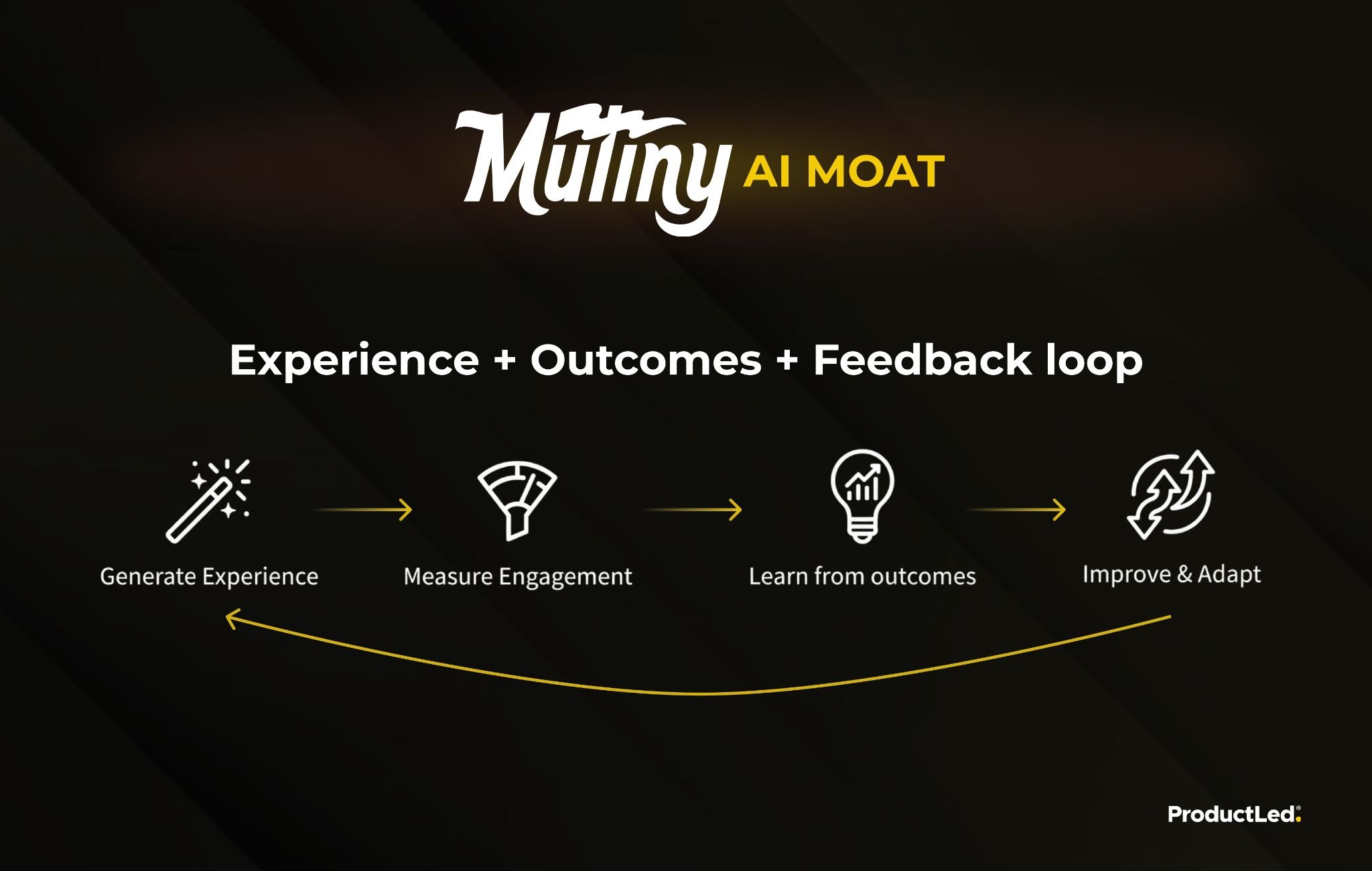
Mutiny’s view is that the more defensible layer sits in experience generation and analytics.
Go-to-market teams do not just need data pulled from tools. They need customer-facing outputs that are on-brand, context-aware, and measurable. A landing page, a deal room, and a business case may all draw from the same underlying information, but each requires different structure and quality standards.
By owning the experience layer, Mutiny can also capture richer usage and engagement data. That closes the loop between what was created and how buyers interacted with it. Over time, that makes the system smarter.
That is the real moat: self-improving outputs grounded in customer context and outcome data.
Jaleh’s Highest-Leverage AI Workflows
On a practical level, Jaleh uses AI heavily in three areas.
First, recruiting. AI helps triage inbound applications, calibrate against the qualities the company values, and speed up sourcing.
Second, meeting prep. With systems connected across tools like Amplitude, HubSpot, and Stripe, it becomes much easier to generate useful context for customer, candidate, and media conversations.
Third, writing support. She does not rely on AI to create original writing because strong writing still needs a real point of view. But she does use it to refine, tighten, and optimize drafts.
That distinction is worth noting. AI can accelerate communication, but the sharpest ideas still need human judgment.
Resources
- 🚀 Mutiny: https://mutinyhq.com
- 💼 Connect with Jaleh Rezaei on LinkedIn: https://www.linkedin.com/in/jalehr/
- 💼 Connect with Wes Bush on LinkedIn: https://www.linkedin.com/in/wesbush/
- 💼 Connect with Esben Friis-Jensen on LinkedIn: https://www.linkedin.com/in/esbenfriisjensen/
- 🧠 Sign up for the ProductLed Newsletter: https://www.productled.com/newsletter
Want to build your own product-led success story?
Mutiny's story is a strong reminder that product-led growth is not just a go-to-market choice. Sometimes it is the cleanest path to better product truth, faster learning, and stronger conviction.
If you are ready to build a product-led growth engine of your own, here are a few ways to go deeper:
- 👉 Book a Free Growth Session to get personalized advice on your biggest PLG challenges
- 👉 Join the ProductLed MBA™ and learn the frameworks top product-led companies use to scale
- 👉 Download the ProductLed Playbook for free resources you can apply right away
- 👉 Subscribe to the newsletter for weekly insights on building smarter