Most founders believe scaling requires a massive headcount, co-founders, and VC funding. They think success is measured by the size of the team, not the efficiency of the revenue.
In this episode of the ProductLed 100 series, Wes Bush sits down with Vincent Jong (Founder of Poolside Ventures) and Esben Friis-Jensen (Co-Founder of Userflow) to discuss the emerging era of the "One-Person Company" - businesses designed to generate millions in revenue with just a single operator.
Vincent reveals his strategy for building a portfolio of lean, highly profitable SaaS companies like MeetBot. Together with Esben, they break down how AI tools like Lovable and Cursor have removed the technical barrier to entry, why "speed" is the new competitive moat against incumbents like Calendly, and the exact skill sets required to thrive as a solo builder.
Whether you are a developer looking to launch your own venture or a founder trying to maximize efficiency, this episode offers a blueprint for building high-revenue, low-headcount businesses that are built to last forever.
Why Vincent Stopped Looking for Co-Founders and Started Building Alone
Vincent Jong tried the traditional startup path multiple times. Each attempt ended the same way: co-founder issues derailed everything.
"I tried to start a few companies already. The first few failed because of issues with co-founders. Not enough commitment from the person doing it with me, or something dragged them into another direction."
Sound familiar?
The dependency on finding the "right" co-founder before you can even start has killed more companies than bad ideas ever did. Vincent realized something critical: waiting for the perfect partner was just another form of procrastination.
With AI tools now capable of handling the technical heavy lifting, the equation changed completely. You no longer need a technical co-founder to validate whether an idea is worth pursuing. You can build it yourself, test it in the market, and prove traction before bringing anyone else into the picture.
The shift is profound. Co-founders went from "absolutely necessary" to "nice to have, but not required."
The AI Tech Stack (How Tools Like Lovable and Cursor Replace Engineering Teams)
Vincent describes himself as someone who wasn't a strong coder. That would have been a dealbreaker five years ago. Today, it's irrelevant.
With tools like Lovable and Cursor, Vincent went from "I'm not a good coder" to "I'm unstoppable on that front."
The transformation is seismic:
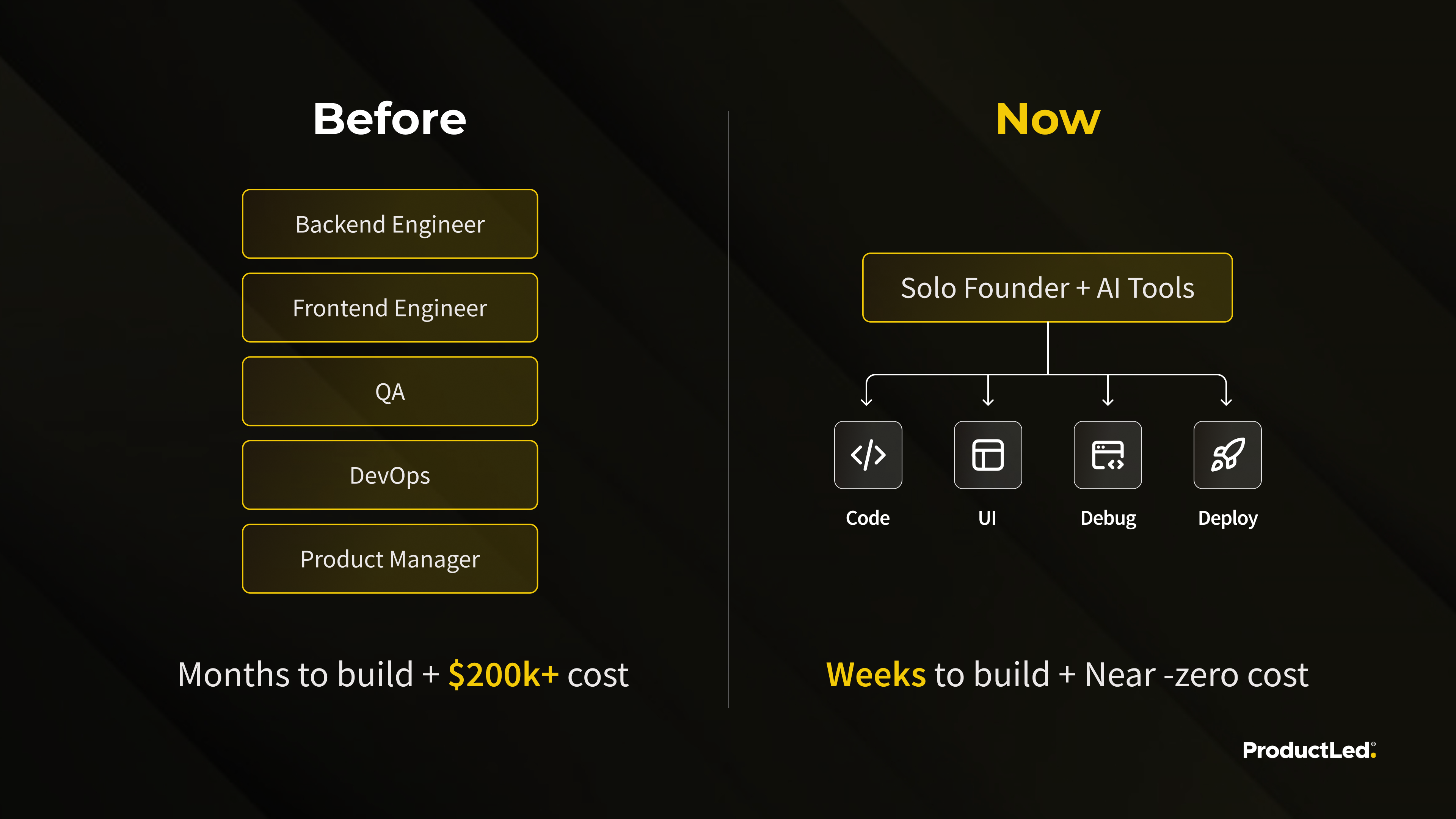
Before: You needed $200K+ to hire engineers and build for months before seeing your first user.
Now: You can build a working, production-ready product in weeks for essentially free.
"You don't need the money anymore to get to a first product. And that's really true for most products you could think of," Vincent explains.
Esben Friis-Jensen confirms the rapid evolution: "Six months ago I tried Lovable and it kept giving me errors. Today, it gives me a fully functioning web interface on the first prompt."
This isn't about building janky MVPs anymore. Solo founders are creating polished, production-ready products that compete head-to-head with venture-backed teams of engineers. The technical moat has evaporated. What matters now is execution, taste, and go-to-market strategy.
The things you don't understand about technology? "Ask your agent. Ask ChatGPT. It can actually answer those questions for you already."
Why Building the Product Is the Easy Part (And Selling Is the Hard Part)
Here's where most people get blindsided.
Building got dramatically easier. Selling got harder.
Vincent learned this lesson the brutal way with his product-led sales tool. He invested a year and a half building exactly what he envisioned. The product worked beautifully. Then reality hit.
"As I was getting further down the journey, I started to realize the market for this is very small. And the onboarding was notoriously hard. You need people, account managers, customer success."
That realization changed everything. He was building something that couldn't scale without linear headcount growth. The exact opposite of a one-person company model.
"Building I thought was the hard part. After one and a half years we finally had what we wanted, and only then did I realize... damn it, the hard part is actually the selling."
When Vincent launched MeetBot, he set realistic expectations: "I'm expecting 10-20 signups on day one." He got 12.
"Nobody cares right away. It's the continuous grind. The continuous optimizations. The asymmetric results where a few things bring in most of the growth."
Viral launches are a myth. Real growth comes from consistently executing on distribution over months and years.
Esben raises an even more fundamental challenge: "In the future, I think the challenge won't be skill. It'll be interest."
His co-founder Sebastian is a "100x engineer" who built their product, then realized: "Now I've built what's good enough. Now I need to sell it. And that doesn't interest me."
The future belongs to people who are genuinely interested in go-to-market AND can build product with AI assistance. If you hate sales and distribution, even the best AI tools won't save you.
Disrupting a Red Ocean (Why MeetBot Entered the Crowded Scheduling Market)
Conventional startup wisdom screams: Find a blue ocean. Avoid competition.
Vincent did the opposite. He deliberately entered one of the most competitive markets in SaaS: scheduling software, dominated by Calendly with hundreds of employees and massive market share.
Why would anyone do that?
Because red oceans have hidden advantages:
- Customers already have budgets allocated for the solution
- They're actively searching for alternatives
- You don't need to educate the market on why they need scheduling software
- You just need to be different enough to carve out a defensible position
MeetBot's differentiators are strategic:
The Market: Saturated (Calendly dominates)
The Differentiator: API-first architecture, pay-per-meeting instead of per-seat pricing
The Cost Structure: A few hundred dollars per month to operate
The Strategy: Partner integrations at zero cost to partners
Esben agrees completely: "I'm a big proponent of building businesses in red oceans. Market exists. There's competitors already. It's an established budget among customers. So they will search for that kind of product."
Vincent's distribution strategy exploits what large competitors can't do: "If you're building something, you can include our scheduling functionality basically at no cost. Anyone creating something in Lovable can now have a scheduler."
Calendly can't offer that. Not at their scale. Not with their cost structure. Not with investors demanding growth.
That's how you compete with giants: Go where they can't follow.
The Economics of Infinite Runway (Operating a SaaS for a Few Hundred Dollars a Month)
MeetBot costs a few hundred dollars per month to operate. Total.
No office. No employees. No benefits. No corporate overhead.
Compare that to Calendly's burn rate with hundreds of employees.
"There's always this talk about infinite runway. Well, if your cost is a few hundred a month, then you can keep doing that even if you have a job somewhere. There's nothing stopping you from being around forever."
This is the ultimate unfair advantage.
Vincent's companies aren't lifestyle businesses. They're designed to be insanely profitable with almost zero overhead. Each one is built to hit $1M revenue per employee minimum.
The math is simple but powerful:
Your burn rate: $300/month
Their burn rate: $500K/month
You can survive indefinitely on revenue that would be considered a rounding error for a VC-backed competitor. You can experiment with pricing. You can offer features for free as a customer acquisition strategy. You can pivot without asking permission from a board.
Time becomes your moat.
"A lot of the value that a company has comes from just being around long enough, and just from people associating your name with a certain topic. If your cost is a few hundred a month and you really love this thing, you can keep doing that even if you have a job somewhere."
Success isn't about winning the entire market. As Esben puts it: "You might not need to win the market. You just need to get your share."
UserFlow reached $4M ARR with just 3 people. Built With went from $1M to $20M+ ARR with approximately one person. The pattern is clear: you don't need to dominate to win.
Speed vs. Scale (How One-Person Teams Outmaneuver Incumbents)
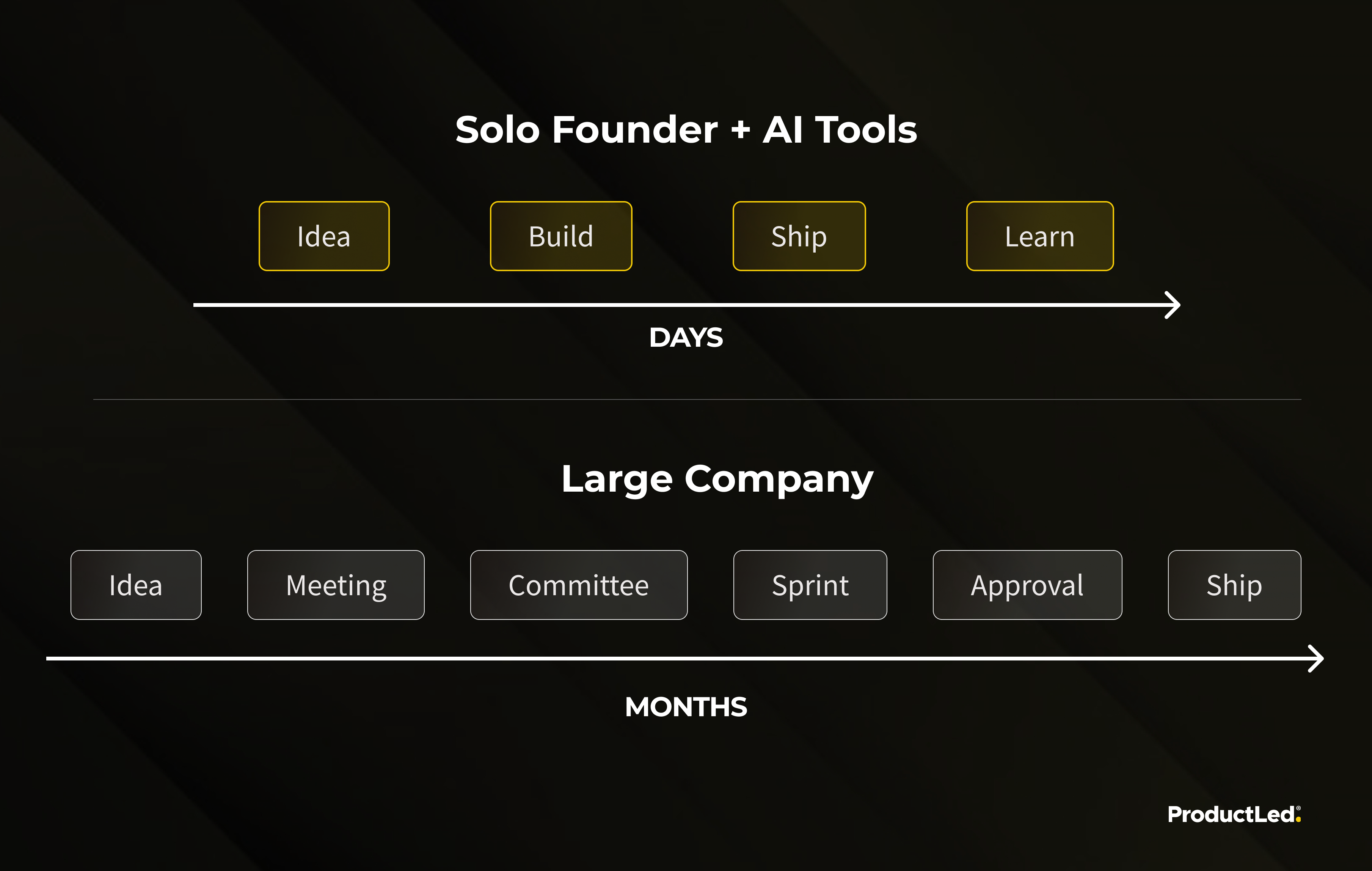
Calendly has hundreds of employees. MeetBot has one person: Vincent.
Guess who can pivot faster?
"You're stuck on all fronts if you're the incumbent," Vincent points out. "Existing customers to protect. Existing revenue to protect. Existing teams who protect themselves. Whereas if you're a 1-3 person company, you just decide it and you go."
The speed advantage is 10x. Maybe 100x.
While large companies are scheduling sprint planning meetings to discuss whether to add a feature, solo founders ship it before lunch. No stakeholder buy-in required. No roadmap prioritization debates. No committee approvals.
Vincent operates in distinct phases:
Building Phase: "I have phases where I say, okay, the next version has all these things, and I'm just going to spend my time now and build this the right way."
Growth Phase: "From January/February onwards, I have to switch to growth mode. One day a week to add new things. The other four days working on messaging, website, how people find this."
You can't do both simultaneously. Pick your phase and commit fully.
The new competitive moats have nothing to do with technology:
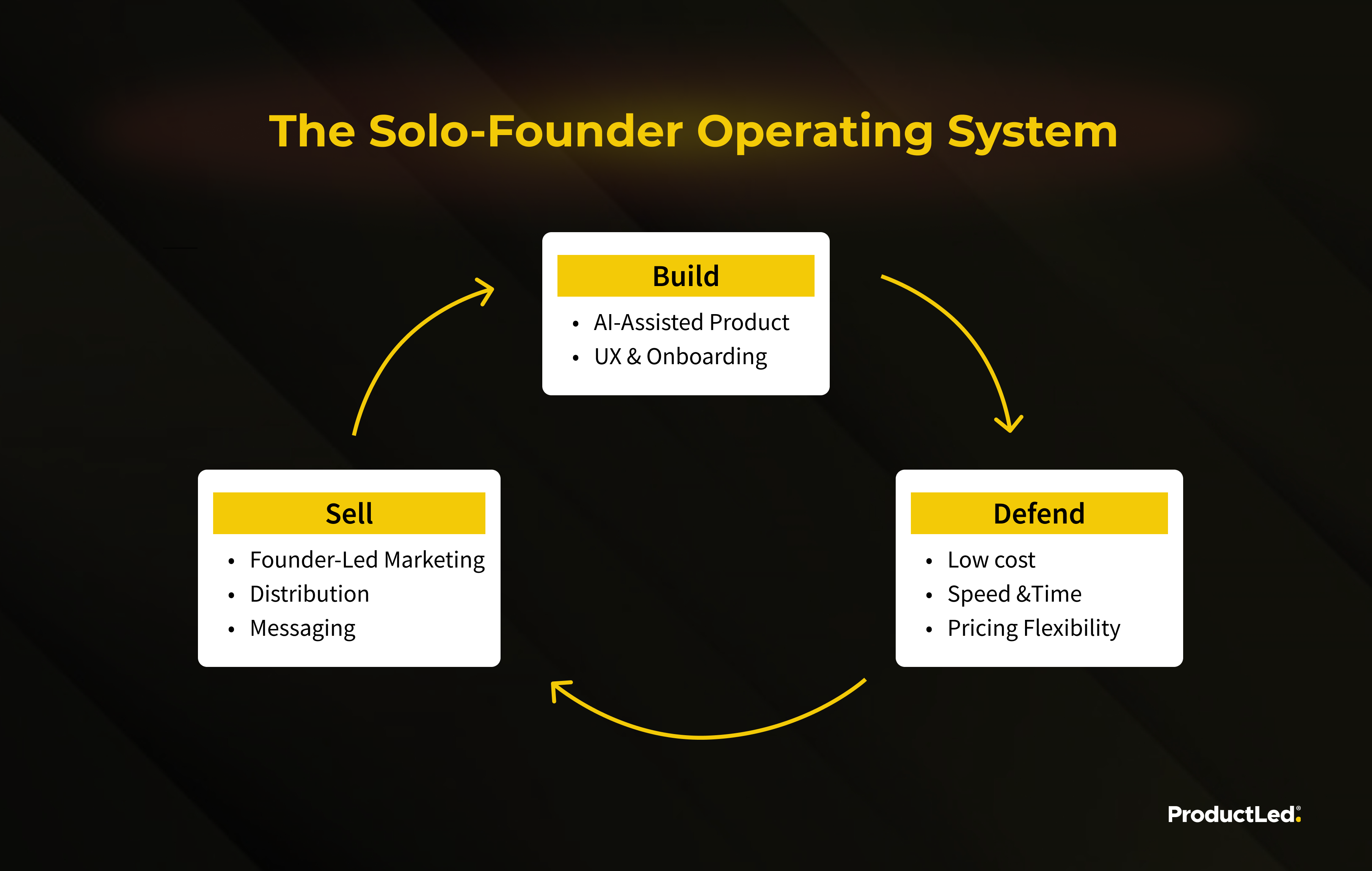
Cost Structure: You can give away features for free that they need to monetize
Speed: You ship features in days; they need sprints and stakeholder approval
Pricing Flexibility: You can experiment radically without cannibalizing existing revenue
Focus: You own one category completely; they're trying to serve everyone
Economics: Your entire operation runs on what they spend on coffee
But there's an uncomfortable truth hiding here: Your advantage is temporary.
You have 12-18 months to build real defensibility before big companies catch up on the technology side. Their AI pilots are failing now. Their teams are confused now. But eventually, they'll figure it out.
What does defensibility look like?
- Brand recognition in your specific category
- Distribution channels they can't access
- An economic model they can't match
- Community-generated content that compounds
- Network effects baked into the product
As Vincent explains: "These small companies are becoming more and more relevant slowly. They're not that relevant yet because they're still growing, capturing market share and mindshare. But there is a moment where their brands become well-known enough that suddenly these companies will need to adapt in ways that they can't anymore."
The window is open. But it won't stay open forever.
The "Launch Early" Myth vs. the New Bar for MVP Quality
Reid Hoffman famously said: "If you're not embarrassed by your first version, you've launched too late."
Vincent thinks that advice is outdated.
"It was true before because it took so much time to build. Now, where you can build so easily and where a lot of categories already exist, and people are expecting a certain level of usability... it's more and more important that you actually build something really good."
The context has fundamentally changed. When building required months of expensive engineering time, launching with an embarrassing MVP made economic sense. You needed to validate demand before investing more resources.
Now? You can build a polished product in weeks.
Vincent spends most of his time on what AI can't do: "I actually spend most of my time on the other 20%. The AI gets you 80% there real quick. But that other 20%. The attention to detail, the onboarding flow, the pricing strategy. That's where you spend your time."
The new skill isn't coding. It's taste.
"In a world where every tool has AI, taste becomes the differentiator," Vincent emphasizes. The AI handles the commoditized 80%. The remaining 20% (where you obsess over details, perfect the user experience, craft the positioning) is where you win.
Don't ship embarrassing MVPs anymore. Ship opinionated products with a clear point of view and a level of polish that respects your users' expectations.
The bar has been raised. And because building is so cheap and fast now, there's no excuse not to clear it.
Vincent's Advice (Don't Quit Your Job. Build on Weekends)
Vincent's advice cuts through the "burn the boats" mythology that dominates startup culture.
Start. But don't quit your job.
"With the speed at which you can build things now, you really want to do this on weekends. Christmas morning when everyone's asleep... that's when I was writing my book. You can also write an app during that time."
The economics support this approach completely. When your monthly burn rate is a few hundred dollars and you can build an MVP in weeks, there's zero reason to quit your stable income prematurely.
Build on weekends. Validate with real users. Prove you can acquire customers and generate revenue. Then decide if you want to go full-time.
Vincent is emphatic about the biggest mistake he sees: "The biggest problem right now is that people have tried it once and then they don't for a year. The cost of that is actually the biggest cost, both from a company perspective and your personal development."
The tools are evolving exponentially. Your six-month-old assumptions are already outdated.
Images used to have distorted letters. Not anymore.
Lovable used to error constantly. Not anymore.
Code generation used to require extensive debugging. Not anymore.
If you tried AI tools once and gave up, try again. The difference will shock you.
If you're stuck, you probably don't want it enough. The barriers are gone. The tools are available. The path is clear.
The question isn't whether one-person companies can compete with venture-backed giants.
The question is: Are you going to be one of them?
Want to Build Your One-Person SaaS Company?
Vincent Jong is building his portfolio at Poolside Ventures. Follow his journey on LinkedIn for transparent updates on revenue, learnings, and strategy.
Resources:
- 📅 MeetBot: The API-first scheduling solution
- 💼 Connect with Vincent Jong on LinkedIn
- 💼 Connect with Wes Bush on LinkedIn
- 💼 Connect with Esben Friis-Jensen on LinkedIn
For go-to-market strategy and product-led growth tactics:
👉 Jump into a Free Growth Session and get hands-on guidance
👉 Check out the ProductLed PLG System for a clear, step-by-step plan to grow faster
👉 Become a Top PLG Operator with the ProductLed MBA™ as a practical blueprint for mastering product-led growth
👉 Get the ProductLed Playbook (Free) to master the fundamentals of PLG. If you want the full system for building a product that grows itself, read Product-Led Growth: How to Build a Product That Sells Itself.
👉 Sign up for our Newsletter for weekly tips and ideas to scale smarter