Below, I break down why LaunchDarkly’s product-led growth motion works in some areas, where it breaks down, and what I’d fix to help more users get to value faster 👇
LaunchDarkly is a strong product. It’s trusted by enterprise teams, built for developers, and clearly designed for scale.
But PLG isn’t about how powerful your product is.
It’s about how quickly a new user feels that power.
And that’s where things start to break down.
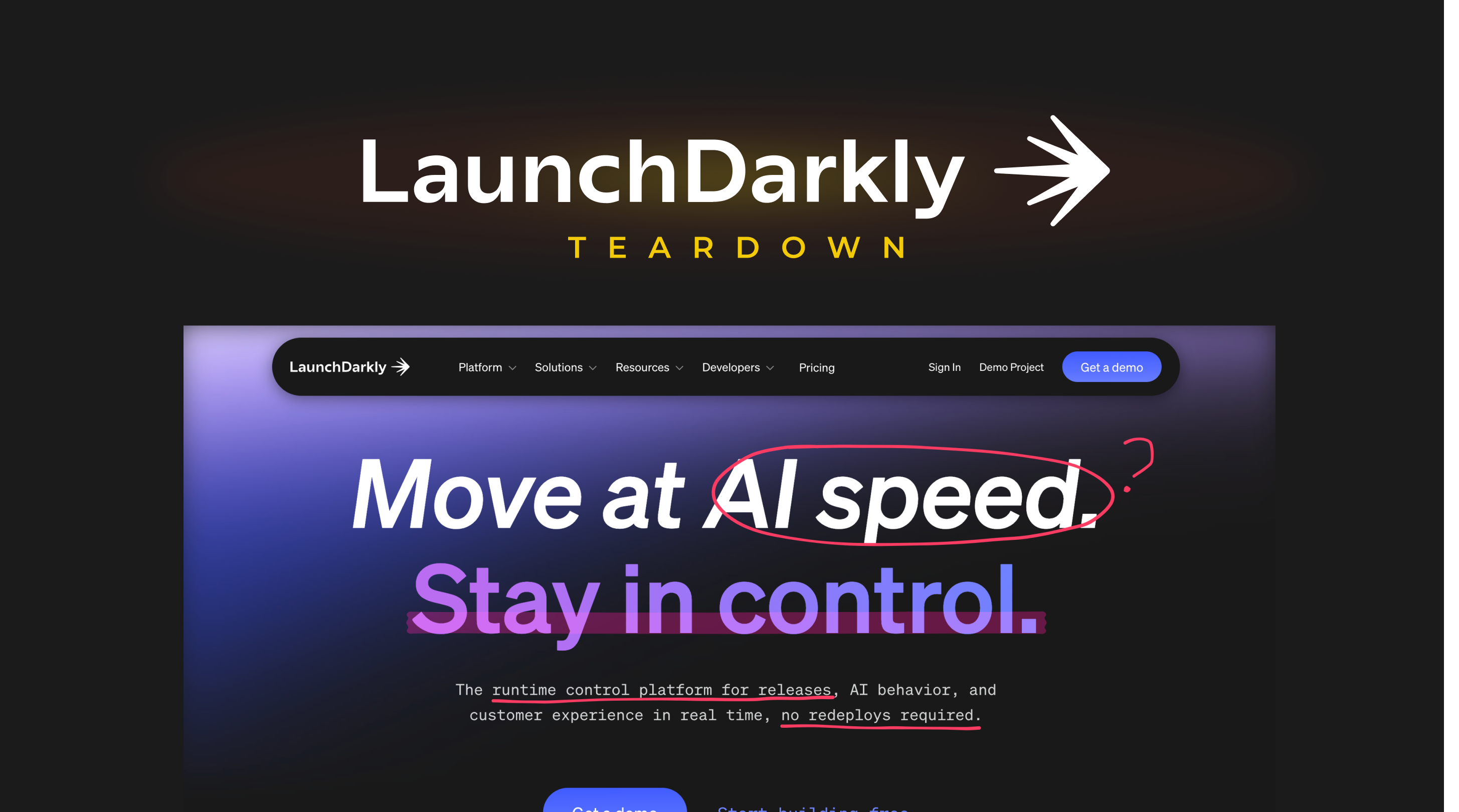
The homepage doesn’t pass the 5-second test
When I land on the homepage, I still don’t know what LaunchDarkly does.
I see phrases like:
- “Move fast at AI speed”
- “Stay in control”
- “Runtime control plane”
These sound impressive. But they don’t explain the product.
In PLG, clarity is everything. If a user has to think, you’re already losing them.
There’s also a demo video to explain things. That’s fine, but it shouldn’t be required.
Your homepage should do the heavy lifting.
If I can’t answer “what does this do?” in a few seconds, I’m not going to sign up.
The structure is solid, but the value isn’t obvious
There are good elements here.
The safety, observe, and iterate framework works. It gives users a mental model. The enterprise logos build trust.
So the foundation is strong.
But the value isn’t obvious.
And in PLG, that’s the gap that matters.
Because users don’t convert based on potential. They convert when the value is clear and immediate.
Pricing shows a strong hybrid motion
This is where LaunchDarkly does well.
You’ve got:
- A free developer plan
- Clear upgrade tiers
- Enterprise expansion built in
This is a classic hybrid PLG model.
Developers can get started on their own. Enterprise teams can still go through sales.
That balance is hard to get right, and they’ve done a good job here.
But then you see “Request a Demo” everywhere.
That tells me something.
Either:
- The product is hard to understand on its own
- Or sales is still needed to unlock value
In this case, it feels like both.
The reverse trial is a big win
This is one of the best parts of the experience.
You get 14 days of full access, then move to a free plan.
That’s exactly how you want to do it.
Let users experience the full product first. Let them see what’s possible. Then scale them down if needed.
PLG works when the product proves itself.
This is a great example of that.
Onboarding captures intent… then ignores it
During signup, LaunchDarkly asks what you want to do.
That’s perfect.
But then nothing changes.
If I say I want to run experiments, I should be guided directly into that workflow.
Instead, I land in a generic setup.
This is one of the biggest missed opportunities.
Because this is where you create momentum.
Good onboarding doesn’t just ask questions. It uses them to shape the experience.
The product is strong, but assumes too much
Once you’re inside, the product starts to make sense.
You connect your app. Install an SDK. Start working.
It’s clean. It’s logical. It’s clearly built for developers.
That’s a strength.
But it also assumes you already understand feature flags.
If you don’t, there’s no clear “first win.”
And in PLG, the first win is everything.
Users shouldn’t have to figure out what success looks like. You need to show them.
Small friction points slow everything down
There are a few smaller issues that add up.
Email verification is one.
If you force that too early, you lose users before they even get into the product. We’ve seen removing that step increase conversion significantly.
Another is the lack of a guided path after setup.
Once I connect my SDK, what should I do next?
That answer isn’t obvious.
And when the next step isn’t clear, users stall.
What LaunchDarkly gets right
There’s a lot working here:
- Strong developer experience
- Smart pricing model
- Excellent reverse trial
- Clear enterprise positioning
This is not a weak product.
It’s a product with a strong foundation that just needs a tighter path to value.
What I would fix
I’d focus on three things.
First, simplify the homepage. Make the value obvious in seconds.
Second, remove the dependency on demos. Let users understand and experience the product without needing a walkthrough.
Third, personalize onboarding. If a user tells you what they want, take them there immediately.
These aren’t massive changes.
But they have a massive impact.
Final takeaway
LaunchDarkly is powerful.
But power doesn’t convert.
Clarity and speed to value do.
Right now, users have to work to understand the product.
If LaunchDarkly removes that friction and guides users to their first win faster, they unlock a completely different level of growth.
That’s the opportunity.
Want to apply this teardown to your own onboarding?
LaunchDarkly is a great reminder that even a powerful product can lose momentum if users do not quickly understand the value.
In PLG, it is not enough to have a strong product. Users need to understand what it does, why it matters, and how to get to their first win fast.
If your homepage is unclear, your onboarding feels generic, or users are not activating quickly enough, do not guess.
Here are a few ways to tighten the path to value and build a smoother product-led growth engine:
- Get hands-on help: Book a Free Growth Session and we’ll diagnose where users are dropping off, what is slowing down activation, and what to fix first.
- Level up as a PLG operator: Become a Top PLG Operator with the ProductLed MBA™, built as a practical blueprint for mastering product-led growth.
- Start with the fundamentals: Grab the ProductLed Playbook (Free) to lock in the core PLG principles before optimizing the details.
- Keep improving weekly: Sign up for the Newsletter for practical tips, teardown-style insights, and ideas you can apply right away.