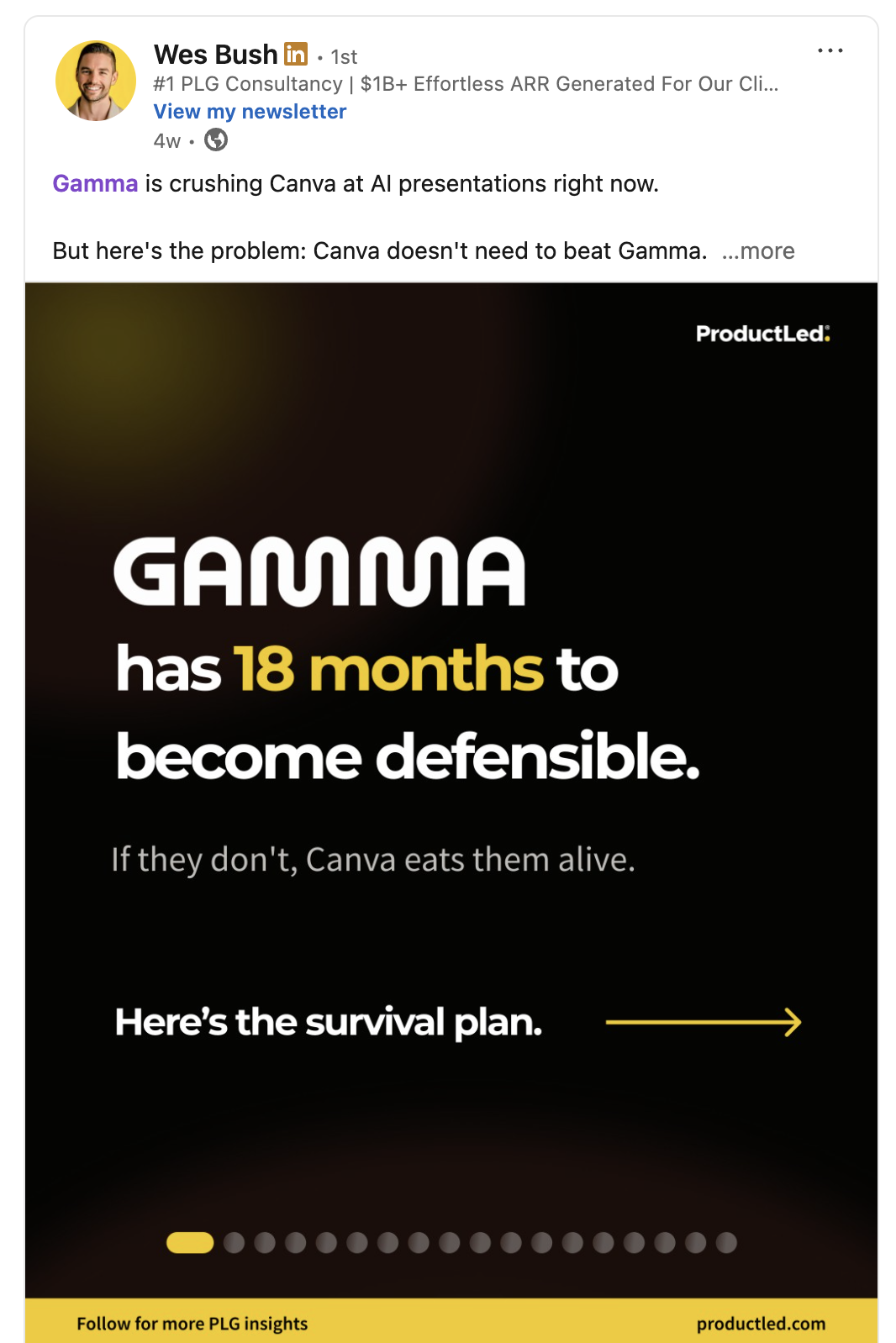
Gamma is crushing Canva at AI presentations right now.
But here's the problem: Canva doesn't need to beat Gamma.
They just need to get "good enough."
Why? Distribution.
Below, I cover the 5 strategic moves I'd make to beat Canva at presentations. Click the image below to view the presentation, or scroll below to read my analysis 👇
Canva’s distribution moat:
- 170M monthly active users
- ChatGPT integration (100M+ users default to Canva)
- 85% of Fortune 500 already paying them
- Google Workspace and Microsoft Teams partnerships
Gamma's distribution: Direct signups, word-of-mouth, organic search.
When Canva's AI presentations cross the "good enough" threshold:
- Users think: "Why switch? I'm already here"
- Teams think: "Why add another tool?"
- Enterprise thinks: "Why pay for both?"
This is the classic PLG trap where product superiority masks a distribution gap.
I've seen this movie before. Superior product loses to inferior product with better distribution. Every. Single. Time.
Unless you build defensibility that makes distribution irrelevant.
If I were Grant Lee, here are the 5 moves I'd make:
Get the majority of users to presentation-ready value in 60 seconds or less
Gamma is already faster than Canva at creating presentations. But speed isn't enough.
The gap I see: Users, including myself, still delete Gamma's output (i.e. stock images and generic branding) and hire designers to redo sections or manually fix things.
That means the output can still look like AI slop instead of professionally designed.
What 10x looks like:
- Auto-brand from company email domain (pull logo, colors, fonts automatically)
- Eliminate stock photography entirely (use minimalist design, or AI-generated abstract art)
- Output quality where someone asks "What designer did you use?" not "What AI tool is this?"
In a world where every tool has AI, taste becomes the moat.
The companies that win make AI outputs indistinguishable from human craft.
That's the standard.
Built-in Virality (every presentation = 10 new users)
Right now, the entire focus in the app is to present.
And the share icon looks "locked" (confusing)

The fix: Swap share with present as the primary CTA—this is the key behavior you want to drive.
Why it matters: Presentations are collaborative. Most people share with 3-5 teammates before presenting.
This is your key usage indicator: presentations are collaborative. Most people typically share it with someone else in their team before presenting it to them.
So make it as frictionless as possible.
The math: 10,000 presentations/day × 5 viewers each = 50,000 impressions × 2% conversion = 1,000 new signups/day at zero CAC.
Template Marketplace
This isn't just about better templates. It's about SEO distribution and creator-led growth.
What Canva did:
- 800K templates = 800K landing pages
- Each template ranks for specific searches
- Result: 73M monthly organic visitors
What Gamma needs:
- Let users publish templates and earn royalties (20-30% of upgrades they drive)
- Curate quality with 100 professional seed templates
- Build the search experience: "all hands deck" returns 5 top-rated, heavily-used templates
Why this works:
- Every template = SEO distribution channel
- Creators promote their templates = social distribution
- Users save templates = switching cost (lock-in)
- Community builds product faster than any 50-person team could
The genius: Your AI stops generating from scratch. It starts with proven, community-validated templates and customizes them.
Better output. Faster creation. Zero marginal cost to you.
Focus on owning one category
Trying to be the best AI design solution is going to be insanely hard to pull off.
The contrarian move: Dominate presentations before diversifying.
The risk if you spread yourself too thin? You’ll get weak adoption and have ok products with everything else while your core product doesn’t improve much while your competitors easily catch up.
Look at Zoom - they tried to be a video platform and do a million different things.
Yet, most people just want them for solid video meetings.
Disrupt the economics in your category
Canva disrupted Photoshop by making their product 10x cheaper. The product wasn't as good, but it was cheap, easier to use, and more fun.
Tons of people switched. Now Canva dominates and Photoshop is a differentiated (read: expensive) product.
To disrupt Canva, you need to do something they won't copy at their scale.
One of the hardest things for them to consider: changing their pricing.
Right now, Gamma and Canva have similar per-seat pricing. But given that it's an AI product, you could offer:
Free for entire team, charge only for credits.
This would 10x internal virality. Although you'd potentially make less per team short-term, as the entire company adopts Gamma, you'd increase adoption and stickiness exponentially.
The bet: Land-and-expand through usage economics beats seat-based monetization at enterprise scale.
With all of that said, there’s still a big question mark.
How on earth are you going to win on distribution?
It’s not any one thing but combined these all contribute to making Gamma much harder to copy by
- Focusing on what you do best
- Making the product the absolute best in its category where others can’t touch you
- Using your users to spread the word for you
Gamma's REAL Unfair Advantage
It's not better AI. Canva will catch up.
It's not better design. That's subjective.
It's this:
Gamma is AI-native. Canva bolted AI onto an existing design tool.