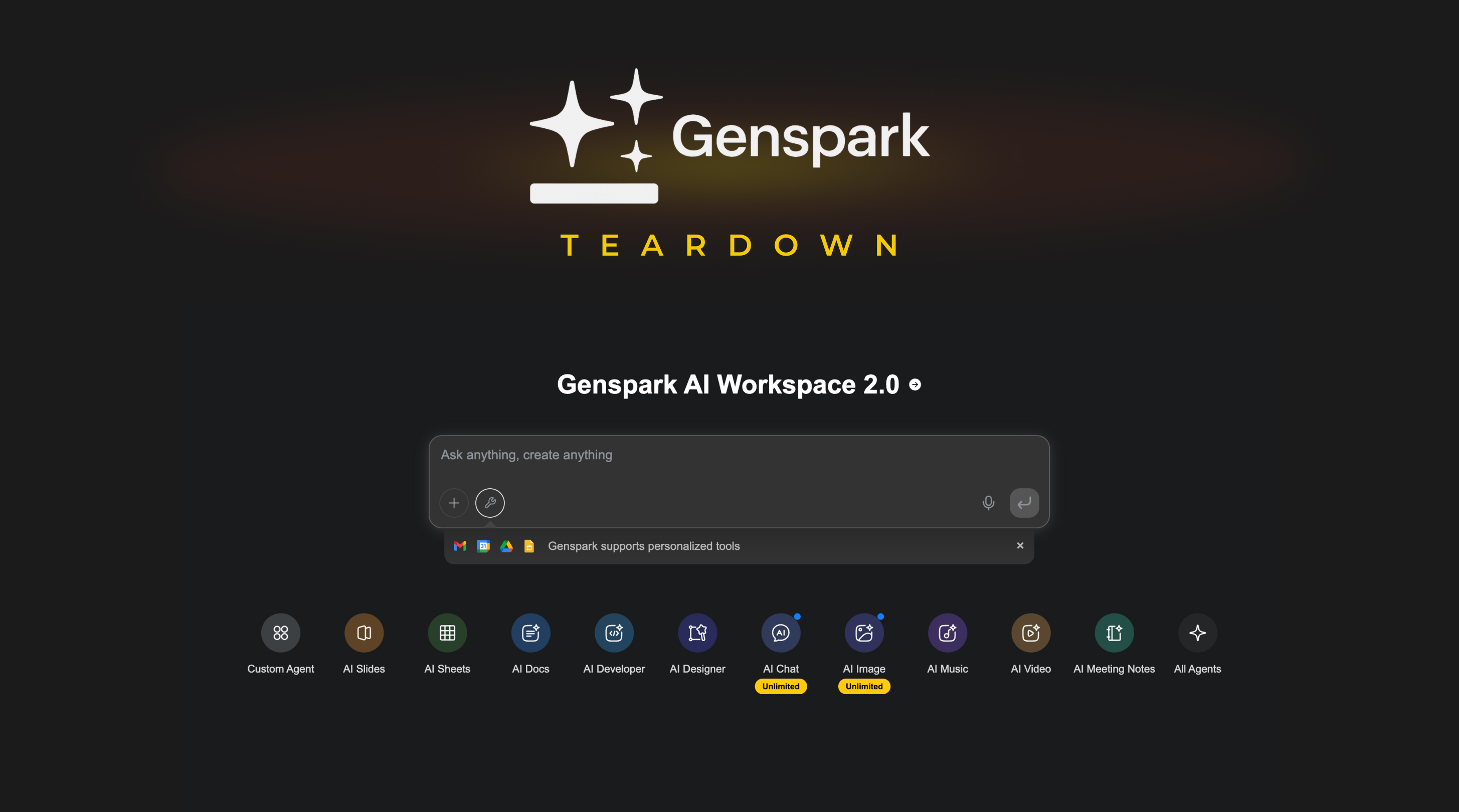
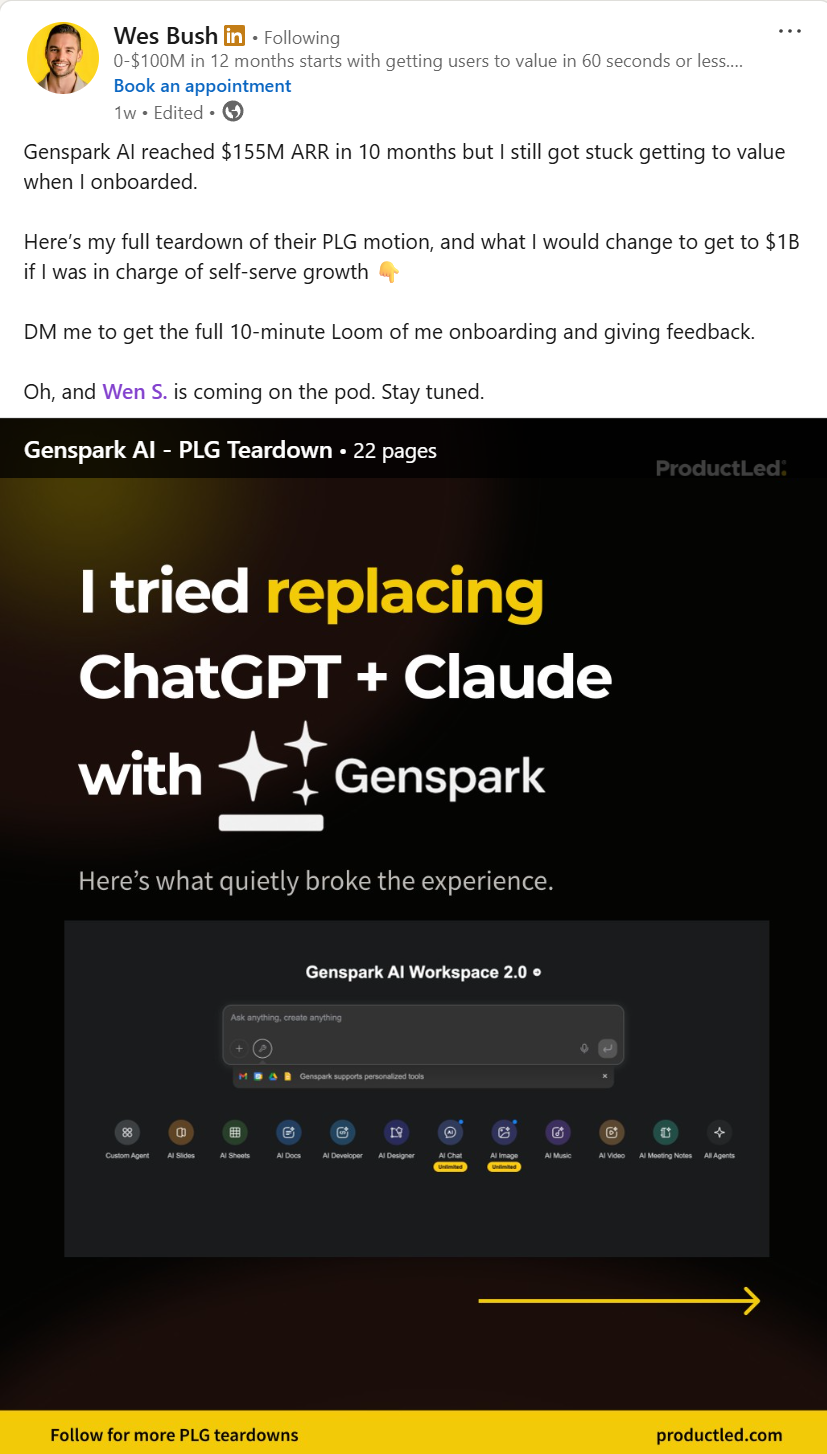
Below, I share what happened when I tried to replace ChatGPT and Claude with Genspark for my daily work 👇
Genspark is having a moment.
It reportedly hit $100M ARR in nine months. That kind of growth forces you to pay attention.
So I ran a simple test.
I tried replacing ChatGPT and Claude with Genspark for my daily work. Writing. Research. Email. Turning long content into structured assets.
Nothing blew up.
But a few small things quietly broke the experience.
And in a product-led world, small breaks are the whole game.
The first 30 seconds felt unclear
The biggest issue was not the product. It was clarity.
When I landed inside Genspark, I immediately asked myself:
Is this a tool?
A workspace?
A multi agent platform?
A company?
That hesitation matters. In product-led growth, the first mental model wins. If I have to figure out what something is before I use it, friction creeps in before value has a chance to land.
If you want a deeper framework for getting users to value fast, this pairs well with ProductLed’s guide on product-led user onboarding.
Monetization showed up before meaning
Before I fully understood what made Genspark different, I saw upgrade prompts.
That is not wrong, but it felt early.
When an upgrade prompt shows up before you’ve experienced a clear win, it creates friction.
Instead of thinking, “Okay, this is awesome,” users start thinking, “Wait, what am I paying for?”
Pricing is not the problem. Timing is.
If you want to tighten this “value first, monetize second” sequencing, the pricing side of this conversation is covered well in SaaS monetization strategies and this breakdown of a product-led pricing page.
The hidden ideal user
The messaging feels broad, but the product assumes you already understand AI models, credits, and compute tradeoffs.
That is a narrower audience than it appears.
If onboarding assumes model literacy, you are optimizing for power users and silently dropping.
A more useful lens here is designing onboarding around the user’s first “oh, this is for me” moment. ProductLed calls that out directly in how to use aha moments to drive onboarding success.
The credit tax
Credits make sense on paper. Experientially, they feel like a tax on curiosity.
When I experiment, I do not want to think:
Is this worth the credits?
Should I save this?
What if I run out right before something good happens?
And that is exactly what happened. I asked Genspark to turn a long article into a presentation, and then ran out of credits right at the payoff.
Free plans should create a wow moment, not interrupt it.
If you want a practical framework for getting users to value fast, ProductLed’s AI onboarding guide and their broader user onboarding guide are both strong references.
The real power is buried
Genspark’s real advantage shows up once you find it: multi model orchestration plus agents in a single workspace.
It can turn a long article into structured output, multiple assets, and agent-driven workflows. That is legitimately hard to do elsewhere.
But the product does not lead with that story.
Instead of immediately showing a transformation, it presents capability. And capability without context can feel complex.
If you’re thinking about how to create “the moment it clicks,” this ties nicely into ProductLed’s user activation framework and the difference between activation and an aha moment.
Working is not the same as transforming
I connected my email. It worked.
But I never saw a dramatic before and after transformation, so the value felt optional.
If AI email only gives slightly better replies, most users will not trade security concerns, cognitive load, and another integration.
This is the difference between “nice” and “necessary.”
For more on making users stick after signup, ProductLed’s user adoption strategies is a good companion piece.
Small naming friction adds up
“Hub” vs “Project” seems tiny. It is not.
Language shapes how people understand a product. When terminology feels unfamiliar, users slow down to interpret instead of act.
Interestingly, the “life hubs” concept is genuinely strong once it clicks. Planning, learning, writing, all in a clean structure. The problem is you have to work to get there. The clarity comes after effort, not before it.
If you’re auditing onboarding language and flow, it’s worth skimming ProductLed’s SaaS onboarding best practices and their roundup of user onboarding examples
The question that would not go away
I kept asking one thing: why is this better than ChatGPT or Claude?
The product knows the answer. I didn’t.
And the competitor is not “no tool.” The competitor is habits, muscle memory, and sunk subscriptions.
If the advantage is not obvious, people fall back to what they already use.
If you want the broader strategic framing, ProductLed’s guide on what product-led growth is is the best grounding doc for this “switching cost meets habit” dynamic.
Features without concrete scenarios do not land.
AI Drive sounds powerful. But I did not know when to use it, why it is better than Google Drive, or what good usage looks like.
“Download files with one prompt” is interesting.
Showing a real scenario where that saves 30 minutes is compelling.
This is a classic onboarding issue: features do not sell themselves, outcomes do.
If you are refining how you teach value without overwhelming users, common product-led onboarding myths busted is a strong reminder of what not to do.
What actually needs to change
This is not about adding more features. It is not about redesigning the pricing page.
It is about clearer storytelling inside the product.
Internal power needs external clarity.
Here are the specific fixes I would start with:
- Show why this beats ChatGPT up front
- Guide first actions aggressively toward a transformative workflow
- Protect users from wasting credits before they experience a win
- Remove or dramatically elevate neutral features
If you want to go deeper on designing onboarding that prioritizes the right users and the right outcomes, ProductLed’s classic on product-led onboarding is still worth a read.
The path from $100M to $1B
Genspark is already a strong product. The growth proves that.
But the jump from $100M to $1B is not about stacking more capabilities.
It is about translation.
Taking internal sophistication and making the value obvious in the first minute.
Because in AI, habit wins.
And the product that makes its advantage unmistakable will own the habit.
Final thoughts
If this teardown hit close to home, it’s probably because the problem is common.
Most products do not lose because they lack features.
They lose because the value is unclear in the first minute. The story is buried. The “why switch” never lands. And users quietly go back to what they already know.
If you want to fix that in your own product, here are a few ways we can help.
👉 Jump into a Free Growth Session and get hands-on guidance
👉 Become a Top PLG Operator with the ProductLed MBA™ as a practical blueprint for mastering product-led growth
👉 Get the ProductLed Playbook (Free) to master the fundamentals of PLG
👉 Sign up for our Newsletter for weekly tips and ideas to scale smarter