Below, I’m breaking down the 5 moves I’d make if I were trying to get RB2B to $10M ARR with a three-person team in 2026 👇

RB2B is already doing what most SaaS companies only say they want to do.
A tiny team. A simple product. Serious ARR.
They nailed the fundamentals: memorable brand, easy setup, clear value prop, and a strong content distribution engine.
So this teardown is not about what’s broken.
It’s about what’s next.
Because there’s a very plausible version of 2026 where RB2B gets to $10M ARR with three people by fixing one thing:
They stop selling visitor identification and start delivering “hot lead, ready to contact.”
The market moved and visitor ID is now the floor
Visitor identification used to feel like magic.
Now it’s table stakes
Buyers have moved from asking:
“Who visited?”
to asking:
“Who’s a hot lead?”
That shift matters because it changes what “value” means.
The value ladder looks like this:
Visitor ID → ICP match → meeting booked
RB2B is strong at the first rung.
The $10M path is owning the second and third rung.
The real problem: nobody wants “150 visitors identified”
Here’s the blunt truth:
Nobody wants “150 visitors identified”.
They want:
- 5 ICP people worth contacting
- with a non-creepy next step
That is the job.
Not a list.
A short, confident, “do this next” plan.
The clean outcome path is:
ICP → 5 leads → message → meeting
If the product does not help with those middle steps, the user has to.
And that is where conversions stall.
Why activation leaks: it still feels like buying a new job
Even after setup, users still have to:
- filter leads
- craft outreach
- track it all in a CRM
It still feels like buying a new job.
This is the hidden tax inside the self-serve motion.
The product gives you data, then asks you to become the analyst, the SDR, and the ops person.
If you want to see this through a tighter activation lens, the WAVE user activation framework is a useful reference.
Move 1: Fix pricing language for trust
One of the easiest growth wins is also one of the most overlooked.
RB2B’s pricing unit is confusing.
“Resolutions” is confusing, and when users do not understand the unit, they delay upgrading.
This shows up as “people aren’t converting,” but it’s often “people don’t trust what they can’t understand.”
The simplest fix is to sell outcomes, not units.
Rename pricing around what users actually want, like:
ICP matches.
If you want to go deeper on this, these two posts map directly:
Move 2: Remove the “is this working?” moment
There is a moment in the product experience that quietly kills retention.
It’s when the user thinks:
“I expected way more.”
The carousel calls it out clearly: when users see lower-than-expected tracking numbers, confidence drops, and confidence down means retention down.
This is not only a tracking issue. It is a framing issue.
Fixes that help immediately:
- show a coverage percentage, not only total identified visitors
- explain what impacts identification rates
- highlight ICP matches so the user sees quality, not quantity
Make the user feel certainty fast.
Move 3: Make the free plan upgrade itself
The best free plans do not sit there and wait.
They pull the user back in with a reason.
RB2B’s opportunity here is a weekly email that is actually useful.
The template is simple:
- top 3 to 5 visitors or companies
- why they matter
- recommended action
Not a dashboard screenshot.
Not a list dump.
A short “here’s what matters this week” email that makes you feel like you’re missing money by not acting.
Move 4: Shift to agentic activation
This is the biggest lever in the teardown.
Shift to agentic activation. Remove the legwork. Remove the noise.
In plain terms, onboarding should behave like a smart teammate.
It should collect:
- persona
- intent
- ICP definition
Then output:
exact leads plus what to say.
This turns RB2B from “visitor identification software” into “your pipeline assistant.”
If you want examples of practical AI workflows that actually help PLG motions, this one is worth reading: 7 real AI workflows for PLG practitioners.
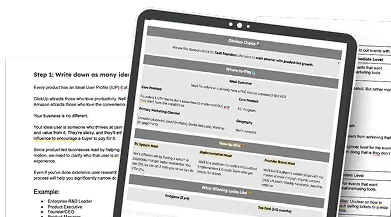
The WARP check: activation is the constraint
The WARP score summary is telling:
- pervasive pain is strong
- repeatable leverage is strong
- activate instantly is the weak link
This is good news.
Because it means RB2B does not need a new team to scale.
It needs a better path to the first win.
If you want the broader PLG strategy framing behind this, revisit the product-led growth strategy playbook.
The fastest path to $10M in 2026
Here’s the “do this in order” plan:
- Pricing language overhaul for trust
- Weekly email that drives FOMO and action
- ICP prompt that outputs curated hot leads
- ICP scoring agent
- Outreach recommendation agent that suggests what to say
This is how RB2B gets to $10M with three people.
Not by doing more work.
By making the product do more of the work.
Final thoughts
RB2B already has what most PLG companies chase for years: leverage.
The next step is removing the last mile between data and outcome.
When the product can reliably answer, “Who should I contact first, and what should I say?” the upgrade becomes the obvious next click.
That is where the next $3M ARR lives.
Ready to get your own product to $10M with a lean team?
If reading this RB2B teardown made you think, “We’ve got a similar last-mile problem,” here are a few ways to get help tightening your positioning, activation, and self-serve motion:
- Book a free Growth Session and get hands-on guidance for your biggest PLG bottleneck
- Become a top-tier PLG operator with the ProductLed MBA™, a practical blueprint for mastering product-led growth
- Grab the ProductLed Playbook (Free) to lock in the fundamentals and build a stronger PLG foundation
- Join the ProductLed Newsletter for weekly tips and ideas to scale smarter