
TL;DR
Key Takeaways
- Product-Led Growth exists on a spectrum from sales-led to fully self-serve.
- Most successful SaaS companies operate a hybrid Product-Led Sales model.
- Sales adds value when complexity is high, and buyers need guidance.
- Sales creates friction when it blocks users from experiencing value.
- The best growth motion is the one that matches how your customers prefer to buy.
–
At its core, PLG is simple. You let people buy the way they want to buy.
Some users want to explore, click around, and figure things out on their own. For them, the product does the selling. It guides them to value fast and makes the next step obvious. When they get value, conversion follows naturally.
Other users want a little help. They might have questions or want to confirm the product works for their specific use case. In these cases, the product should surface the right help at the right time, whether through documentation, in-product guidance, or a brief conversation with a real person. The key is that help shows up when it’s useful, not when it’s forced.
Then there are buyers who need sales. This usually happens when the product is complex or when security, compliance, or data requirements are involved. A product-led approach doesn’t fight this reality. Instead, it uses product usage to spot serious buyers, flag them as leads, and bring sales in when a real conversation adds value.
That’s the beauty of PLG. You’re not pushing every buyer through the same path. The product adapts to the buyer.
“The goal of Product-Led Growth isn't to eliminate Sales. It's to make buying easier.”
Once you see PLG this way, you realize that there is no single right way to be product-led. It lives on a spectrum. Where you land on that spectrum should be a clear strategic choice, not something you stumble into by accident.
The Product-Led Growth Spectrum
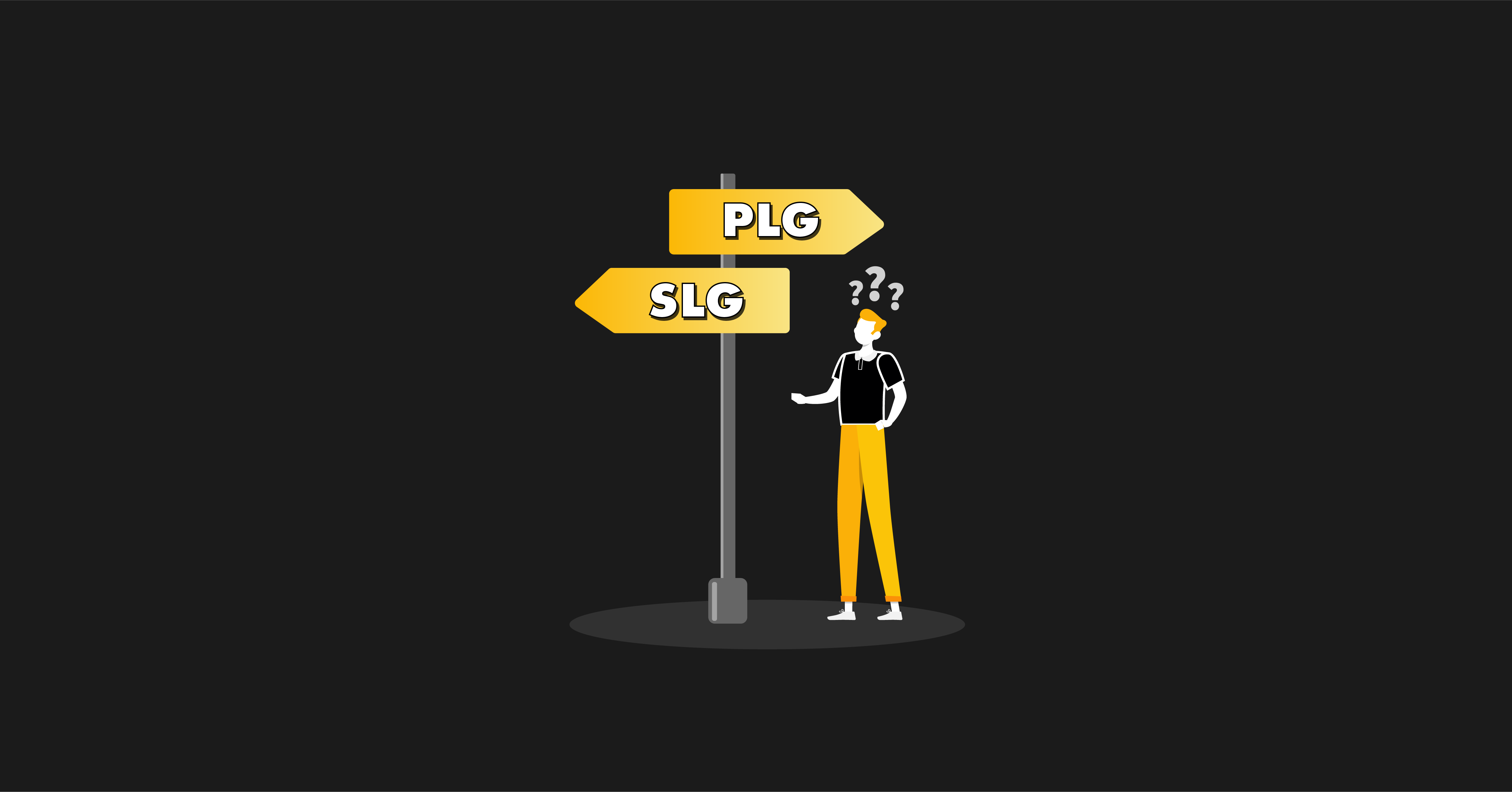
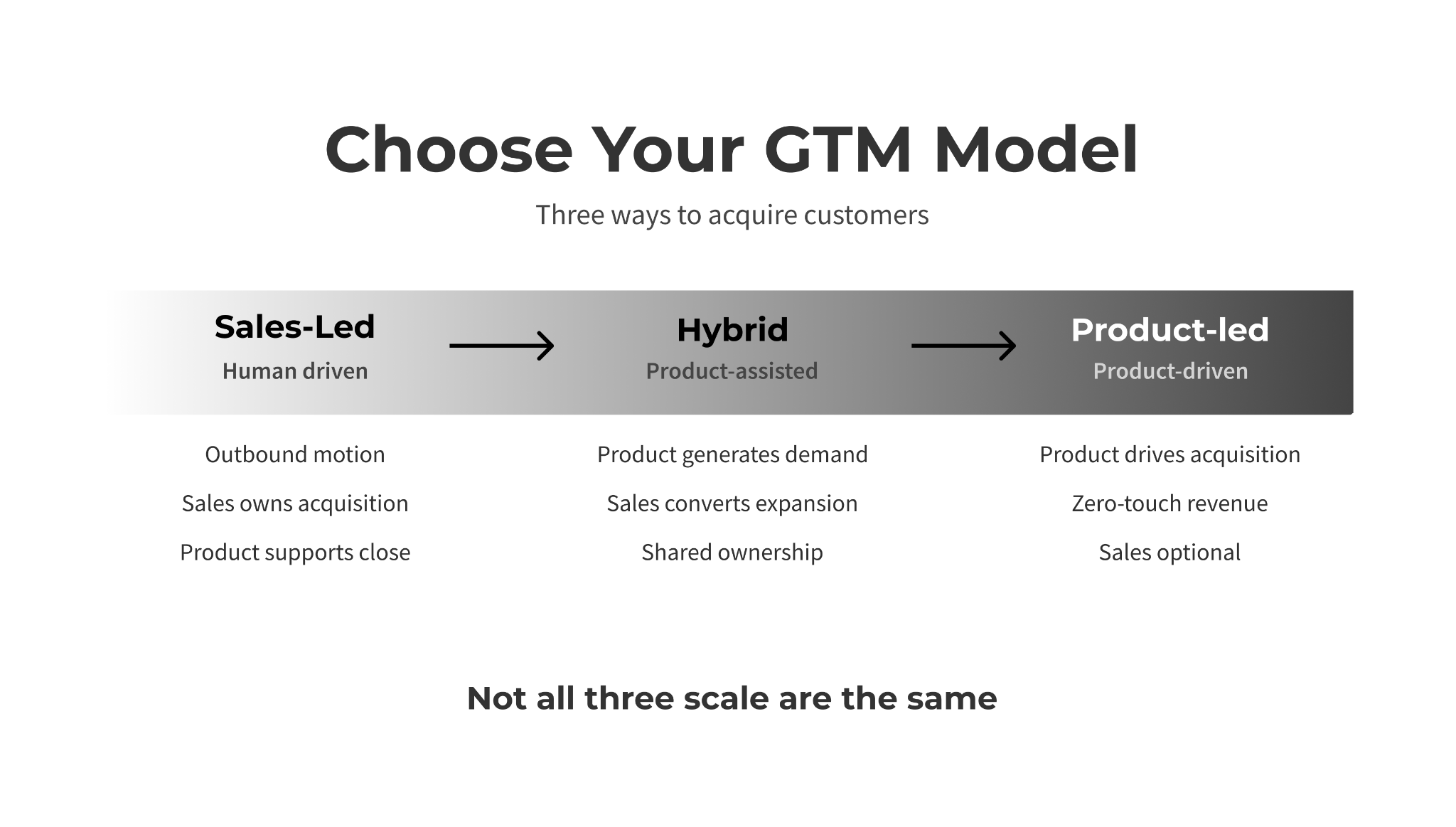
The PLG spectrum shows how much of the buying journey is handled by the product versus Sales, from fully sales-led to fully self-serve, with most companies operating in the middle by design.
What Is Sales-Led Growth?
Sales-led growth is best suited for complex enterprise solutions, typically with ACVs above $50,000. These products solve high-stakes problems that require deep discovery, customization, and alignment among multiple stakeholders before a decision can be made.
In this model, sales leads the entire motion. Relationships are built early, and value is communicated through conversations, demos, and proposals long before users touch the product in a meaningful way. The buying process is deliberate by design because the risk of getting it wrong is high.
Salesforce, Workday, and Palantir all follow this model. Potential buyers need to talk directly to sales to even test out the product.
What Is Hybrid Product-Led Sales?
Product-led sales sit in the middle of the spectrum and is the most common destination for companies as they scale. This hybrid model works best for products that serve multiple customer segments, often spanning $5,000 to $50,000 in ACV.
In a hybrid motion, the product leads early engagement, but Sales steps in based on user behavior, intent, and complexity. Small businesses may adopt and convert entirely through self-serve. Mid-market customers may engage through a sales-assisted motion when questions or complexity arise. Enterprise accounts move into a more traditional sales-led experience once the product has already demonstrated value.
Successful companies that follow this model are Zoom, Notion, and Miro. Users adopt through self-serve, then Sales engages for larger teams, security requirements, and/or enterprise contracts. To get to your first $1 million, you’ll want to choose between sales-led or product-led before layering on a hybrid motion.
What Is Pure Product-Led Growth?
Pure PLG sits at the opposite end of the spectrum and works best for simple products with low ACVs, typically under $5,000.
Users discover the product, experience value, upgrade, and expand usage without ever speaking to a salesperson. The buying decision is low risk, and the product is intuitive enough to deliver value quickly without guidance. Scale comes from volume, not deal size.
Canva is a classic example of a company that started off as pure PLG. Users can sign up, create designs, collaborate with others, and upgrade as their needs grow, all through a self-serve experience.
But very few companies stay purely product-led as they grow.
Even Canva has layered in sales for larger teams and enterprise use cases. The same pattern shows up with Figma, Loom, and Grammarly. They all start with a strong self-serve motion, then introduce sales as they move upmarket. Large companies still want the easiest tools to use.
When users can discover the product, experience value, and upgrade on their own, you’re able to grow faster. That is why companies with self-serve revenue consistently outperform their peers, with the biggest gains showing up early, even when self-serve revenue is still modest.12
But this is also where teams often draw the wrong conclusion.
The goal is not to force every customer into self-serve. The goal is to know when Sales helps and when it hurts. Get this wrong, and you add friction where speed should exist. Get it right, and Sales becomes a force multiplier instead of a bottleneck.
That leads to the most important question in a product-led GTM motion.
When Do Sales Reps Add Value vs. Friction?
Sales is powerful when the complexity is real.
I was chatting with a sales rep at VMware, and I told him I wasn't sure self-serve could work for the products he sold. He explained why. His job was to advise companies on which software solutions would actually help them hit their goals. Most of the time, he was combining multiple products into a custom configuration. If any piece of that combination went down, people at the client's company would lose their jobs. Millions of dollars were on the line.
He wasn't taking orders. He was constructing solutions. Customizing them for each client's environment. That's consultative selling at its finest, and it's insanely valuable. The client isn't just buying software. They're buying someone who knows how the pieces fit together and will stake their reputation on it.
That's the line. When a sales rep is constructing the solution, they earn their place in the journey. When they're processing a transaction the buyer could handle alone, they become overhead.
Sales becomes a problem when it shows up too early or blocks the path entirely.
I signed up for a free trial at a data enrichment company. Within the first 15 minutes, I'd been called and emailed three times. I hadn't even enriched a single contact yet. Instead of exploring the product, I started looking for alternatives. Their sales motion sabotaged my experience before it started.
Then there's the other version of this problem. I was looking for a client portal tool to help us scale our client engagements. I found one with great reviews. The only option was "Book a Demo."
I had an hour right then to test solutions. I didn't want to wait so I booked the demo anyway, but nine days passed before I had the call scheduled. By then, I'd already found and started using an alternative.
Most sales-led companies don't factor that gap into their time to value. The clock doesn't start when the demo happens. It starts the moment a buyer decides to evaluate your product. Every day between "Book a Demo" and the actual call is dead time where they're either finding competitors or losing interest in solving that problem. Nine days of dead time cost that company a customer.
The reality is that 97% of B2B buyers prefer to try before they buy rather than talk to sales first.13 Your sales process should align with this preference, rather than fight against it.
Do people want to buy the way you're selling?
What Successful Transformations Actually Look Like
Some of the strongest PLG transformations come from companies that already had established sales motions.
After working with more than 400 companies implementing PLG at ProductLed, one pattern has shown up consistently. Businesses that are successful at PLG redesign the relationship between Product and Sales so the product does the proving and sales does the accelerating.
Here are a few examples of ProductLed clients that have successfully made the transition.
Boomi
Boomi is a $4 billion-dollar platform serving complex enterprise customers.
Instead of forcing every buyer through a sales conversation, Boomi introduced a self-serve entry point that allows users to experience real value before engaging with sales. The product became the first touchpoint.
The result was not a smaller sales motion, but a sharper one. Boomi doubled its free-to-paid conversion rate and began sourcing roughly 10 percent (or $400 million) of new customers through self-serve channels. Sales stayed deeply involved in enterprise deals, but those conversations happened later and with more qualified, product-educated buyers.
PLG did not replace sales, but made it more effective.
Ascora
Ascora is a fast-growing field service management platform for home service businesses established in 2009. At first, Ascora relied entirely on a sales-led motion. Buyers had to talk to a rep and pay for a mandatory, human-led onboarding.
Instead of forcing every buyer through sales and paid onboarding, Ascora decided to lead with the product. They reduced onboarding friction, simplified the user experience, modernized the interface, added an AI chat assistant, and built interactive demos and guides for key features. Now users can either sign up for an interactive demo themselves or book a meeting with Sales to help them discover features faster.
As a result, about half of new sales now come from self-serve channels. While the Sales team still plays a role for buyers who want help, the product now carries much of the early discovery and conversion work. PLG did not replace sales, but it made Ascora’s growth more scalable, less dependent on headcount, and opened a larger path for buyers to get started on their own.
Enzuzo
Enzuzo is a privacy and compliance platform that helps ecommerce and SaaS companies handle GDPR, CCPA, and cookie consent without legal overhead.
This small team of three started with a freemium model through its Shopify app, letting users install and manage basic compliance for free. Adoption was strong, but conversions lagged. Too many users stayed free, and the path to paid value was unclear.
Instead of abandoning freemium, Enzuzo tightened it. They simplified onboarding so users could activate compliance quickly, clarified which features were free versus paid, and aligned upgrades with moments of real compliance risk and business growth.
Within six months, Enzuzo doubled its free-to-paid conversion rate and cut the sales cycle to roughly 15 minutes. Users now self-qualify through product usage, and Sales steps in only when buyers are ready to upgrade.
These examples show how powerful PLG can be at changing how you sell, regardless of company size. But it is not the right fit for every business.
Which warrants the question: how do you know if PLG is right for you in the first place? You can’t just Google the pros and cons or ask a fellow founder if sales-led or product-led will work best for you.
Why not? Because that advice comes from people managing completely different businesses—different target audiences, different pricing strategies, and different products, which may range from “simple and familiar” to “how on earth do I even use this thing?”
What works for them won’t necessarily work for you.
There is no universally correct place on the Product-Led Growth spectrum.
The goal isn't to become more self-serve. The goal is to make buying easier.
The best product-led companies know exactly where Sales creates value, where it creates friction, and how to build a buying journey that feels effortless to customers.
That's one of the core ideas behind the second edition of my bestselling book Product-Led Growth: How to Build a Product That Sells Itself.
Frequently Asked Questions
What is Product-Led Growth?
Product-Led Growth (PLG) is a go-to-market strategy where the product plays a central role in customer acquisition, conversion, and expansion. Instead of relying primarily on sales and marketing, PLG companies help users experience value directly through the product, making it easier for them to adopt, upgrade, and expand usage over time.
What is Product-Led Sales?
Product-Led Sales (PLS) is a hybrid go-to-market model that combines self-serve product adoption with sales assistance. Users typically discover and experience value through the product first, while sales teams engage later when buyers need help, have complex requirements, or are evaluating larger purchases.
What is the difference between Product-Led Growth and Sales-Led Growth?
The main difference is how customers experience value. In a Sales-Led Growth model, sales conversations, demos, and proposals typically happen before customers use the product. In a PLG model, customers experience value through the product first, with sales support introduced only when it helps accelerate the buying process.
Is Product-Led Growth right for enterprise software?
Yes, PLG can work for enterprise software. Many enterprise companies use self-serve experiences, free trials, or product-led onboarding to help buyers evaluate the product before engaging with sales. While complex enterprise purchases often require sales involvement, the product can still play a major role in generating demand and qualifying buyers.
What companies use Product-Led Growth?
Many well-known software companies use PLG, including Canva, Zoom, Notion, Figma, Grammarly, Calendly, and Miro. These companies allow users to experience value before making a purchase decision, often through free plans, free trials, or self-serve onboarding experiences.
Can Product-Led Growth work with a sales team?
Absolutely. Most successful PLG companies use some form of sales assistance. Product-Led Growth is not about eliminating sales. It is about using sales strategically. The product helps users discover value, while sales supports buyers when additional guidance, security reviews, procurement processes, or enterprise requirements arise.
When does sales create friction in Product-Led Growth?
Sales creates friction when it slows down a buyer who is ready to evaluate or purchase a product independently. Common examples include forcing users to book a demo before accessing the product, requiring unnecessary sales calls, or introducing long delays before prospects can experience value. In these situations, sales becomes a bottleneck rather than an accelerator.
What is a hybrid Product-Led Sales model?
A hybrid Product-Led Sales model combines self-serve adoption with sales-assisted growth. Customers can often sign up, explore the product, and achieve initial value on their own. As account size, complexity, or buying requirements increase, sales teams step in to guide evaluations, support procurement, and help expand adoption across larger organizations.