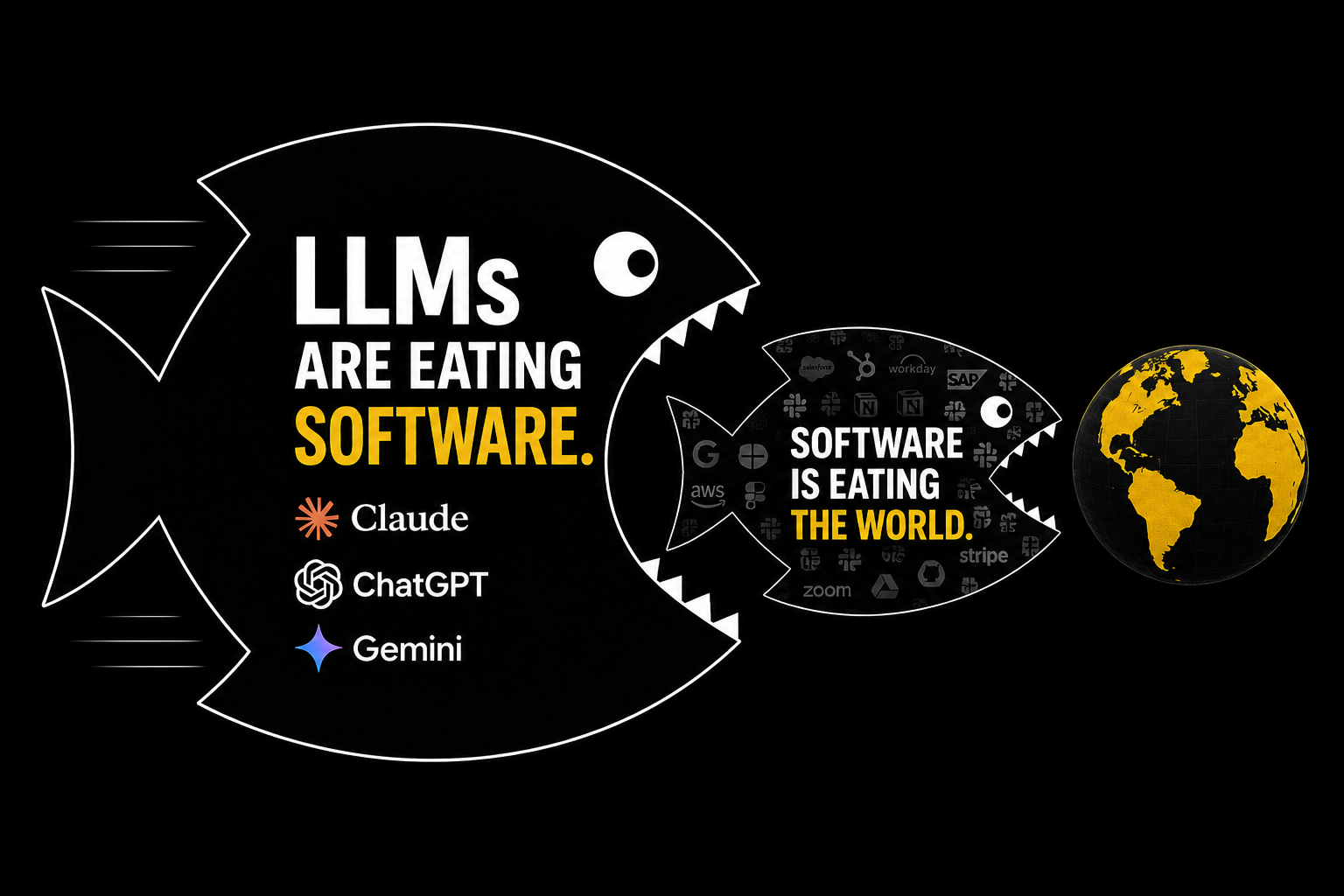
Marc Andreessen said software is eating the world. Now LLMs are eating software.
Every week, a founder tells me the same thing. Customers are canceling. Not for a competitor, but for ChatGPT or Claude. They're doing the job inside the chatbot instead of paying for the tool built to do it.
Here's why it's happening, and what to do about it.
What does "LLMs are eating software" mean?
It means general AI tools like ChatGPT and Claude can now do much of what specialized software used to do. A customer can get 80% of the result from an LLM in 10 to 30 minutes of setup. So they stop paying for the tool made for that one job.
Why are customers leaving SaaS tools for ChatGPT and Claude?
Your product didn't get worse. The free option got better.
The thing customers compare you to used to be a clunky competitor. Now it's an LLM that's cheap and 80% as good. Your edge shrinks from clearly better to barely better.
And a product that's only a little better doesn't get killed. It just quietly stops being worth paying for.
You feel it across the funnel. Churn climbs. New users stall during setup, because configuring your product takes longer than just asking an LLM to do the same job.
How do you compete when an LLM does 80% of the job?
Stop defending the part the LLM now does for free. Assume the core thing your product does today will be free in 18 months. Then go find the harder problem your customer is left with once the easy part is solved.
That harder problem has a name. The pervasive pain.
What is pervasive pain?
Pervasive pain is the deeper, unsolved problem that's left in a market once the basic task becomes easy or free. It's the most valuable problem to solve, because it's what customers actually care about. And it's usually still wide open.
How one company found its pervasive pain
David, the founder of Spoks, an affordable alternative to Klaviyo, thought the pervasive pain in email marketing was setup. It's the part most tools choke on.
So his team made setup dead simple. The moment they did, the real problem showed up. Customers never wanted easy setup. They wanted more money.
So David built automated email and SMS workflows that actually make his customers revenue. Setup got customers in the door. Revenue is what keeps them.
How to find the pervasive pain in your market
- Assume the core job your product does will be free in 18 months.
- Solve the obvious pain so simply it disappears.
- Ask what your customer is still stuck on after that.
- Build for that next, harder problem.
- Repeat. Each layer gets commoditized in turn.
Where to go next
Assume your core feature goes free. Then go hunt the pervasive pain before someone else does.
To go deeper, read the Product-Led Growth book for free, join the ProductLed MBA which now includes WARP Week, or get hands-on help with the ProductLed Sprint, our done-with-you program.