TL;DR
Key Takeaways
- Most PLG failures happen because companies launch before they're ready.
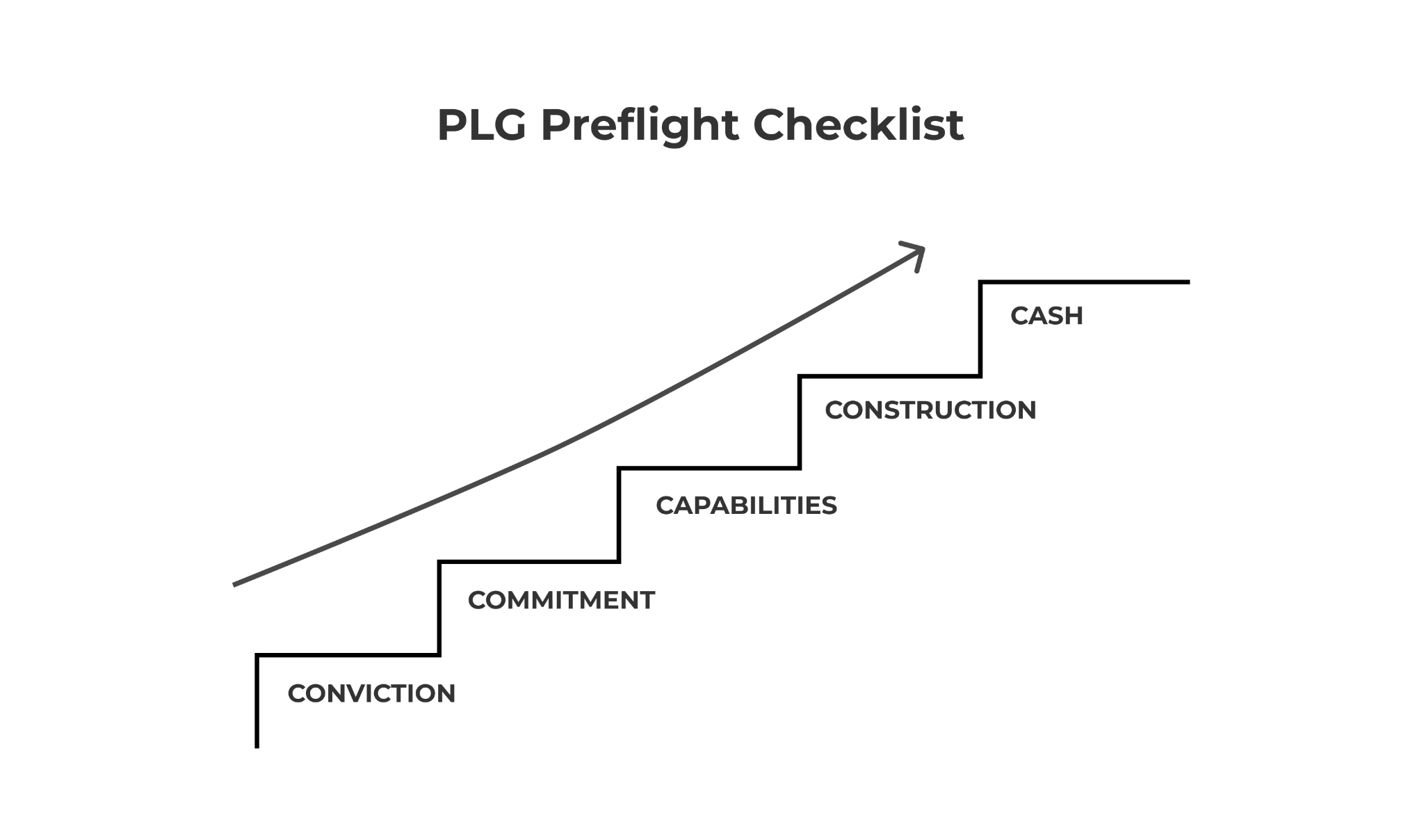
- The PLG Preflight Checklist evaluates five readiness factors: Conviction, Commitment, Capabilities, Construction, and Cash.
- Each level builds on the one below it.
- Your lowest score is your biggest bottleneck.
- Companies that skip levels often struggle to make PLG work.
Most companies that fail with a product-led approach don't happen because the strategy was wrong. They happen because the company wasn't ready.
After analyzing hundreds of successful and failed PLG transformations, I learned that the companies that succeed don't just check a few boxes. They build readiness from the ground up in a specific order, with each level supporting the one above it.
Think of it like a preflight checklist before a rocket launch. Nobody would skip the fuel check because they're excited to fly. Nobody would ignore the engine warning because the weather looks good. Every item on the checklist exists because somebody, somewhere, skipped it, and the launch failed. PLG works the same way. There's an order to getting this right, and the companies that skip levels are the ones that crash.
The preflight checklist has five levels. Each one builds on the one below it. Let's start at the base: conviction.
Conviction: Do We Believe PLG Is Right For Our Market And Vision?
A couple of years ago, I analyzed hundreds of our customers to pinpoint what separated the companies that succeeded with PLG from those that didn't. The number one factor wasn't the budget, team size, or product maturity.
It was whether the CEO and founding team truly believed PLG was the right path. Not as an experiment, but as the way forward.
Not "are they open to it?" Not "did they approve the budget?”
They need to want it.
If the leadership team doesn't have conviction around PLG, it won't work. At the end of the day, it's not just a “product thing.” It's a company thing. Without strong conviction, you're building PLG on a shaky foundation. And nothing you stack on top of a shaky foundation will hold.
Your Preflight Check
Since every flight starts with a preflight check, let’s go through the questions you and your team need to consider to ensure conviction is strong enough for your PLG motion to take off.
- Is PLG the only way to achieve your company's vision, or just one option you're considering?
Could Canva democratize design without a product-led motion? Absolutely not. There's no version of "make design accessible to everyone on the planet" that runs through a Sales team. The vision demands PLG. That's conviction. Now ask yourself the same question. Does your vision demand PLG, or are you telling yourself, "Yeah, maybe we can make it work alongside our sales motion"? If it's the latter, you don't have conviction yet.
- Can you articulate why PLG is the right strategy for your company without referencing competitors?
If your conviction is rooted in "well, everyone else is doing it," that's not conviction. That's peer pressure. Peer pressure fades the moment results take longer than expected. Real conviction comes from understanding your buyer, your market, and why self-serve is the best way to reach them.
- If PLG took 18 months to show meaningful results, would you keep going?
This is the question that separates real conviction from surface-level excitement. PLG is a compounding motion. Early results are almost always underwhelming. The companies that win are the ones whose leadership says, "We expected this, let’s stay the course." The companies that fail are the ones where someone in the C-suite says, "Let's pause this and revisit next quarter," after only a few months of giving PLG a shot.
- On a scale of 1 to 10, how deeply do you believe PLG is the right path for your company?

If you're below a 7, that's not a failure. It's a signal. It means you need to do more work at this level before moving up the pre-flight checklist. Go deeper into the research and talk to companies that have made the transition. Pressure-test your assumptions.
Conviction is the fuel in the tank. Without it, nothing else matters. But fuel alone doesn't get you off the ground. You need the rest of the team to strap in.
Commitment: Is Your Leadership Team Willing To Back PLG With Real Resources and Real Patience?
Conviction is personal. Commitment is organizational.
That distinction matters more than almost anything else in this book.
I was on a sales call with the CEO of a successful real estate SaaS company. He was growing fast with a sales-led motion, and he was convinced PLG was the next move. So he hired an executive from Meta who had worked on PLG there. Smart hire on paper. They went all in.
It bombed.
When I dissected what went wrong, the problem was obvious from the beginning. Only the CEO and the new Meta executive were pushing the rock up the hill. Nobody else on the leadership team bought into it. Sales saw PLG as a threat. Product had other priorities. Because they didn't have buy-in, they didn't get the resources or the support. And because the CEO had a hundred other things on his plate, the whole initiative got dropped.
Three years later, he came back. "Wes, I messed up. Now we're ready to do this right." The difference wasn't the strategy. The strategy was the same. The difference was that this time, his entire leadership team was committed to seeing it through.
You can have all the conviction in the world. But conviction lives in your head. Commitment is what happens when that conviction spreads to the people who actually control resources, timelines, and priorities across the entire organization.
Your Preflight Check
Here are the questions that will tell you if that commitment is real.
- Does your entire leadership team get it, want it, and have the capacity for it?
Not just you. Not just the one VP who read the book. Every person on your leadership team. Do they understand what PLG actually means for their function? Do they actively want it? And do they have the bandwidth to support a transformation of this magnitude? If even one of those is missing for even one leader, you have a commitment gap.
- Is PLG a top-three priority for the business?
Not top 10. Not "on the roadmap." It needs to be one of the top three priorities. The only time PLG works is when it's treated this way across the entire organization. If it's priority number seven, it will get bumped every single quarter by something that feels more urgent. The free trial launch will get delayed because Engineering is focused on an enterprise feature request. The onboarding redesign will stall because marketing is busy with a conference. PLG doesn't survive as a side priority. It either matters enough to protect, or it slowly dies on someone's backlog.
- Do your incentives actually reward PLG, or are they still rewarding the old playbook?
This is the silent killer. You can get every person in the company to say they're committed to PLG, but if their compensation, KPIs, and performance reviews still reward the old way of doing things, behavior won't change. If your Sales team is still compensated purely on outbound closed deals, they have zero reason to support the self-serve motion. If your Product team is measured on feature shipping velocity instead of activation rate, they'll keep building features nobody uses during the free trial. People don't follow mission statements. They follow their paychecks.
- Are you willing to change your culture to excel at PLG?
Sales-led companies celebrate closed deals. Product-led companies obsess over making their product insanely good and easy to use. If your culture still revolves around the old motion, you're trying to run new software on an old operating system. It just won’t work.
- How strongly has your leadership team committed to PLG as a core strategic priority?

If you're below a 7, don't proceed to the next task on the preflight checklist. Go back to your leadership team and have the hard conversation. Not about whether PLG is a good idea, but about whether it's a top priority, whether everyone is genuinely bought in, and whether incentives match the mission. If someone on that team can't get there, acknowledge that too.
Conviction gets you in the door. Commitment gets the whole crew on board. But a committed crew still needs to know how to fly the plane.
Capabilities: Does Your Team Have The Skills to Build a World-Class Product-Led Business?
This is where things get uncomfortable because it’s where most companies discover the gap between wanting PLG and being able to do it well.
PLG is like learning a new sport. You've decided you want to play (conviction). You've joined the league and showed up to your first practice (commitment). Now you actually have to develop the skills. And that first practice? It's going to be humbling. You're going to be slow, and your technique is going to be rough. You're going to watch the experienced players read the game effortlessly and wonder how they make it look so easy.
Your first PLG motion is going to feel exactly like that. Your onboarding will be clunky. Your activation metric will probably be wrong on the first attempt. Your free model will give away too much or too little. That's normal. You're learning a new sport.
This is what separates the companies that are good at PLG from the ones that quit after a month: they understand they're developing a new skill, not flipping a switch. They find a coach, and they study the fundamentals. They accept that the first few games will be ugly. The ones who show up to their first game expecting to compete at a professional level get crushed and conclude that the sport doesn't work.
That's the key distinction. PLG is a skill set you develop. Over time, with practice and feedback, that skill turns into instinct; knowing when to invest in onboarding versus pricing, when to go freemium versus free trial, when to let the product sell versus bringing in sales. That kind of judgment doesn't come from reading a playbook once. It comes from practice, coaching, and reps.
I've seen this pattern hundreds of times. Leadership is convinced, and the whole team is committed. Budget is allocated, and everyone's excited. Then the work begins, and within weeks, the energy drains from the room. Nobody's doing anything wrong. They just haven't developed the skills yet.
This is actually the biggest hurdle once you have conviction and commitment locked in. I recently worked with a company and reviewed their onboarding. It was terrible. Then I started working with their UX person, and I understood why. He was a junior. Nothing against him; he was talented and a quick learner. But he wasn't designing to get users to value as fast as possible. He was designing to make things look good. Those are two completely different skills. Once we trained him on that distinction, he was unstoppable. The talent was there. He just needed coaching on the right technique.
If you don't have the right capabilities (i.e., if your UX person is junior, if your data person doesn’t really know what activation is, if nobody on your team has ever designed a self-serve onboarding flow), it just won't work that well. The skills your team built in a sales-led motion don't automatically transfer. Some do, but many don't.
When I was working with Boomi, their Head of PLG told me his biggest priority was creating a common language. He needed his team to be able to have educated debates about whether to launch a free trial or freemium, why onboarding needed to be cut in half, and what "product-led" actually meant for their business. Without that shared context, leading a PLG transformation is like herding cats. Everyone has opinions, but nobody is working from the same playbook.
That's one of the reasons we wrote this book. The frameworks here aren't just for you. They're designed to give your entire team a shared way to think and talk about PLG so you can move faster and argue less. Because you can either spend months building your own language from scratch, or you can borrow one that already exists and is proven to work. When you're ready to launch your PLG motion, that's exactly what The Product-Led Playbook walks you through.
Your Preflight Check
Let’s take an honest look at your team's capabilities.
- Could your team have an informed debate about PLG and back up their positions with reasoning, not opinions?
If you asked your leadership team tomorrow, "Should we offer a free trial or a freemium model?" would you get educated arguments with trade-offs, or blank stares and gut reactions? The companies that succeed with PLG are the ones where the team can engage in strategic debate about these decisions because they have the foundational knowledge to think critically.
- Does your team have the right skills to execute PLG?
Your UX designer needs to optimize for time-to-value, not aesthetics. Your data person needs to monitor activation milestones, not just upgrades. Your marketer needs to drive self-serve signups at a fraction of the cost of demo requests. Be honest about your team's PLG skill gap. That gap is where implementation breaks down.
- Does your team have the right knowledge about PLG?
Skills and knowledge are different concepts. Skills are whether they can do the work. Knowledge is knowing what work to do.
Can your team define your activation metric right now without looking it up? This shouldn’t be a vague answer like "when users get value." It needs to be the specific behavior that signals a user has experienced enough value to convert. If they can't, every decision they make is a guess. If your team can't engage in strategic debate about these decisions, they're not ready to make them.
- Do you have the core PLG capabilities covered on your team?
PLG touches a lot of disciplines: product marketing, data analytics, user experience, onboarding design, pricing strategy, product analytics, customer research, and conversion optimization. You don't need world-class talent in each one on day one. Remember, your first few sessions in the gym aren't going to be pretty. But you need to know where your gaps are. If nobody on your team has ever set up product analytics properly, you won't know what to track. If nobody understands pricing psychology, your tiers will be based on guesswork. Every uncovered capability is a blind spot that will eventually show up in your results. That's why we have ProductLed Implementers—to fill specific skill gaps on your team while you build internal strength.
- On a scale of 1 to 10, how prepared is your team to build a world-class PLG motion today?

If you're below a 7, this is actually the most fixable level of the pyramid. Conviction and commitment require alignment and willpower. Capabilities just require investment. Get your team trained with the ProductLed MBA. Build the common language. Close the knowledge gap before you start building. The worst thing you can do is rush into implementation with an untrained team, because the failure won't look like a capabilities failure. It'll look like a strategic failure. And then you'll abandon a strategy that would have worked if you'd just prepared your team for it.
Your crew is trained. Your team is ready. Now the question is: do you have the right flight plan?
Construction: Does Your Product Overdeliver on Value?
What we promise in our marketing is the perceived value. What we deliver in our product is the experienced value.
When we promise more than we deliver, that gap is called a value gap.
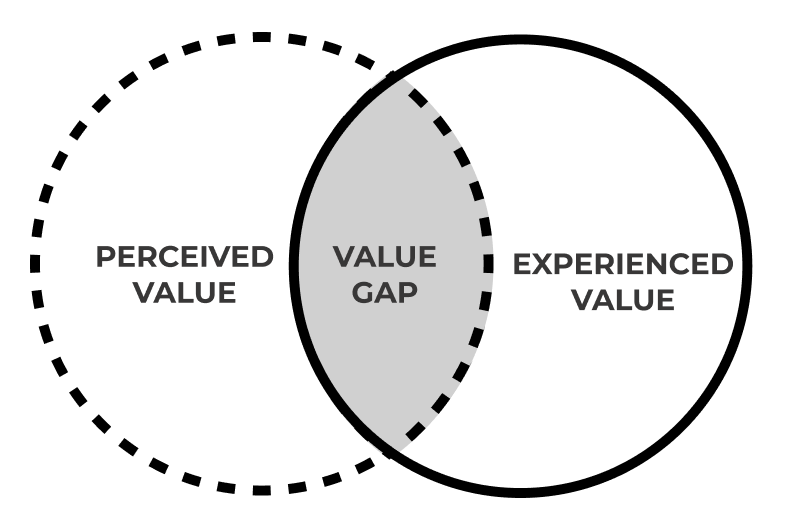
The bigger your value gap, the leakier your funnel. Forty to 60% of users who sign up for a product will use it once and never come back. A big value gap makes that number worse. You're not just losing users. You're teaching them not to trust you.
Let’s say you walk into a restaurant expecting a hot plate of spaghetti. Instead, someone takes you into the kitchen, hands you the raw ingredients, and points at the stove. Then they leave. That's a value gap. You came for a meal but now you have to cook it.
Now imagine you walk in and get seated at another restaurant. The food comes out in 30 or 40 minutes. It's fine. Nothing special. You eat, pay, leave, and don't tell anyone. That's meeting expectations. It’s a 5 out of 10 experience which is still very forgettable.
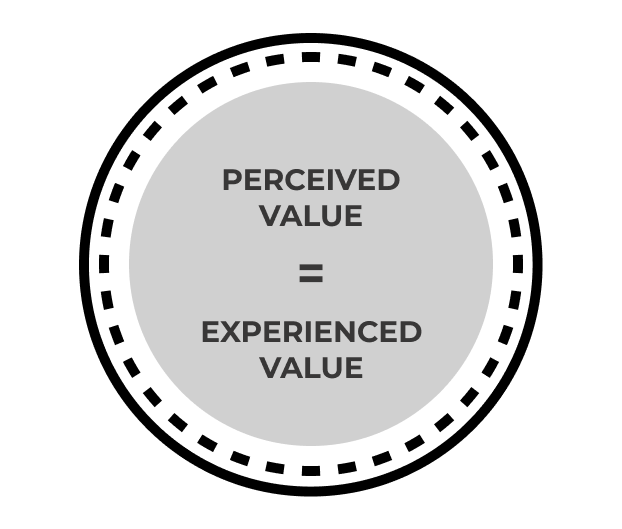
Now imagine you walk in expecting that same plate of spaghetti and you get a Michelin-star meal. The food is extraordinary. It arrives fast. And the price makes you feel like you stole it.
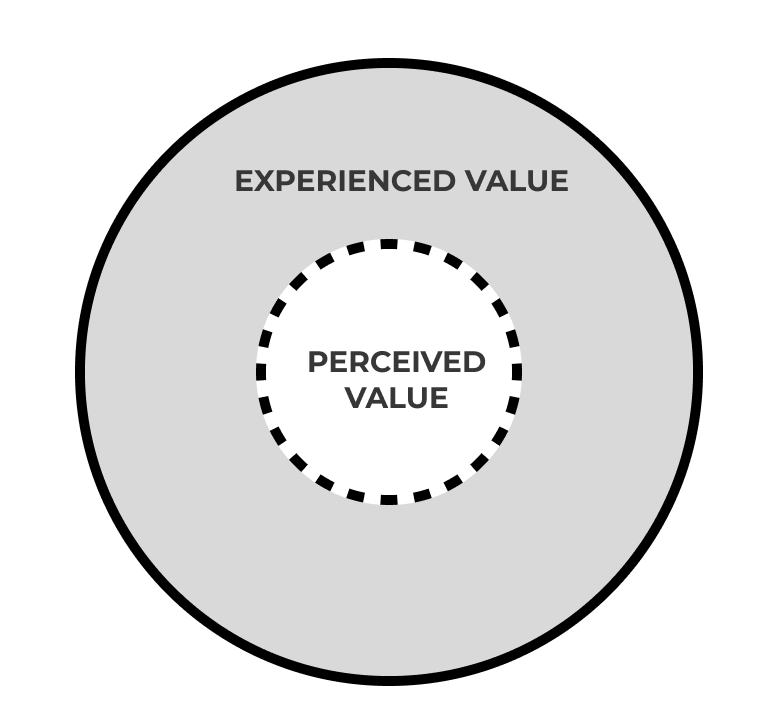
You're telling everyone you know.
That's what overdelivering feels like, and it’s the bar you need to aim for if you want to create a product that stands out in your market.
Three things make a product overdeliver: the quality of what the user gets, how fast they get it, and what they pay. Nail one and you're competitive. Nail all three, and you're the product people can't stop talking about.
Think about how you first heard of Canva. Probably from someone who couldn't shut up about it.
Before Canva, making a professional graphic meant opening Photoshop, watching tutorials, and spending hours on a single design. Canva changed everything. The quality was professional with beautiful templates that made anyone look like a designer. The speed was minutes instead of hours. And the price was free. Free, for something that replaced a $600 piece of software.
No wonder Canva didn't need to spend on advertising to grow initially. Their users did the selling for them.
That's what happens when you overdeliver on all three. Users become raving fans. Raving fans bring more fans to your door.
And the bar for speed keeps moving.
When I wrote the first edition of this book, getting a user to value within an hour or two was the standard. Now ChatGPT delivers value in seconds. Lovable lets you build a working app in under a minute. Your users aren't comparing your product to your competitors'. They're comparing it to the fastest product they've ever used. The expectation is now getting users to value in 60 seconds or less.
Your users’ success will eventually become your success. If you're not building a product that overdelivers, you're leaving the most powerful growth lever on the table.
Your Preflight Check
Let's evaluate how well you're constructing user success.
- How good is the outcome your user gets?
When someone finishes their first session with your product, are they thinking "that was fine" or "wow, that's amazing"? There's a big difference. "That was fine" means they got what they expected. They might come back, they might not. "Wow, that's amazing" means you gave them something better than they thought was possible. That's the reaction that turns a user into a raving fan.
- How fast does a new user experience meaningful value?
Time it. Seriously. Sign up for your own product as a new user and count the seconds until you hit a meaningful outcome. If it takes more than 60 seconds, you're behind the new bar. If it takes more than a few minutes, you're losing the majority of your signups before they ever see what your product can do.
- Could your user get the same outcome somewhere else for less money or effort?
If yes, you're vulnerable. Before Canva, the alternative was Photoshop at $600. Canva gave you a better outcome, faster, for free. That's why users switched and never looked back. The product that overdelivers on quality, speed, and price is the one that wins. If a competitor can match your quality faster or cheaper, your users will find them. It's not a matter of if — it's when.
- Does your product deliver an outstanding outcome, faster than expected, at a price your users love?

If you're below a 7 (and most people reading this will be), this is the level you'll spend the most time on. That's expected. Construction is the hardest part. That’s why I spent two years writing The Product-Led Playbook to make it easier to execute. It gives you the blueprint in the exact order you need to build a world-class product that overdelivers.
Reminder: your users’ success will eventually become your success. Get this right first. Then let's talk about turning those raving fans into revenue.
Cash: Is PLG driving the majority of your revenue?
When you first launch your PLG motion, the revenue will be underwhelming. That's okay. Self-serve might drive 1% of your overall revenue while sales carry the other 99%. Your onboarding will be clunky. Your pricing won't be quite right.
This is normal. Every company that's great at PLG today made almost nothing from it on day one. The question isn't whether your launch revenue is impressive. The question is whether you have the conviction, commitment, capabilities, and construction to keep improving until PLG becomes undeniable.
Because that's the journey. It goes from 1% of revenue to "hey, this is becoming substantial" to "PLG is driving the majority of our business." That progression doesn't happen by accident. And it doesn't happen at all if you panic at the early numbers and pull the plug.
But here's the uncomfortable truth: even if you nail the first four Cs, if PLG never generates real cash, it won't stick. Leadership will lose patience, and the board will ask questions. The Sales team will say, "told you so." And slowly, quietly, you'll drift back to the way things were.
That's why cash is the final level of the preflight checklist. The first four levels ask: Are you ready for PLG? This one asks: Is PLG becoming your business?
Your Preflight Check
Take a good look at your revenue.
- Does PLG drive the majority of your revenue, or at least impact over 50% of it?
If self-serve revenue is a rounding error three years in, PLG is on borrowed time. It doesn't need to be 100% of revenue overnight; plenty of great companies run a hybrid motion. But PLG has to be the main source. For example, revenue is growing faster than headcount, your CAC is decreasing, and customers are upgrading themselves. If PLG isn't driving or shaping the majority of your business, go back to the pre-flight checklist and find what's holding you back.
- Is PLG revenue growing every month, or is it flat?
A revenue number is a snapshot. A growing revenue number is a growth engine. If your PLG revenue hasn't moved in the past three months, something in the preflight checklist is broken. Maybe your team lacks the right capabilities or PLG isn’t a top 3 company priority. The best PLG companies run a weekly rhythm: identify the biggest bottleneck, launch experiments to fix it, measure the results, repeat. That rhythm is what turns a flat number into a trajectory. - Is PLG generating real revenue for your business?
“PLG revenue” does not require the product to sell itself in a purely self-serve motion. Many PLG deals still involve sales.
For example, an enterprise team might start with your free product, invite colleagues, and begin using it internally. Later, a sales rep reaches out and closes a larger agreement to roll the product out across the organization. The deal involved sales, but the product created the demand. That revenue is still PLG-attributed.

If you're below a 4, that's expected early on. You're building a new capability. The question is whether the number is moving up month over month. If it is, you're on the right track.
If you're between 4 and 7, PLG is making money, but it's not the main source yet. This is the danger zone. Good enough to keep alive, not good enough to be permanent. This is where most companies stall. Don't coast. Install the weekly rhythm. Run experiments and upgrade your team. Invest in building a world-class product-led motion.
If you're above a 7, PLG is your growth engine. Your job now is to protect and compound it.
What Your Lowest Score Means
Look back at your five scores. Find your lowest number. That's your bottleneck.
That's holding you back from taking off.
If your lowest score is in Conviction, get completely on board with whether PLG is absolutely critical to pursuing your vision or not.
If your lowest score is Commitment, stop building and get your leadership team fully behind this before you spend another dollar on your PLG motion.
If your lowest score is in Capabilities, invest in your team before you invest in your product. Train and give them a common language.
If your lowest score is in Construction, you need the right approach. Pick up The Product-Led Playbook. The blueprint exists. Follow it in order and resist the temptation to skip ahead.
If your lowest score is in Cash, you've built something. Now you need to make it undeniable. Get your data system in place, install a growth process, and keep leveling up your team until PLG outperforms everything else.
The companies that build from the bottom up and refuse to skip levels are the ones that end up in the top 1%.
The rest are still wondering why their free trial isn't working.
The Preflight Checklist tells you what's holding you back.
But once you're ready for takeoff, a new question emerges: what does great actually look like?
In the second edition of Product-Led Growth, you'll learn how today's most successful product-led companies create value faster, remove friction from the user journey, and build products people can't stop recommending.
Frequently Asked Questions
What is the Product-Led Growth Preflight Checklist?
The PLG Preflight Checklist is a framework that helps companies assess whether they are ready to launch and scale a Product-Led Growth motion. It evaluates five critical areas: Conviction, Commitment, Capabilities, Construction, and Cash. Together, these five levels help identify the biggest bottleneck preventing a successful PLG transformation.
What are the five levels of PLG readiness?
The five levels of PLG readiness are: Conviction, Commitment, Capabilities, Construction, and Cash. Conviction ensures leadership believes in the strategy. Commitment ensures the organization supports it. Capabilities ensure the team has the necessary skills. Construction focuses on delivering exceptional user value. Cash measures whether PLG is generating meaningful business results.
Why do Product-Led Growth initiatives fail?
Most Product-Led Growth initiatives fail because companies launch before they are ready. Common causes include weak executive buy-in, lack of organizational commitment, skill gaps within the team, poor onboarding experiences, and products that fail to deliver value quickly enough. The strategy often isn't the problem. Readiness is.
What capabilities does a PLG team need?
Successful PLG teams typically require expertise in onboarding design, user experience, product analytics, pricing strategy, conversion optimization, product marketing, and customer research. While teams do not need to be experts in every area immediately, they must understand where their skill gaps exist and invest in developing them.
How do I know if my company is ready for Product-Led Growth?
Companies are generally ready for Product-Led Growth when leadership has strong conviction, the organization is committed, the team has the required capabilities, the product delivers exceptional value, and PLG is beginning to generate measurable revenue. The goal is not perfection across all five levels, but confidence that your weakest area will not prevent the strategy from succeeding.