TL; DR:
Key Takeaways
- Every market eventually becomes more product-led as buyer expectations evolve.
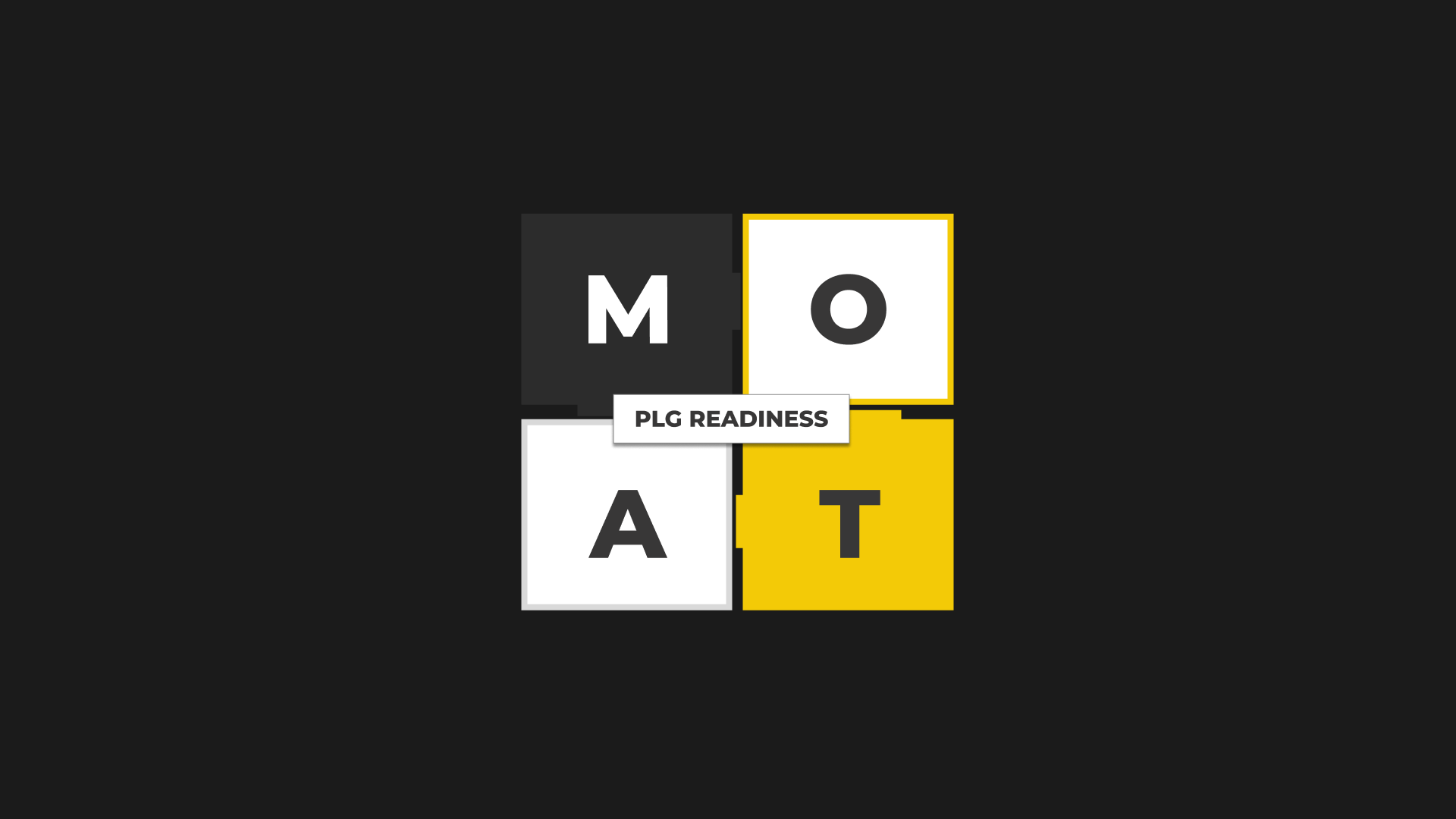
- The MOAT framework helps determine whether your company is ready for Product-Led Growth.
- Market Strategy, Ocean Conditions, Adoption, and Touch-to-Value are the four factors that matter most.
- Multiple green flags suggest you're ready now.
- Yellow and red flags reveal where you need to improve before scaling a PLG motion.
Every market eventually becomes product-led.
Not because founders wake up one day and decide to embrace Product-Led Growth. Because buyers force it.
I was talking with David Darmanin, the founder of Hotjar, on the ProductLed Podcast about what the screen recording market looked like before he entered it. It was an enterprise-focused sales play. The tools were expensive and complex. If you wanted screen recordings or heatmaps of your website, you were booking demos, negotiating contracts, and writing big checks.
Then Hotjar showed up with a simple product at a fraction of the price. You could sign up and start seeing how visitors interacted with your site in minutes.
The enterprise incumbents didn't disappear overnight. But the market shifted beneath them. Hotjar captured the customers who would never have booked a demo in the first place, then expanded upmarket from there. The same pattern keeps playing out across every market. A product-led competitor enters, makes the old way of buying feel slow, and the entire market recalibrates.
Your market is next. If it's not already happening.
Companies that build a product-led motion early will have a massive head start over those forced to build one later. Product-led companies are harder to build, but much easier to scale.
So the question is not "Should we do PLG?" The question is "Are we ready to do it now, or do we need to build toward it?"
That's what the MOAT framework answers. It doesn't give you a yes or no. It gives you a when and a how. It forces you to answer four questions that determine whether your business is ready to go product-led today or needs to address some fundamentals first.
- M — Market Strategy. Which market are you going after?
- O — Ocean Conditions. Are you in a red or blue ocean?
- A — Adoption. How easily can someone experience your product's value on their own?
- T — Touch-to-Value. Does getting users to value require your team?
Each dimension gets a simple flag. Green means you're ready now. Yellow means you can move forward, but you need to address something along the way. Red means you're not ready yet, and there's work to do before PLG will perform.
By the end of this post, you will know exactly where you stand. Not whether PLG is in your future. It is. But whether your business is ready for it today, and what needs to change if it's not.
First up: the market you choose.
M — Market Strategy: Which Market Are You Going After?
This is the first filter because it's the one companies get wrong most often. They want PLG to work so badly that they ignore what their market is actually telling them.
There are really only three options here.
Small and Medium-sized Business (SMB). If you are selling to small businesses, PLG is your natural motion. These buyers expect to try before they buy. They don't want to sit through a demo for a $50/month product. They want to sign up, see if it works, and pull out their credit card when it does. A sales-led approach in SMB means you are paying your most expensive people to close your smallest deals. The math never works.
Mid-market. If you are selling to mid-market companies, PLG is still a strong fit, but you will likely need a hybrid motion. The product drives adoption, education, and qualification. Sales steps in when deal complexity or contract size justifies the human touch. Most winning mid-market companies run a product-led sales model. The key is that the product-led motion exists first. Without it, hybrid collapses back into sales-led by default.
Enterprise. If you are targeting true enterprise buyers with high contract value, complex procurement, and long buying cycles, PLG is not your primary motion. That doesn't mean product-led elements can't help. They can support expansion, land-and-expand strategies, and smaller accounts that don't justify heavy sales involvement. But the core GTM runs through sales.
O — Ocean Conditions: Are You In a Red Or Blue Ocean?
Before we dive into how your ocean strategy will affect your PLG model, I want to explain the difference between blue and red-ocean companies.
Red-ocean companies try to outperform their rivals to grab a greater share of existing demand. As the market gets crowded, prospects for profits and growth reduce. Products become commodities, and cut-throat competition turns the bloody ocean red.
Blue-ocean companies access untapped market space and create demand, giving them the opportunity for highly profitable growth. In blue oceans, competition is irrelevant. Yes, imitators arise, but experience shows there is a wide window of opportunity to stay ahead of them.
Here’s a high-level overview of the differences between the two ocean strategies:
Red Ocean
To determine if you’re in a blue or red ocean, you can’t simply ask, “Am I creating or harvesting demand?” It’s also not enough to look at your market, label the competitors, and assume that you’re in a bloody red ocean.
In a red ocean, prospects already know how your product can help them. A product-led model is your advantage. It widens your funnel, decreases your CAC, and helps you expand globally in a fraction of the time.
PLG helps you convert "non-customers." These are people who typically won't reach out to request pricing or sign up for a demo. But they are willing to try your product and, if it's right for them, buy it.
Take live-chat software. When it first came to market, most companies started with a traditional sales-led approach. Once the category matured, it became almost impossible to find a live-chat application without a product-led model. In a red ocean, PLG isn't optional. It's how you survive.
Blue Ocean
If you are in a blue ocean and creating demand, your product may have a steep learning curve. Before you can make the sale, you need to educate your market on why your new approach is better.
Take Snowflake. When they first entered the market, most companies did not understand what a cloud data warehouse was or why they needed one. Snowflake's Sales team had to spend a lot of time educating buyers. Without those conversations, most buyers would not have trusted the product enough to try it. People do not buy what they do not understand.
That's why in a blue ocean, most companies start with a sales-led or marketing-led approach. Education comes before scale.
But there’s an exception. If your product can teach users what is possible through direct use and deliver value quickly, you can still lead with PLG in a blue ocean. Notion and ChatGPT both entered markets that required education, but their products demonstrated their value almost immediately. Users did not need a pitch to understand why it was better. The experience did the teaching.
Here is the thing about blue oceans: they all become red oceans eventually. Competition catches up. Buyers get educated. The category matures. When that happens, the companies that already have a product-led motion built will have a massive head start over the ones scrambling to build one from scratch.
That’s why many founders choose to start in a red ocean, not despite the competition, but because of it.
As the founder of Userflow, Esben Friis-Jensen, put it:
“Going into a red ocean is something I recommend any founder should do. Blue oceans are so much harder. In a blue ocean you have to educate the market. They don’t know about your solution or how it fits into their budget. It’s 10x, if not 100x harder to get buy-in. If you want to do something like product-led growth or a self-serve approach, educating buyers is incredibly hard. If I were starting again, I would go into a red ocean. You don’t have to reinvent the wheel. You just need something differentiated enough to attract the market.”
Pay attention to how this flag interacts with the next two. A blue ocean on its own is manageable. A blue ocean combined with high adoption friction is a different story.
A — Adoption: How Easily Can Someone Experience Your Value?
Here is the simplest way to think about this. Ask yourself: how many hurdles does a user need to get right in order to see value in my product?
If the answer is just one (learn the product), that's straightforward. If the answer is two (learn the product and understand some key concepts), that's harder. If the answer is three hurdles (learn the product, gain real knowledge, and develop actual skills), that's very hard.
Those are the three layers of adoption.
Product adoption. Can someone sign up, navigate the core workflow, and complete a meaningful action without hand-holding? This is what most people think about when they hear "adoption." It's table stakes.
Knowledge adoption. Does the user need to understand something new before the product becomes useful? Not how to click the buttons, but what they need to know to get results.
Skill adoption. Does the user need to develop an actual capability to succeed? This is the hardest layer. It's the difference between "learn where to click" and "learn how to think differently." For example, there are a lot of user onboarding tools in the market today. Product adoption is very simple. However, what's not so simple is understanding what a good user onboarding strategy actually is. You can't just slap on tooltips to your product and guide users to the next logical step. You have to ask, what is the way we could get people to value the fastest through some of these tooltips?
If you just start slapping them on, you end up creating really long user journeys with a ton of clicks, and it doesn't actually get users to value.
Here are a couple of other examples.
Think of Zoom, Notion, or Slack. Product adoption is straightforward. You sign up, you poke around, you start getting value. There's not much knowledge or skill required to see what the product can do for you. That's green flag territory.
Now think about a CRM like Salesforce. The product itself isn't that hard to navigate. But to actually get value, your team needs to understand how to structure a sales process, define pipeline stages, and build reports that matter. There's real knowledge adoption required. The tool is only as useful as the knowledge behind it. That's a yellow flag.
Now think about a mission-critical infrastructure tool that touches your entire business. If it goes down, people lose their jobs. Product adoption is heavy. Knowledge adoption is heavy. Skill adoption is heavy. Users need hand-holding at every layer before they trust the product enough to run it. That's a red flag for PLG.
I'll be honest. Our own business is a good example of how adoption friction works. Adopting PLG is not just one thing people need to get right. They need to understand what PLG is and determine whether it's right for them. They need to learn the right approach, the right frameworks, and the right order of operations. There's a ton of knowledge. There are real skills to build. That's why we give away our books for free. It's our way of closing the knowledge gap before someone ever signs up. But even with that, making PLG adoption fully self-serve is very hard. We know that about our own business, and we plan around it.
The Yellow Flag Trap
The yellow flags are the ones that actually catch you off guard. Green flags are obvious. Red flags are obvious. But yellow flags? Smart founders underestimate them constantly.
That's because founders usually have deep knowledge in their product's domain. They look at their own product and think, "This is so easy. Anyone can figure this out." They forget that they have years of context that their users don't.
Remember what I said earlier about compounding flags? A yellow flag on adoption by itself is manageable. But a yellow on adoption combined with a yellow on ocean conditions means you are asking users to educate themselves about a new category and develop new skills at the same time, which is hard to scale.
T — Touch-to-Value: Does Getting Users to Value Require Your Team?
Adoption measures how difficult it is for users to succeed. Touch-to-Value measures how much of your organization's involvement is required to get them there.
A product can have simple adoption but still require your team to configure it. And a product can have a complex adoption that the user handles independently.
The core question is how much human involvement from your organization is needed before someone experiences value? Is it no-touch, low-touch, or high-touch?
No-Touch
Users get value and upgrade completely on their own.
Canva is the textbook example. You sign up, pick a template, and create something that looks professional in minutes. No demo or implementation call. The product does all the work.
Grammarly works the same way. Install the extension and start writing. Value is obvious before you've even thought about paying.
Low-Touch
Automated onboarding handles most of it. Your team steps in for edge cases, expansion, or high-value accounts.
Slack is a good example. A small team can sign up, start messaging, and get value immediately. But as Slack grows inside a company, sales gets involved for enterprise deals, security reviews, and organization-wide rollouts. The product opens the door. Sales walks through it when the deal gets big enough.
High-Touch
A Customer Service Manager, an Implementation Specialist, or a Sales Engineer must be involved before the user reaches value. Think enterprise SaaS with complex integrations or consulting-heavy onboarding.
But high-touch is not automatically a problem. Sometimes it's the smart play.
Alex Turnbull, the CEO of Groove, launched a new company, Helply, an AI customer support tool. In the first year, he personally onboarded every single customer. It was extremely high-touch. He did it on purpose. Not because the product couldn't work without him, but because he wanted to learn. Every onboarding conversation revealed new friction points, new use cases, and new objections. He used that direct contact to learn faster about what challenges customers faced and what the product needed to do to get them to value on their own.
That's the right way to think about high-touch in the early stages. It's not a permanent state. It's a learning strategy that you deliberately work to eliminate over time.
Reducing Touch Over Time
Every investment you make in better onboarding, smarter product defaults, in-app education, and automated workflows reduces the human involvement needed to get users to value. That is one of the highest-leverage investments a product-led company can make.
Paubox started with a guided setup experience. Every improvement they make to that flow moves them closer to no-touch. Alex Turnbull's high-touch onboarding at Helply was never the destination. It was the research phase that made low-touch and eventually no-touch possible.
If your Touch-to-Value is currently high, don't assume it's permanent. Map out what it would take to reduce it.
Is Now the Right Time For PLG?
Look at your flags.
🟢All green. PLG absolutely makes sense for your business. You have the market, the ocean conditions, the adoption dynamics, and the touch profile to make this work. Don't overthink it. Get focused on how to actually get started.
🟡One or more yellows. PLG can work, but you have areas that need attention before the motion runs smoothly. A yellow on Ocean means you pair education with your product experience. A yellow on Adoption means you build guided onboarding or bring in AI agents to close the skill gap. A yellow on Touch-to-Value means you automate more of the path to value. These are solvable problems. Plenty of companies build successful PLG motions while actively working to address them. Just know that the more yellows you have, and the more they reinforce each other, the harder PLG will be until you address them. If your yellows are stacking up, slow down and build the foundation first. Fix the flags, then build the motion.
🔴Enterprise only. If your sole focus is enterprise and you have no plans to serve SMB or mid-market, PLG is probably not the right path. It's going to pull you in a direction that fights your core business instead of supporting it. You can use product-led elements to support sales and expansion, but building your entire strategy around self-serve for enterprise buyers is a recipe for frustration.
No matter where you scored, PLG will become your future. Even enterprise markets will adopt product-led elements as buyers demand proof and expect to try before they buy. Competition will force self-serve into every category. The companies that build product-led motions now will compound that advantage for years. The ones that wait will eventually be disrupted.
The MOAT framework doesn't tell you if you should be product-led. It tells you when and how.
If you are mostly green or working through a few yellows, you are ready to move forward. The decision is made. But even with clear signals, PLG can still fail. Not because the strategy is wrong, but because companies make avoidable mistakes in how they get started.
The companies winning with PLG today aren't necessarily the ones with the best products. They're the ones that understand the realities of their market, their buyers, and their path to value.
That's what the MOAT framework is designed to help you do.
Now you know where you stand. The next step is deciding what to do about it.
The companies that win with Product-Led Growth don't succeed because they offer a free trial. They succeed because every part of the business is designed to get users to value faster.
Their product, onboarding, pricing, and go-to-market strategy all work together to turn users into customers.
That's exactly what the second edition of my book Product-Led Growth: How to Build a Product That Sells Itself teaches.
Or, if you're not ready to buy yet, start by sharing this article with your team and discussing where your business scored on the MOAT framework.
Frequently Asked Questions (FAQs)
Should every company become product-led?
Not today, but eventually most companies will need product-led elements in their business. As buyers increasingly expect to try products before talking to sales, companies that make it easy to experience value will gain a competitive advantage. The question is not whether Product-Led Growth is your future. The question is whether your business is ready for it right now.
What is the MOAT Framework?
The MOAT Framework is a ProductLed assessment designed to determine whether a company is ready for Product-Led Growth. It evaluates four dimensions: Market Strategy, Ocean Conditions, Adoption, and Touch-to-Value. Together, these factors help identify whether PLG is a good fit today and what barriers need to be addressed first.
How do I know if Product-Led Growth is right for my business?
The best place to start is with the MOAT Framework. Companies that serve SMB or mid-market customers, operate in mature markets, have low adoption friction, and can deliver value without heavy human involvement are typically strong candidates for Product-Led Growth.
Can enterprise companies use Product-Led Growth?
Yes, but usually not as their primary go-to-market motion. Enterprise companies often use product-led elements such as free trials, self-serve onboarding, product-qualified leads, and product-driven expansion. However, large enterprise deals still typically require sales involvement due to procurement, compliance, security, and stakeholder complexity.
What is a Red Ocean market?
A red ocean is an existing market where customers already understand the problem and available solutions. Companies compete for existing demand, often against many rivals. In these markets, Product-Led Growth can become a significant competitive advantage because it allows buyers to evaluate products quickly and independently.
What is a Blue Ocean market?
A blue ocean is a new or emerging market where demand must be created rather than captured. Buyers often require education before they understand the value of a new solution. While many blue-ocean companies begin with sales-led or marketing-led motions, they often become more product-led as the market matures.
What is Touch-to-Value?
Touch-to-Value measures how much involvement from your team is required before users experience meaningful value. Products with low or no-touch experiences generally have an easier path to Product-Led Growth because users can reach value without demos, onboarding calls, or implementation support.
What are the signs a company is ready for Product-Led Growth?
Companies are usually ready for Product-Led Growth when they serve SMB or mid-market customers, operate in markets where buyers understand the problem, allow users to experience value quickly, and can deliver that value with minimal involvement from their team. The more green flags a company has across the MOAT Framework, the stronger its readiness for PLG.