TD;LR
Key Takeaways
- Every product-led company falls into one of five stages on the Market Ascent™.
- The five levels are Commodity, Contender, Cusp, Chosen, and Cause.
- Each level has a different bottleneck, priority, and growth challenge.
- Companies move up by solving the constraint of their current stage.
- Understanding your level helps you identify what to focus on next.
After working with more than 430 companies, I've found that every product-led business falls into one of five competitive positions. I call this the Market Ascent™. It's the journey every product-led company must climb to dominate its market.
These aren't permanent achievements. They're levels in a game that never stops. Companies move up. Companies slide back. And most companies stall at a level they could have moved past, simply because they didn't know what the next level required.
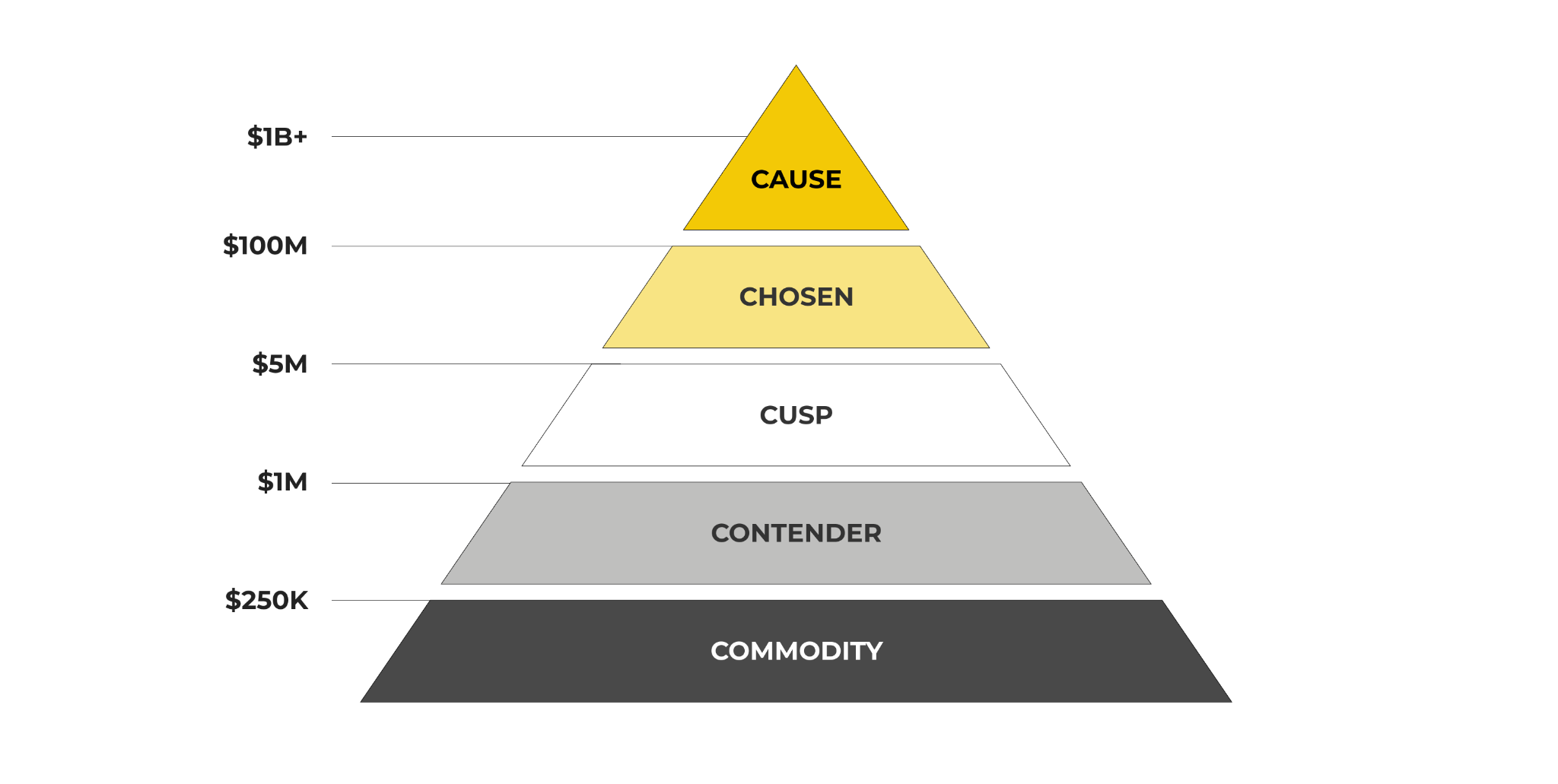
Let's go through each level.
Level 1: Commodity
Your product isn't compelling enough for prospects to care.
Being a Commodity doesn't mean you're a copycat. Some of the most innovative companies I've worked with were Commodities. They had genuinely useful products, real technical advantages, and founders who were passionate about the problem they were solving. The market just didn't care.
That's the painful part. You might be doing something unique. But if your prospects don't see the difference, you're a Commodity whether you deserve to be or not.
Think of it like finding a Patagonia shirt in a $5 t-shirt bin at a garage sale. It's a high-performance shirt designed to protect you from sunburn while swimming in the ocean. But at a garage sale, nobody sees that. They see a shirt in a bin with the others. The product might be special, but the context is stripping away everything that makes it special.
That's what happens to Commodities in crowded markets. Prospects glance at your homepage, see something that looks like the other 15 tools they've already evaluated, and move on. You never get the chance to explain what makes you different.
One of our clients experienced this firsthand. She had built a product that could do something her competitors couldn't. If you sell visual items, like custom balloons or event decorations, her tool lets you create a layout, attach it to an invoice, and send it to the client in a single step. It wasn't just a Customer Relationship Management (CRM) tool. It was a completely different workflow. But the market kept bucketing her with every other CRM. Prospects would look at the product and say, "Oh, so it's a CRM," and she'd have to fight that perception in every single conversation.
The product was differentiated. The positioning wasn't. And until positioning caught up, the market treated her like a commodity.
Once she addressed that gap and made the difference obvious to prospects before they ever got on a call, the business moved to the next level. People finally got what she did and why it was different. She went from fighting for attention to earning it.
You'll recognize the Commodity level by how it feels. Profits are tiny because you're competing on price. You feel like you're treading water—working hard but not moving forward. And your customers are tiresome, constantly needing hand-holding because the product isn't doing enough of the heavy lifting on its own.
The myth at this level is that running a business is just a tough slog. That's the lie founders tell themselves to normalize the pain. The truth is that your product needs to do the heavy lifting. As a Commodity, your job is product-market fit. Make your difference impossible to miss. Make it something prospects can experience, not just hear about. Until that happens, you're the Patagonia shirt in the garage sale bin.
Companies stay stuck in Commodity not because they're incapable. They stay stuck because they don't know what they don't know. They've never seen what a working PLG motion looks like. They've never built an onboarding flow that converts without sales involvement. They don't know the frameworks or the order of operations. The gap isn't talent. It's knowledge.
That's why this book exists. Once you see the path, you can start climbing.
Level 2: Contender
You have a real product, but growth still depends on effort, not pull.
When you're a Contender, the product is differentiated. People understand what you do and why it's different. That's the breakthrough that got you out of Commodity. But getting users to sign up, reach value, and upgrade still requires heavy involvement from your team. Revenue is real, with maybe a few hundred thousand, maybe a couple of million, but it feels sporadic. Some months are strong. Others are quiet. The pipeline is unpredictable because the product isn't doing enough of the selling on its own.
Your company is more streamlined than it was at Commodity. Some things are working well. You've found pockets of traction. But the overall motion still depends on hustle.
The myth at this level is that you need to be everything to everyone. Contenders are tempted to chase every market segment, every use case, and every feature request. That instinct is backwards. The truth is that you need a winning GTM motion. You need to find your focus and build a system that turns a differentiated product into one that sells itself.
But there's a trap at the Contender level that most founders miss. Being differentiated isn't enough. You need to become hard to copy. If a bigger player can match your move next quarter with a minor product update, you don't have a strategy. You have a temporary advantage.
I've watched this play out in both directions.
Tally.so is a form builder with about 500,000 active users. What makes Tally a real Contender, not just another form tool, is its strategy. They give away unlimited free forms. Typeform, the dominant player, caps its free tier. That pricing difference isn't a generous gesture. It's a strategy that Typeform can't copy. If Typeform matched it, they'd cannibalize a massive chunk of their existing ARR. So Tally gets to offer outsized value to users while the market leader is structurally locked out of responding.
Now compare that to one of our clients in the low-code app space. They make it easy to turn messy spreadsheets into custom apps for your company. For a while, that was a real differentiator. Then Lovable came out. Suddenly, users could describe what they wanted in plain language and get a working app without needing a spreadsheet or database to start. The whole value proposition, "This is the easiest way to build apps quickly," got undercut overnight. The company is now focusing on a specific market niche, which is a reasonable move, but they're still fighting an uphill battle. Their time-to-value is longer than the alternatives. When users can prompt their way to the same outcome in minutes, a longer path to value is a losing position, no matter how good the end result is.
That's the difference between a strategy that's hard to copy and one that's just temporarily convenient. Tally's moat is built into their business model. The low-code builder's advantage was built on speed, and someone faster showed up. One company is climbing. The other is scrambling.
The shift from Commodity to Contender happens when you build a product that stands out. The shift from Contender to the next level happens when you build a product that sells itself. Those are two completely different capabilities. The first is about what your product does. The second is about how your product grows.
At the Contender level, your job isn't just to build a GTM motion. It's about doing something genuinely different and getting it to market before anyone else does. This is a race. The low-code builder had a real differentiator until someone faster showed up and made it irrelevant. Tally moved quickly with a strategy the competition couldn't match. Speed without differentiation burns cash. Differentiation without speed gives competitors time to respond. You need both.
The Product-Led Playbook was written for exactly this stage. It gives Contenders a practical system for turning effort-driven growth into product-driven growth.
Without that system, you remain a Contender forever. With it, you start compounding.
Level 3: Cusp
You're one of the top companies in your market, but you're not the leader.
At the Cusp level, you're typically between $5M and $10M in ARR. Your PLG motion is generating real revenue. You have predictable monthly revenue. Your team has prolific performers who consistently deliver results. And you've become a profit powerhouse, with margins that give you real options.
But you're still duking it out with a few other companies for market share. When you release a new feature, competitors copy it within months. When you find a new marketing channel, they follow you in. You're one of the top three to five players in your category, but you're not the obvious choice.
The myth at this level is that you need to hire a big team to grow the business. Founders look at the next level and think, "I need more people." The truth is the opposite. You need to make it effortless for your users to do everything so that you can design a business that runs itself without you.
At the Contender level, the founder's job was to design a product that sells itself. At the Cusp level, the founder's job is to design a business that runs itself. That means turning intuition into systems. Reducing the company's dependence on day-to-day execution by a few key people. Focusing resources on what the business does uniquely well and cutting everything else.
Esben Friis-Jensen from Userflow is a perfect example of what's possible at this level. He and his co-founder took Userflow from $0 to $4.6M ARR with just three people. No contractors. That's over $1.6 million in revenue per employee. They built an incredible product-led business, reached the Cusp of their market, and then sold the company for an 8x revenue multiple. The whole journey took about three years.
Not every founder wants to go past this level. Esben didn't need to become the dominant player in his category to build a phenomenal outcome. For many founders, reaching the Cusp and building a business that runs itself is the goal. It's a legitimate path that produces life-changing results.
But between the Cusp and the next level sits a barrier that kills more potential than any other: "good enough." The Cusp is comfortable. You have profits, a good team, and predictable revenue. Some founders exit here and build a phenomenal outcome, as Esben did. Others coast. They stop reinvesting and convince themselves that holding steady at $10M is the smart play. Then a hungrier competitor takes the leap they wouldn't, captures the market position they could have had, and suddenly the Cusp starts feeling a lot less comfortable. Staying still at this level isn't safe. It's the beginning of a slow slide backward.
Level 4: Chosen
You become the obvious choice in your market.
This is the level that Calendly, Slack, and Zoom have reached. When someone needs to schedule a meeting, they think of Calendly. When someone needs team messaging, they think of Slack. The market defaults to you, and your competitors react to you instead of the other way around.
When you reach Chosen status, you experience automatic profits. The market sends customers to you without your team having to chase them. You can afford to build an ace team—the best people in the industry want to work for the market leader. And you have absolute leverage, because your product handles the majority of the heavy lifting while your marketing punches above its weight through sheer word of mouth.
Getting here is harder than most people realize, because it's not entirely about what you do. It's about what the market decides.
The myth at this level is that the best products win. They don't. The companies that win the majority of the market win. You can build the best product in your category. You can have the fastest onboarding, the cleanest design, and the highest activation rate. And you can still not be the obvious choice. That's because becoming the Chosen requires the best product and the marketing engine to capture the majority market share. One without the other isn't enough.
Now you might be thinking, I could never become the obvious choice in my market.
But there's still a way to win. As they say, the riches are in the niches.
You could have a real estate CRM that's the obvious choice for real estate agents, while HubSpot is the obvious choice in the entire CRM market. There can be multiple obvious choices across the same broad market because big markets have niches. The founder who thinks "I can't compete with HubSpot" is asking the wrong question. The right question is "Can I become the obvious choice for a specific segment that HubSpot underserves?"
Once you reach Chosen status, nobody gets fired for picking you. But being the obvious choice is not a permanent achievement. To stay here, you must keep deepening your moat, investing in the product, and expanding the market. The moment you coast, a hungry competitor starts closing the gap.
Level 5: Cause
You stand for something bigger than your product.
This is where the biggest opportunity lives, and where most businesses never reach. At the Cause level, you're not just the obvious choice. You're building something that matters beyond the transaction. The defining characteristic of this level is leading with generosity so extreme that it becomes your moat.
Canva is the clearest example. Their vision is to democratize design. The only way to fulfill that mission is to give away an outrageously generous free product. And that's exactly what they do. Canva's free plan unlocks core design features, thousands of templates, and collaboration tools that most users will never outgrow. Millions of people create and share designs every day without paying Canva a cent. That generosity creates a flywheel. More free users means more designs shared publicly, which means more people discovering Canva, which means more users. And here's why it's a moat: any competitor trying to enter Canva's market would have to match that level of generosity to compete. They'd have to give away what Canva gives away, at the scale Canva operates, without the revenue base Canva has built over a decade. That's a near-impossible entry point. Canva's free plan isn't a marketing tactic. It's a wall around their business that gets taller every year.
Insight Timer runs the same playbook in a completely different category. If you talk to anyone who meditates regularly, Insight Timer is one of the first names that comes up. They're already the obvious choice. Users spend more time in Insight Timer than in all other wellbeing apps combined, including Calm and Headspace.14 What sets them apart is how they got there.
Insight Timer offers a generous free plan that lets millions of people meditate without paying a cent. Because they built such a strong product-led foundation, they have the margins to give away far more than their competitors can afford to. More free users means more content creators on the platform, which creates more value for everyone and drives more word of mouth. The free plan isn't hurting their business. It is their moat.
That's what Cause looks like in a product-led company. You've built a business strong enough that you can afford to be outrageously generous. And that generosity creates a flywheel that competitors relying on tighter margins can never replicate. Any competitor who wants to take your market has to be willing to lose a significant amount of money just to match what you give away for free. Most can't. Most won't.
I believe this is where the future of product-led business is heading. Product-led companies are, at their core, a force for good. They democratize access. They make things cheaper, faster, and more available. The companies that fully embrace that potential and build it into their mission will create something competitors can never copy. You can replicate a feature or match a price. You can't replicate genuine purpose.
Not every founder will reach this level. That's fine. But every founder should know it exists. Because the companies that aspire to Cause build deeper loyalty and create businesses that outlast any single competitive cycle.
Where Are You on the Market Ascent?
Be honest with yourself. Which level best describes your company right now?
If you're at Commodity, your next move is product-market fit. Make your difference impossible to miss. Make it something users get excited about before they even click “get started.”
If you're a Contender, your next move is scaling up your go-to-market motion. Build a product that sells itself. Stop relying on hustle and start building the system.
If you're on the Cusp, your next move is designing a business that runs without you. Systems over intuition. Leverage over effort by building a leadership team.
If you're the Chosen, your next move is to deepen your moats and expand your market before a competitor catches up.
And if you're building toward Cause, your next move is to make your generosity a strategic advantage. Build the margins that let you give away more than anyone else can afford to.
Now ask yourself: where do you want to be in three years? The gap between where you are today and where you want to be is the work ahead.
The Market Ascent™ gives you a way to understand where your business is today and what the next level requires.
But before you can climb, you need to understand the engine that powers the journey: Product-Led Growth.
In the second edition of Product-Led Growth: How to Build a Product That Sells Itself, I break down what PLG really is, when it works, when it doesn't, and why the fastest-growing companies are obsessed with reducing the time it takes users to experience value.
If you're wondering whether PLG is right for your business, or how product-led companies create sustainable competitive advantages in the AI era, start with the book.
Get your copy of Product-Led Growth (Second Edition) here.
Frequently Asked Questions (FAQs)
Frequently Asked Questions
What is the Market Ascent™?
The Market Ascent™ is a framework that categorizes product-led companies into five levels of competitive maturity: Commodity, Contender, Cusp, Chosen, and Cause. Each level represents a different growth challenge, and each requires a different strategy to advance. The framework helps founders identify where their company is today and what must happen to reach the next stage.
What are the five levels of the Product-Led Journey?
The five levels of the Product-Led Journey are Commodity, Contender, Cusp, Chosen, and Cause. Companies start as Commodities when buyers struggle to see their differentiation. As they grow, they become Contenders, then Cusp companies, then the Chosen option in their market. The final level, Cause, is reached when a company's mission and generosity become a sustainable competitive advantage.
What is a Commodity company?
A Commodity company is one that struggles to stand out in the eyes of prospective customers. Even if the product has unique capabilities, buyers view it as interchangeable with competing solutions. Commodity companies typically compete on price, experience unpredictable growth, and spend significant effort trying to explain why they are different.
What is a Contender company?
A Contender company has established meaningful differentiation, but growth still depends heavily on founder effort, sales activity, or marketing execution. Customers understand the value proposition, but the business has not yet built a repeatable product-led growth engine. The goal at this stage is to create a product and go-to-market motion that can generate consistent growth.
What is a Cusp company?
A Cusp company is one of the top competitors in its market but has not yet become the obvious choice. These businesses often have predictable revenue, strong margins, and established systems, but they still face significant competition. The challenge at the Cusp stage is turning a successful company into a category leader.
What does it mean to become the Chosen company?
A Chosen company is the default option buyers think of when they need a solution in a particular category. Companies such as Slack, Zoom, and Calendly have achieved this status in their respective markets. At this stage, growth becomes easier because customers actively seek out the company rather than needing to be convinced to evaluate it.
What is a Cause-driven company?
A Cause-driven company operates at the highest level of the Market Ascent™. These businesses stand for something larger than their product and use that mission to create a competitive advantage. Companies like Canva demonstrate this approach by making their products accessible to millions of users while advancing a broader vision that competitors struggle to replicate.
How do companies move up the Market Ascent™?
Companies move up the Market Ascent™ by solving the primary challenge of their current stage. Commodity companies must establish clear differentiation. Contenders must build repeatable growth systems. Cusp companies must become the obvious choice in their category. Chosen companies must deepen their competitive advantages. Cause-driven companies must align their business model with a mission that creates lasting loyalty and market influence.
What level should SaaS startups focus on first?
Most SaaS startups should focus on escaping the Commodity stage. Before worrying about market leadership or category dominance, founders need to make their differentiation obvious and achieve product-market fit. If customers cannot quickly understand why the product is different and valuable, progress to higher levels becomes extremely difficult.