
Two things remain irretrievable: time and first impressions.
Cynthia Ozick
I'd like to start by asking a simple question.
Why did you decide to read this book?
Were you intrigued by the title? Did the fancy graphic on the cover spark your curiosity? Or maybe you read or heard a summary somewhere and the topic fascinated you. Perhaps it was recommended to you by a friend or colleague… in that case, thank them for me, will you? 🙂
My point is in the short time you stumbled across this book, it was enough to compel you to start reading it. Those first few moments were crucial in shaping your perception of it.
This concept folds into everything – job interviews, and coffee dates. And yes, even product experiences. When a user has a bad first experience with a product, chances are they’ll toss it away within minutes. Even worse, they might become vocal critics stifling the growth of your company.
This is what Moz experienced when they released the first version of Moz Analytics:
People judge by first impressions… Many who tried [Moz Analytics] came away unimpressed. The “word on the street” (or, in our case, the web forums, conference halls, and social media discussions) said Moz had a crappy new product that wasn’t worth the money. That reputation dogged us for three, long, growth-stunted years.
Rand Fishkin, founder and former CEO of Moz
It boils down to this: a product’s growth depends on the users’ first experience.
This is especially true for software businesses like Moz, where first impressions are formed during what we call the “user onboarding” experience.
You might be thinking, “Doesn’t user onboarding start after a user signs up for a product? Isn’t the first impression formed before the user onboarding?”
That’s the problem with this term. It’s vague and has varying definitions – even for people in the same company. How are you supposed to have great user onboarding if your team isn't on the same page about it?
Three Common Myths About User Onboarding
Some define user onboarding as teaching users how to use a product. Others call it a quick tour, with a few emails highlighting key features. Many believe it shouldn't be required at all, and that users should be free to explore the product themselves.
Let’s first become clear about what user onboarding isn’t by busting three common onboarding myths.
Myth #1: The goal of user onboarding is for someone to experience that first “Aha” moment.
You can’t bring up user onboarding without bringing up the term “Aha” moment. It’s this magical moment for new users when the clouds open, and a realization hits them like a gorgeous ray of sunshine from the heavens.
“Ah, I now understand what your product does and how it can help solve my problem.” All of a sudden, everything just clicks.
The “Aha” moment is the holy grail of user onboarding… or is it?
If you think the first “Aha” moment happens after users sign up, then it usually means you’ve lost a lot of people already. Because the majority of users never actually make it that far.
These “Aha” moments start at the first touchpoint. A touchpoint is any interaction that users have with a business; whether it's seeing the link on a search results page, watching a video ad on Facebook, or reading a newsletter their colleague forwarded them. A successful first touchpoint helps people visualize a product in the context of their own situation.
Like years ago, when Dropbox first came out and you saw a video of it in action: “Wait a second, I drag my files into one folder and they’re automatically on all my devices?”
Or seeing an ad from Netflix: “Hold on, I can watch any movie for one flat fee every month? Plus, I don’t have to go to the video store or deal with late fees?”
Or hearing from a friend how 1password works: “So you’re telling me I can have those fancy, super-secure passwords with those funny symbols for each of my logins… and I don’t have to remember any of them?”
But user onboarding doesn’t stop at the first touchpoint.
Successful users go through a series of “Aha” moments before, during, and after they sign up for a product. With each “Aha” moment, users receive increasing value from a product in a series of steps; they jump to a higher value as they perceive and experience a product’s capabilities.
Here’s what an “Aha” journey might look like:
- While surfing a website: “Aha! I understand how this product can help me.”
- Once they’ve signed up: “Aha! I’ve tried the product out for the first time and it’s useful.”
- After using the product several times: “Aha! I’ve adopted this product into my workflow and it’s saving me a ton of time.”
- Finally, once they start telling others about it: “Aha! I’ve invited my colleagues and we’re working more efficiently together.”

The user onboarding journey is not about driving users to a singular “Aha” moment but instead guiding them through a series of “Aha” moments. The implication is that the user onboarding experience starts before users even sign up for your product, which leads to the second user onboarding myth.
Myth #2: User onboarding starts after a user signs up for a product.
When Dave McClure, founder of 500 Startups, came up with the Pirate Metrics Framework, it provided an easy way to categorize the user journey in five steps: Acquisition, Activation, Revenue, Retention, and Referral—AARRR for short (...like a pirate. Pirate metrics, get it?).

In this framework, the first touchpoints with users are part of the Acquisition Step. In this step, the marketing or sales teams work to increase awareness, traffic, and sign-ups for a product. It’s also when users form their first impression.
Many assume that user onboarding fits into the Activation Step – when new users interact with a product for the first time. The goal is to guide users through to discover the value of the product.

The problem with this definition is that it dismisses the Acquisition Step’s critical role in user onboarding. The Acquisition Step is when a product’s positioning and perceived value are communicated. If unattainable or confusing expectations are set during the Acquisition Step, good luck with successfully onboarding new users.
For instance, if the marketing and sales team overpromises features that the product can’t do, it’d be almost impossible to successfully onboard new users. They’ll sign up with high expectations and be disappointed when the product underdelivers from what was promised.
Another example is when there’s a mismatch between what users think your product is (a.k.a. the product’s positioning) versus what they experience after signing up. Let me give an extreme example. Suppose someone completely messes up the positioning and messaging of a product, so users think that the product is a project management software when it’s actually a bookkeeping tool. No product tour, in-app messages, or other onboarding tactics can save this situation.
To be successful in onboarding, you need to plant the seed of future value at the very first touchpoint – whether that’s in a Facebook ad, a referral from a friend, or an invite email from a colleague. With crystal clear product positioning and messaging, you can screen out people who shouldn’t be signing up for a product early on and be able to focus more time and resources on providing incredible experiences for people who should be using it.
It’s critical for the marketing team and (if you have one) the sales team to be involved in the effort to improve user onboarding. This ensures that everyone working on improving the onboarding experience is aligned on the positioning and messaging of the product. As I’ll discuss further in Chapter 4, every great user onboarding experience starts with a cross-functional onboarding team working collaboratively to make it happen.
Going back to the Pirate Metrics Framework, we can now assess user onboarding crosses over both the Acquisition and Activation Steps. The next question is, when does user onboarding end?

Myth #3: User onboarding ends after a user becomes a paying customer.
Another common misconception is that user onboarding ends the moment they become a paying customer. The problem with this is that users could be paying for a product even though they’re not getting any value from it.
As Jonathan Kim, founder of Appcues, observed, paying users are not the same as successfully onboarded users:
Because our price point is relatively low, people would hit the end of the 14-day trial period and just buy the product, with the intention of testing it out later. Unfortunately, a lot of people apparently got distracted, didn’t circle back to fully test out the product, and churned.
Jonathan Kim, Founder of Appcues
For Slack, a team is not successfully onboarded until they’ve sent not one, not 10, but 2,000 messages. It’s at this threshold where they’ve found the teams who continue using Slack going forward.
Of course, acquiring a new paying customer is fantastic. But you can’t build a successful business on one-off customers; they need to keep coming back. Considering it costs up to five times more to acquire new customers than to retain them, you should work on increasing customer retention. Even a small amount, say 5%, can boost profit anywhere from 25 to 95%.
For this reason, the end goal of user onboarding is not only to convert users into paying customers but to make sure they stick around for a long time. The initial user onboarding experience ends when a signal is received that the user is gaining meaningful value from a product and is likely to continue using it. As part of the EUREKA framework, I’ll show you how to figure out an onboarding success metric in Chapter 6.
So if we go back to the Pirate Metrics Framework, user onboarding bridges the Acquisition and Activation Steps and leads to the Retention Step.
What Is User Onboarding?
Now that we have a better picture of what user onboarding is not, let’s define what user onboarding is:
User onboarding is the process that takes people from perceiving, experiencing, and adopting the product’s value to improve their lives.
There are three important implications of this definition.
1. The End Goal of Onboarding
The goal of the entire onboarding experience is to help users improve their lives. It’s important and helpful to view onboarding not as an exercise in teaching users about a product but rather as how it makes them successful. For that reason, onboarding shouldn’t be defined by how many features users have adopted. Instead, it should be determined by how much their lives have been improved.
For example, people consume Netflix not because they enjoy streaming videos. They watch it because it relaxes them after a long day at the office.
People adopt Slack not because they need another messaging tool (we already have a ton of those). It’s because it helps them share knowledge, resources, and information effectively within a team, all while cutting back on email.
Samuel Hulick, a UX strategy consultant and founder of useronboard.com, uses Super Mario Bros. to visualize this concept. As a kid playing Super Mario Bros., you’re not excited about a fire flower because it has a green stem, and it’s easy to pick up. It’s because once you pick it, you become a fireball-shooting Super Mario.
In the same way, user onboarding shouldn’t focus on the product (the fire flower) and its characteristics (green stem and easy to pick up)... even though they are important.

How are you helping enhance users’ lives with your product? Are you helping them relax like Netflix, or communicating within teams like Slack? Whatever it is, user onboarding is a means to get there.
2. The Three Key Onboarding Success Milestones
To successfully onboard new users to a product, they have to achieve three key milestones:
- The Moment of Value Perception (MVP): This is when users first visualize a product in the context of their situation. For the initial onboarding of new users, the MVP usually occurs before signing up.
- The Moment of Value Realization (MVR): This is when users first experience a product’s value and achieve their desired outcome with the product for the first time.
- The Moment of Value Adoption (MVA): This is when users start using a product regularly and integrate it into their life or workflow.
Notice how these milestones align with the “Aha” moments mentioned earlier. That’s why “Aha” moments can also be referred to as value moments. Together, these value moments form a value path.
Here’s what Slack’s value path looks like:
- Moment of Value Perception: Users first grasp how Slack can help their team communicate and share information more efficiently than email or other messaging tools.
- Moment of Value Realization: Users send their first message to a colleague using Slack.
- Moment of Value Adoption: Users from the same team send 2,000 messages.

Some would argue that user onboarding is only about helping users experience the value of a product. I’d argue that this is often not enough. Experiencing the value of a product once does not mean new users will continue using it.
Think about it for a second.
Let’s say you want to take up daily running in the morning every day so you can stay fit, feel healthy, and have more energy for your day. That first-morning run, you experience a runner's high–a brief, deeply relaxing state of euphoria.
But the next day, your body is in pain, and you sort of feel like a troll, dragging your body around from one place to the other. But, the more often you run, the easier it becomes. Soon, it’s a habit.
The lesson here is that doing something once is not enough to build a habit. The first time you do it, you might decide that it’s not for you. Or maybe it’s too hard, and you don’t think it’s worth it. But if you do a behavior or activity enough times, it becomes easier and comes naturally without much prompting or reminder. Habits are built through repetition.
Similarly, one of the big goals of onboarding is helping users let go of the old way they performed tasks to embrace new habits with a product. Habit-forming user onboarding experiences require users to experience the value of a product more than once. Once new users have used the product enough times, they’re more likely to continue using it going forward.
This is the reason why Slack defines a successfully onboarded team once they’ve sent 2,000 messages.
3. A Cyclical Process
The final implication is that user onboarding is a process. It involves a series of actions that uses both tools and people to provide new users with the knowledge, skills, and behaviors to interact with a product effectively.
User onboarding is not a linear process. Instead, it’s cyclical. Because it never actually ends.
After the initial onboarding experience for new users, they can (and should) go through a new cycle of perceiving, experiencing, and adopting additional features, capabilities, or use cases of your product. (In Chapter 9, I give tips on how to onboard new users beyond the initial onboarding.)

Much like a flywheel, gaining momentum to start requires considerable effort. New users have to overcome friction, such as letting go of old habits or moving past the anxiety of change. But once users complete each cycle of perceiving, experiencing, and adopting, they achieve an increasing level of value over time.

Let’s look at how this is done with Intercom, a messaging platform that allows businesses to communicate with prospective and existing customers online.
Here’s what a user journey could look like with them:
- The initial onboarding cycle helps companies install live chat software on their website. This speeds up their acquisition time because they can respond to queries from prospects in real-time as visitors are surfing through pages.
- Once users have started regularly using Intercom’s live chat feature, the onboarding team helps users add smart logic that directs conversations to relevant help articles or blog posts.
- The next level helps companies automate conversations using chatbots.
With this example, the Intercom onboarding team assists users by providing more value over time. What’s even more important is that they’re encouraging users to upgrade their pricing tier: from $39 to $499 per month.

As you can see, onboarding customers to additional capabilities and use cases of a product is critical for revenue expansion and increasing the average revenue per user (also known as ARPU). But first, new users need to complete the initial onboarding.
Overcoming Inertia
Like with any flywheel, getting it going requires overcoming friction and inertia. That’s why the first cycle of user onboarding for new users will take the most effort and time. This is where most opportunities and low-hanging fruits lie. As we’ll see in the next chapter, nailing the initial user onboarding experience is the crux of the product-led growth strategy.
Chapter 1 Summary
- Successful user onboarding experiences guide users through a series of “Aha” or value moments before, during, and after users sign up for your product.
- If you are going to be successful in onboarding new users, you need to plant the seed of future value at the first touchpoint. It’s not an exercise in helping users try your product, but rather how your product can make your users successful.
- User onboarding is the process that takes people from perceiving, experiencing, and adopting the product’s value to improve their lives.
- User onboarding has three main components:
- The Moment of Value Perception (MVP) occurs when users first visualize your product in the context of their situation.
- The Moment of Value Realization (MVR) occurs when users first experience the value of your product.
- The Moment of Value Adoption (MVA) occurs when users have integrated your product into their life or workflow.
- User onboarding is a cyclical process where users experience an increase in value over time as they perceive, realize, and adopt advanced capabilities or other use cases of your product.
- The initial user onboarding ends when you have a signal that your user is getting meaningful value from your product and is likely to continue using it going forward.
- Much like a flywheel, getting momentum, in the beginning, will require overcoming friction such as old habits and anxiety with change.
Action Items to Improve Your User Onboarding
As we’ll soon see in later chapters, improving your user onboarding is a team sport. For this chapter, have discussions with several people in your team and ask the following:
- How do you currently define “user onboarding”?
- When does user onboarding start?
- How do you currently define a successfully onboarded user?
Share with your team what you’ve learned from this chapter and write down their thoughts about it. Ideally, they’re also reading this book with you! This will later be useful as you align your team around a common understanding of what user onboarding means for your organization. You can also share with them a PDF version of this chapter at productled.com/eureka-chapter-1

Go all in on product-led growth.
Get three complementary playbooks to turn your product into your biggest growth engine. Read or listen anywhere, on your own or with your team.
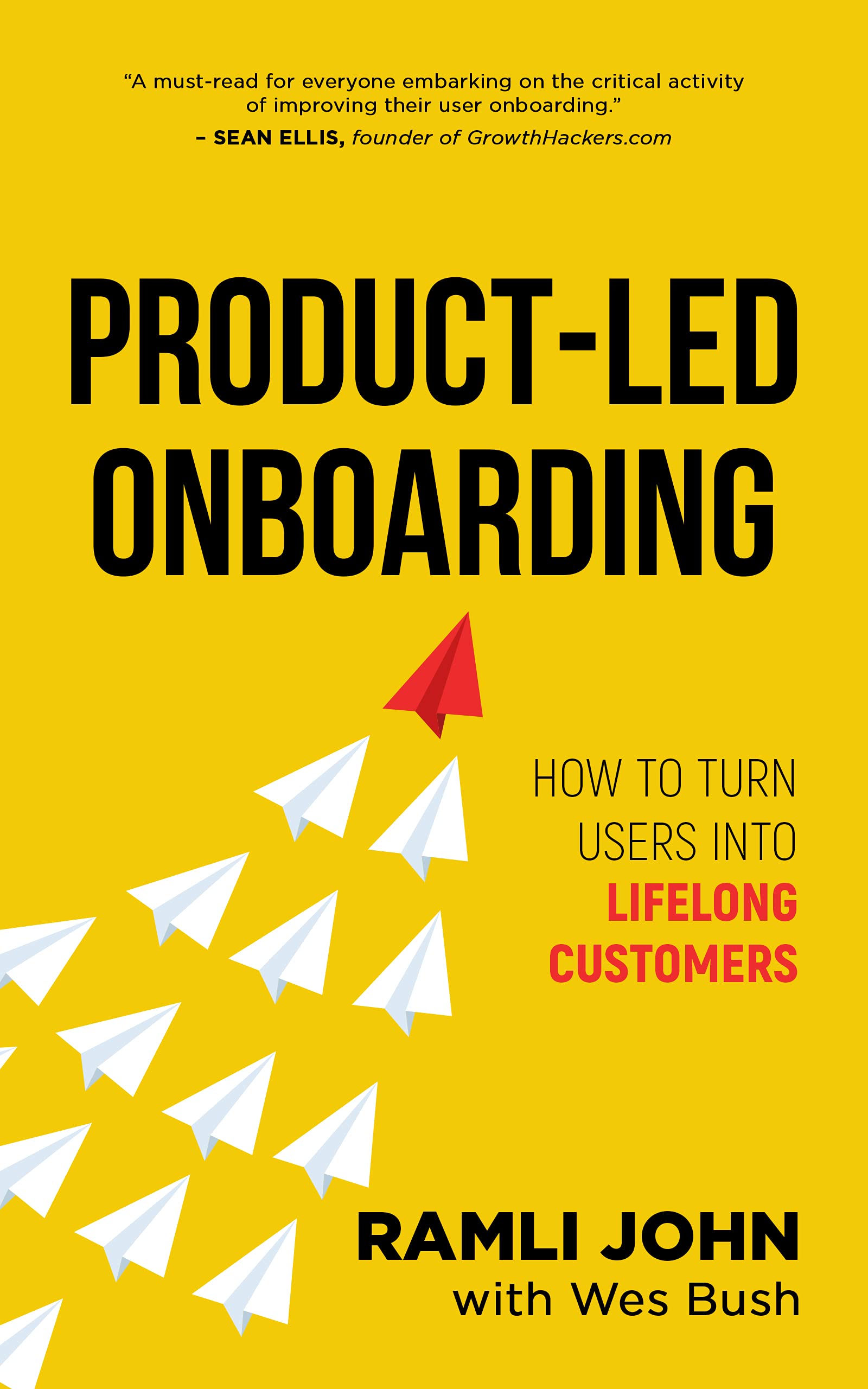
Take {book} with you.
- Download the PDF and EPUB
- Listen to the full audiobook
- Read or listen on your preferred device

Get the complete ProductLed Library for $10 more.
- Product-Led Growth
- The Product-Led Playbook
- Product-Led Onboarding
- All three as PDFs, EPUBs, and audiobooks
- Wes Bush AI to help you apply what you learn
For individual use.
Get all three books
Give your team a shared playbook for growth.
- Everything in the three-book bundle
- Access for everyone on your team
- Each teammate chooses how to read or listen
- Wes Bush AI for every teammate
One purchase. Unlimited teammates.
Get the team bundlePrefer print? Get a paperback on Amazon →