
Free the child’s potential, and you will transform him into the world.
Dr. Maria Montessorri
The first few years of a child's life are crucial. They are the foundation that shapes their future health, happiness, growth, development, and learning achievement. Children need proper nourishment, care, and love to blossom into their true potential. After all, these early years prepare them to become contributing members of society.
This is what Dr. Maria Montessori discovered in 1907 when she opened a school in a slum-ridden district of Rome. Montessori’s “school” was just a few rooms in an apartment building intended for poor families. Her students were a group of three to six-year-old children who had never stepped foot inside a classroom before. Most expected her to fail.
Dr. Montessori got to work to implement the educational materials and methods she developed. She replaced the heavy furniture with child-sized tables and chairs light enough for the children to move. She brought in low shelves so the children could access educational materials on their own. Dr. Montessori also gave her students the freedom to choose and carry out their own activities at their own pace and following their own inclinations.
Thanks to her methods, the children started showing extraordinary understanding, activity, and confidence. By working independently, her students became autonomous and self-motivated.
News of these remarkable children began to spread. People around the world began to visit the classroom. No one could believe the children’s transformation until they saw it in person. Even Queen Margherita of Italy’s royal family made her way through the slums of San Lorenzo to see them!
And it all started with Dr. Montessori’s belief that a child’s potential can be unlocked early on with the right methods and materials in place.
Much in the same way, the earliest stages of the customer journey are crucial in setting new users up for long-term success. By treating them with intentional care during the user onboarding, you lay the groundwork for everything to come. As discussed in the previous chapter, user onboarding directly impacts the future growth of a product, and it starts during the first steps in the Pirate Metrics Framework.

One of my goals with this chapter is to help you get buy-in from the rest of your team on how important user onboarding is to the company’s growth. From my experience, CEOs and company executives realize way too late that they have an onboarding problem, so they don’t invest time and resources on it.
So, in this chapter, you’ll learn the three reasons why user onboarding is so important in a product-led growth (PLG) go-to-market approach and why it’s often overlooked and neglected by companies. We’ll also look at the five signs of bad user onboarding experiences.
If you and your team are already excited to improve your user onboarding experience, feel free to skip this chapter.
Three Reasons Why User Onboarding Is Important
As we’ll soon see, the data doesn’t lie – user onboarding is the crux of the product-led growth strategy. It’s where it all starts.
Here’s why.
1. User onboarding is a retention lever
No matter what industry you’re in, the best customers don’t abandon you after their first purchase. They come back time and again for more.
Though it’s an often-overlooked metric, retention plays a significant role in boosting revenue. That’s because it increases the customers’ lifetime value (CLV).
Retention starts with user onboarding – and the numbers prove it.
ProfitWell studied about 500 different software companies spread between business-to-business (B2B) and business-to-consumer (B2C) companies. They found that customers with a positive onboarding experience were more likely to stick around than those who weren’t happy with it.

HubSpot saw this first-hand with Sidekick, an email tool for salespeople. After making positive changes to the way they nurtured new customers in Week One, they saw a 15% lift in retention during that week. This catapulted into a 50% increase in retained users after ten weeks.

What happened at HubSpot Sidekick is not an outlier.
InnerTrends saw similar data points: users who completed the initial onboarding process were 38% more likely to return one week later.
But it goes even further than that. The effects of user onboarding are even more pronounced once users hit Week 12. For those who completed InnerTrend’s onboarding process, the retention rate is almost three times higher.

When someone first signs up for a product, they’ll either love it or leave it. Those that are successfully onboarded see the value from it and are more likely to stick around, even years later.
This is especially true for SaaS companies:
In working with a number of SaaS portfolio companies, I have found that there are two causes of churn that occur more frequently than any others. They are: failure to successfully onboard the customer and loss of the champion who drove the purchase.
David Skok, General Partner at Matrix Partners
2. User onboarding is a revenue multiplier
A truly fabulous user onboarding experience converts to a revenue multiplier. This is a direct result of improving retention.
We have the numbers to prove it (get ready for some math!).
Let’s go back to the example from HubSpot, where they saw a 15% increase in retention across ten weeks as a direct result of improving user onboarding.
How much did their revenue increase because of this change?
Let’s say they started with 1,000 users and charged each user $5 per week without a free trial period. If you add up the revenue across all ten weeks, it adds up to $21,275. Assuming the revenue and retained users remain the same for the rest of the year at $750 each week after Week 10, the revenue totals $52,775 in 52 weeks.

Now let’s compare that to what happened when they nurtured new customers properly with an improved experience. The revenue from Week 0 to Week 10 adds up to $26,425. Even more remarkable is if the number of retained users and revenue remain the same for the remainder of the year after Week 10. That’s $78,925 in annual revenue, which is a striking 50% increase.

All thanks to a better onboarding experience!
Imagine this is for one cohort of 1,000 users.
Let’s assume that they can consistently get 1,000 new users to sign up each week for the rest of the year. If we assume their new signup growth remains flat at 1,000 new customers per week for one year, the improved user onboarding experience would account for a massive increase of 49% to the monthly recurring revenue (MRR)!
So you see, small improvements in treating new customers with care can result in enormous growth. Plus, those who have a positive onboarding experience are more willing to pay.

The point? User onboarding really does set the stage for future success and has a huge impact on your revenue growth.
So it comes as no surprise the biggest weakness in growth stems from that initial first impression:
In working with a number of SaaS portfolio companies, I have found that there are two causes of churn that occur more frequently than any others. They are: failure to successfully onboard the customer and loss of the champion who drove the purchase.
David Skok, General Partner at Matrix Partners
3. Good User Onboarding Leads To Lower Customer Acquisition Costs
If having an incredible user onboarding experience is a retention lever and revenue multiplier, bad onboarding can lead to higher Customer Acquisition Costs, CAC.
The CAC is easy enough to calculate. Divide all the costs spent on acquiring customers (a.k.a. marketing expenses) by the number of customers acquired in the time period the money was spent.
For example, let’s say a company spent $100 on marketing in one year and acquired 100 customers in the same year. Their CAC is $1.

Let’s revisit the previous example of Hubspot Sidekick. Let's assume it costs $2,000 to acquire 1000 new users and, in this scenario, there's a seven-day trial.
After one week, they have 600 paying customers with the original onboarding or 750 customers thanks to the new onboarding. That amounts to a CAC of $3.33 for the original onboarding and $2.67 for the improved onboarding.
A 15% increase in retention means CAC went down by 20%.

Which one would you prefer to see in your company’s own metrics?
Alright, let’s put this another way.
Perhaps you spend $1 to acquire new signups, converting at 1%. That CAC is $100. But, if you optimize onboarding and increase the percentage of active users who become paying customers from 1% to 2%, that CAC cuts in half to $50.
Excellent onboarding has an abundance of payoffs: it leads to higher activation rates and, subsequently, a lower CAC.
If you’re losing 60% of your new users after the first session, it doesn’t make sense to spend a ton on acquiring signups or your CAC will be high. The unit economics will not work out.
Francois Bondiguel, Growth Head of B2B Marketing and Growth at Canva
The Ugly Duckling of Growth – User Onboarding
Helping new users to perceive, experience, and adopt a product’s value is critical to long-term retention, revenue, and profitability. This doesn’t just appear out of thin air. It takes a well-thought-out strategy to make the magic happen.
User onboarding is often treated like the ugly duckling of growth. It’s largely ignored or assigned as a low priority task to the product or customer success team.
But if it’s so important in a product’s growth story, why don’t the majority of teams invest their resources to improve it?
After working with hundreds of product-led companies, we’ve found a few answers to this perplexing question. The ProductLed team has identified five challenges you might face when trying to improve this experience.
Note: In the next chapter, I’ll provide a framework to help you overcome these challenges.
1. No clear ownership of user onboarding
Who is responsible for the user onboarding experience? Is it the product team or the customer success team?
If no one owns it, then it won’t be prioritized and falls through the cracks. As a result, it takes weeks or even months to see any boosts.
2. Only the product team works on improving user onboarding
This happens because companies believe the first two onboarding myths: that user onboarding starts after a user signs up for the product and ends when users become paying customers. To deliver a seamless onboarding experience, improving it needs to be a cross-functional effort that involves a variety of teams: stretching from sales, marketing, product, and customer success.
3. Misaligned definition of user onboarding across teams
Imagine being in a rowboat, and everyone is rowing in different directions. Good luck getting anywhere in a timely and efficient manner. This is what happens when a product team views user onboarding differently from how other teams see it. It’s important to ensure each team has a clear, aligned understanding of what user onboarding is.
4. No clear quantitative criteria for successfully onboarded users
If you don’t know your destination, then good luck getting there. You need a clearly defined success metric to determine if users have been successfully onboarded or not.
Now the big question is: how do you know when a user has adopted a product into their life or workflow? More on this later.
5. No clear strategy to continuously improve user onboarding
You can’t just slap on a product tour, send a few onboarding emails, and believe you’re going to move the needle. That’s risky behavior. It would help if you had a specific strategy in place based on user research and data. Otherwise, you risk losing users with annoying product tours or spammy emails.
Furthermore, you can’t just work on improving your user onboarding once a year. As you introduce new features to your product, you have to seamlessly integrate these into your onboarding without it becoming bloated.
Five Common Signs of Bad User Onboarding
If you’re reading this and have had a few “Eureka!” moments of your own, then good! You’re acknowledging the pitfalls within your own company. A lack of strategy and ownership are two key elements you won’t want to ignore for too long. Because if you do, you risk stifling your company’s growth.
Like a detective, you should always be on the lookout for signs and symptoms of bad user onboarding.
Not sure where to start?
Here are five common signs of bad user onboarding:
1. Users don’t complete your signup process.
If new users jump through hoops during the signup process, you’ll lose them even before they try your product.
Examine your analytics to determine if new users are getting stuck in the signup process. Are you asking them for a bunch of information that has nothing to do with their initial use of the product?
These are called non-essential fields. They typically consist of questions like, “How many employees do you have?” or, “What are your CRM systems?” Each company will have a different definition of what non-essential fields are. It’s your job to determine if these questions are hindering your signup goals.
These aren’t only hurting your completion rates. It’s biting into the profit margin, too. Marketo found that a few non-essential fields in the signup process increased their cost per lead by up to 25%.

Sure, every field you ask users to fill out could help you learn more about them. One could also argue that with more signup fields, you’ll get higher quality signups because only the most motivated users end up completing it. But, each field in a signup form could be losing you new users. So be sure to consider whether each question justifies the risk of loss.
2. Users sign up and don’t come back.
According to Intercom, 40% to 60% of users who sign up for a free trial use it once and never come back (this happens to be true for the majority of software products).
Mobile apps have it worst: 73% of mobile apps are used only once before they are deleted for good.

But if you deliver a stellar first product experience and help users experience the value of your product, they’ll likely continue to use it.
This is critical.
It doesn’t just involve product tours, either. Get creative and use external triggers like emails, browser or app notifications, and SMS text messages to convince users to return to a product.
3. Users don’t upgrade to a paid account.
Ideally, once users perceive, experience, and adopt the value of your product, they’ll start paying for it. If most users don’t upgrade, it could be a sign that your user onboarding needs some love.
So, what’s a good free-to-paid conversion rate? For freemium businesses, aim for a rate of 2% to 5%. For sales-assisted accounts that include products with free trials, aim for a 15% trial-to-paid conversion rate. For self-serve, unassisted users, this rate will sit a bit lower, at 4%.
Though, this will depend on the annual contract value (ACV) – the higher the price point, the more difficult it will likely be to convert users.

Of course, other variables come into play here, such as the size of the industry and the stage of the company.
4. A high volume of new customers leaves after paying their first invoice.
Have you ever continued to pay for something while not using it? Let’s go back to that lovely New Year’s resolution you made to hit the gym. Gym owners are very aware that some members don’t stick around, so they usually require a long-term contract.
It’s very rare to be forced into a long-term contract for product-led businesses. So, if users are still skeptical about the value of a product, they might pay the first invoice to extend their free trial and then cancel after that.
This is what Jonathan Kim found with Appcues when they had a 14-day trial. Because their price point was relatively low, people would hit the end of the 14-day trial period and buy the product to extend their trial. Unfortunately, they found that most of these users didn’t end up fully testing out their product and churned. So, the Appcues team transitioned to a usage-based free trial that expires after you show 50 Appcues product tours or tooltips on your website.
If you’re finding that a high volume of new users leaves after paying their first few invoices, it could signal users are not finding enough value during the user onboarding to continue paying for it.
5. The customer acquisition cost (CAC) is high or continues to rise.
If good user onboarding leads to lower CAC, then the opposite might imply a user onboarding problem. One reason for this could be “The Bad Onboarding Death Cycle.” If you ignore user onboarding for too long, most new users won’t stick around. As a result, growth flattens or dips.

Instead of identifying and solving the root cause of the problem, teams fall into this cycle because they believe it’s the easy way out. They opt to acquire more users at all costs to make up for the flattening or dipping growth rate.
This is deceiving. At first, growth starts to pick up. But since you’re not investing in showing them the value, they leave. An increasing CAC is a result of this. Don’t fall for the Bad Onboarding Death Cycle.
If your CAC is high or continues to rise, investigate if user onboarding has issues before continuing on.
Treat New Users With Care
Invest in those early moments with your users. By providing a stimulating learning environment, nurturing their growth and development, and treating them with care, users are more likely to find value in a product, and thus stick around and continue paying for it for years to come.
Get it wrong, and it’ll open Pandora's box. A whole host of growth problems will arrive at your doorstep: poor retention rates, decreasing revenue projections, and high CAC.
This is why user onboarding is so crucial and has such an outsized snowball effect on growth – it allows users to unlock the inherent value of a product.
Chapter 2 Summary
- Three reasons why user onboarding is the crux of product-led growth strategy:
- User onboarding is a retention lever. For example, the HubSpot Sidekick team found a 15% lift in retention during the first week of new users resulted in a 50% increase in retained users after ten weeks.
- User onboarding is a revenue multiplier. If you started with 1,000 users and charged each user $5 per week without a free trial period, a 15% increase in the retention during the first week of new users will result in a 50% increase in revenue.
- Good user onboarding leads to lower CAC. Assume it costs $2,000 to acquire 1000 new users and there’s a seven-day free trial. Let’s say improving the user onboarding improved the trial-to-paid conversion from 60% to 75%. That’s a CAC of $3.33 for the original onboarding or $2.67 for the improved onboarding...
- User onboarding is vital because it sets the stage for everything to come, including retention and revenue.
- There are five challenges companies face when improving their user onboarding experience:
- No clear ownership.
- Only the product team works on user onboarding.
- Misaligned definition of user onboarding.
- No clear quantitative user onboarding success metric.
- No clear strategy to continuously improve user onboarding.
- Five signs of bad user onboarding:
- Your users don’t complete the signup process.
- Your users sign up and don’t come back.
- Your users don’t upgrade into a paid account.
- You have a high volume of new customers leave after paying their first invoice.
- Your customer acquisition cost is high and continues to increase.
Action Items to Improve Your User Onboarding
In this chapter, we discussed the importance of user onboarding with sample data. As stated earlier, my goal with this chapter is to help you get buy-in from the rest of your team on how important user onboarding is to a company’s growth.
Share this chapter with your team. You can download the PDF version of this chapter at productled.com/eureka-chapter-2.
If you know how to, create the retention curves for users who did and didn’t complete your current onboarding process. If you don’t know how to, I cover this in more detail in Chapter 6.

Go all in on product-led growth.
Get three complementary playbooks to turn your product into your biggest growth engine. Read or listen anywhere, on your own or with your team.
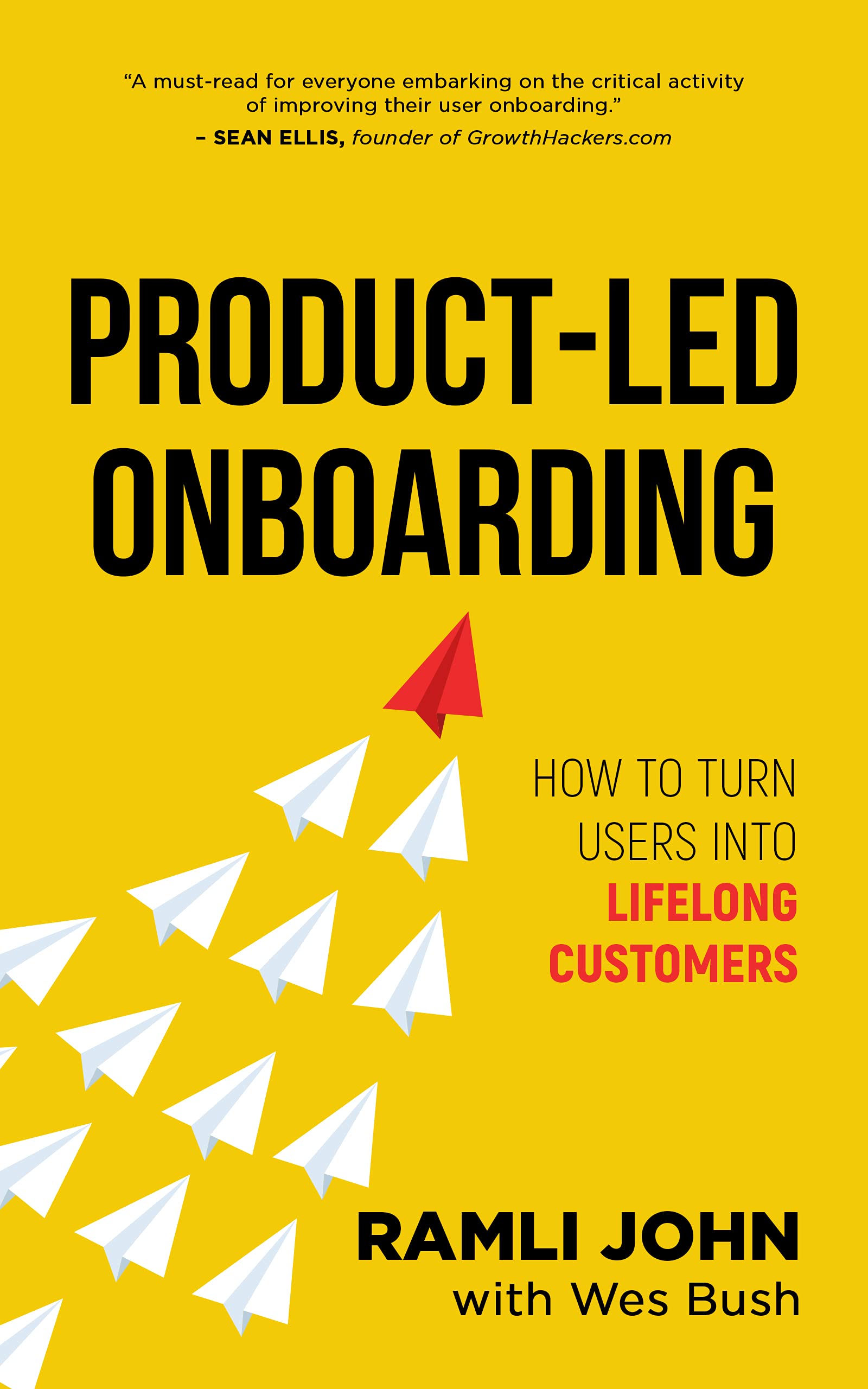
Take {book} with you.
- Download the PDF and EPUB
- Listen to the full audiobook
- Read or listen on your preferred device

Get the complete ProductLed Library for $10 more.
- Product-Led Growth
- The Product-Led Playbook
- Product-Led Onboarding
- All three as PDFs, EPUBs, and audiobooks
- Wes Bush AI to help you apply what you learn
For individual use.
Get all three books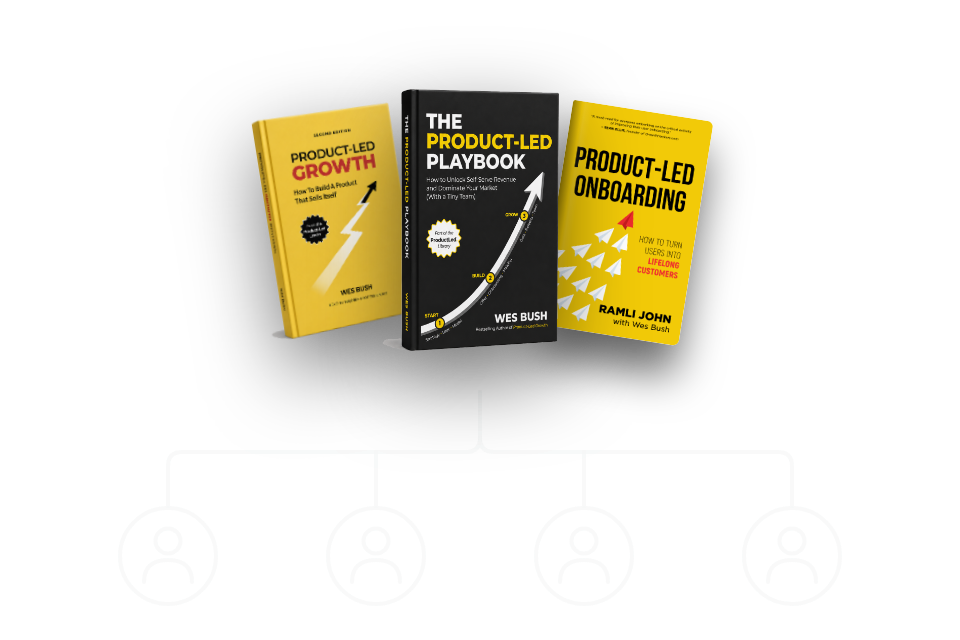
Give your team a shared playbook for growth.
- Everything in the three-book bundle
- Access for everyone on your team
- Each teammate chooses how to read or listen
- Wes Bush AI for every teammate
One purchase. Unlimited teammates.
Get the team bundlePrefer print? Get a paperback on Amazon →