
Building a good customer experience does not happen by accident. It happens by design.
Clare Muscutt
In the first 15 seconds of every new experience, people are lazy, vain, and selfish.
It sounds harsh. But I didn’t say it. Scott Belsky, Chief Product Officer at Adobe, did.
It’s an observation that before users feel invested in a product, they’re all looking out for number one first – themselves.
Think about the last time you tried out a product. What thoughts and questions came to mind first?
- “How will this product help me?”
- “How is this product better than what I’m doing right now?”
- “How will I look if my friends or colleagues found out I’m using this product?”
- “Why would I want to drop what I’m currently doing and replace it with this?”
First, these questions show that we are lazy. We don’t have the time or energy to figure out what a new product is or what it’s not. We want to know now. We have no patience to read long directions. We have no time for steep learning curves. Our default is to find the easiest and quickest path to what we want.
Second, we are vain. We care about how our friends and colleagues perceive us. Once our physiological and safety needs are met, we look for ways to feel loved, connected, and accomplished by others. Whether it’s social apps like Instagram that help us receive more “likes” or a visual reporting tool to help us create presentations at work, products tap into our social needs.
Finally, we are selfish. Even when we’re trying out a product that could help the team be more productive or protects the environment, we want to know what’s in it for us. That’s why assisting new users to achieve quick wins is critical, regardless of a company’s long-term vision.
That’s the real challenge with onboarding—people want the most value for the least amount of time. They are pressed for time, so you have a short window of opportunity to grab their attention and show them the product’s value.
Time-to-Value
For this reason, one of the most impactful tactics to improve user onboarding is to minimize the time-to-value (TTV) as much as possible. This is the amount of time it takes a new customer to realize value from a product.
It’s important to note here that the goal is not to have the shortest possible TTV, but the minimum amount of time for people to experience the product’s value, so they continue using it going forward. This nuance is incredibly important. Some friction is actually good to successfully onboard new users. I’ll discuss this more in Chapter 7.
In a sales-led business model, you can get away with a longer TTV since, in most cases, the customers paid upfront, and they’re usually stuck in an annual contract. Even if it takes a considerable amount of time from purchasing the product to experiencing its value, it’s typically too late for the customers to back out.

In a product-led world where users are easy-come-easy-go (because there is usually no upfront cost), the tolerance for delays and frustrations is much smaller. If your TTV is too long, new users will leave… for good.
Process over Prescription
So, how do you improve a product’s user onboarding to reduce the TTV?
To make it very simple, I could give you a list of best practices and attributes of bad versus good onboarding, like below:

But adopting the wrong best practice could do more harm than good. Being too prescriptive dismisses how unique a product, market, team, and users are.
For example, some users love heavy-handed product tours, while others find it annoying. Some might feel overwhelmed with too many onboarding emails, while others might want more tips and resources.
Instead of explaining what you should and should not do with user onboarding, my goal is to provide a framework and process to help your users perceive, experience, and adopt your product.
The EUREKA Framework
Along with Wes Bush and the ProductLed team, I’ve worked with hundreds of organizations to improve their user onboarding experience from the very first touchpoint. Called the EUREKA framework, this six-step process will shorten the TTV for more new users to be successfully onboarded to your product:
- Establish your onboarding team: To deliver an effective, immersive, and seamless onboarding experience for new users, your approach needs to be collaborative across functions and departments. Onboarding can't just be quilted together from the work of different teams. It must be holistic. If it's not, users will receive a fractured experience. In the next chapter, I’ll help you form an onboarding ‘A’ team.
- Understand your user’s desired outcomes: The best way to successfully onboard new users is to figure out why they signed up in the first place. Particularly, you need to know what value means to users. In Chapter 5, I’ll help you figure out how to do that using the Jobs-to-be-Done (JTBD) framework.
- Refine your onboarding success criteria: Your team needs a clear picture of what it means to successfully onboard new users. In Chapter 6, I’ll help your team identify the onboarding success metric using data. We’ll also define Product Qualified Leads (PQLs).
- Evaluate and optimize your onboarding path: To minimize the time it takes for new users to experience a product’s value, you have to map out the user’s journey to discover which steps should be delayed or eliminated. In Chapter 7, we’ll do just that with Wes Bush’s Bowling Alley Framework.
- Keep new users engaged: To help guide new users to experience a product’s value, consider using triggers both inside and outside of the product. These could include product tours, welcome messages, progress bars, onboarding emails, SMS, and in-app notifications. In Chapter 8, I’ll help you determine which “Product Bumpers” and “Conversational Bumpers” to use for user onboarding using the BJ Fogg Behavior Model.
- Apply the changes and repeat: User onboarding is a continuous process. In Chapter 9, I’ll help you analyze the results and apply the learnings into the next iteration of your onboarding experience.
Ready to experience your own EUREKA moment?
Let’s go!

Go all in on product-led growth.
Get three complementary playbooks to turn your product into your biggest growth engine. Read or listen anywhere, on your own or with your team.
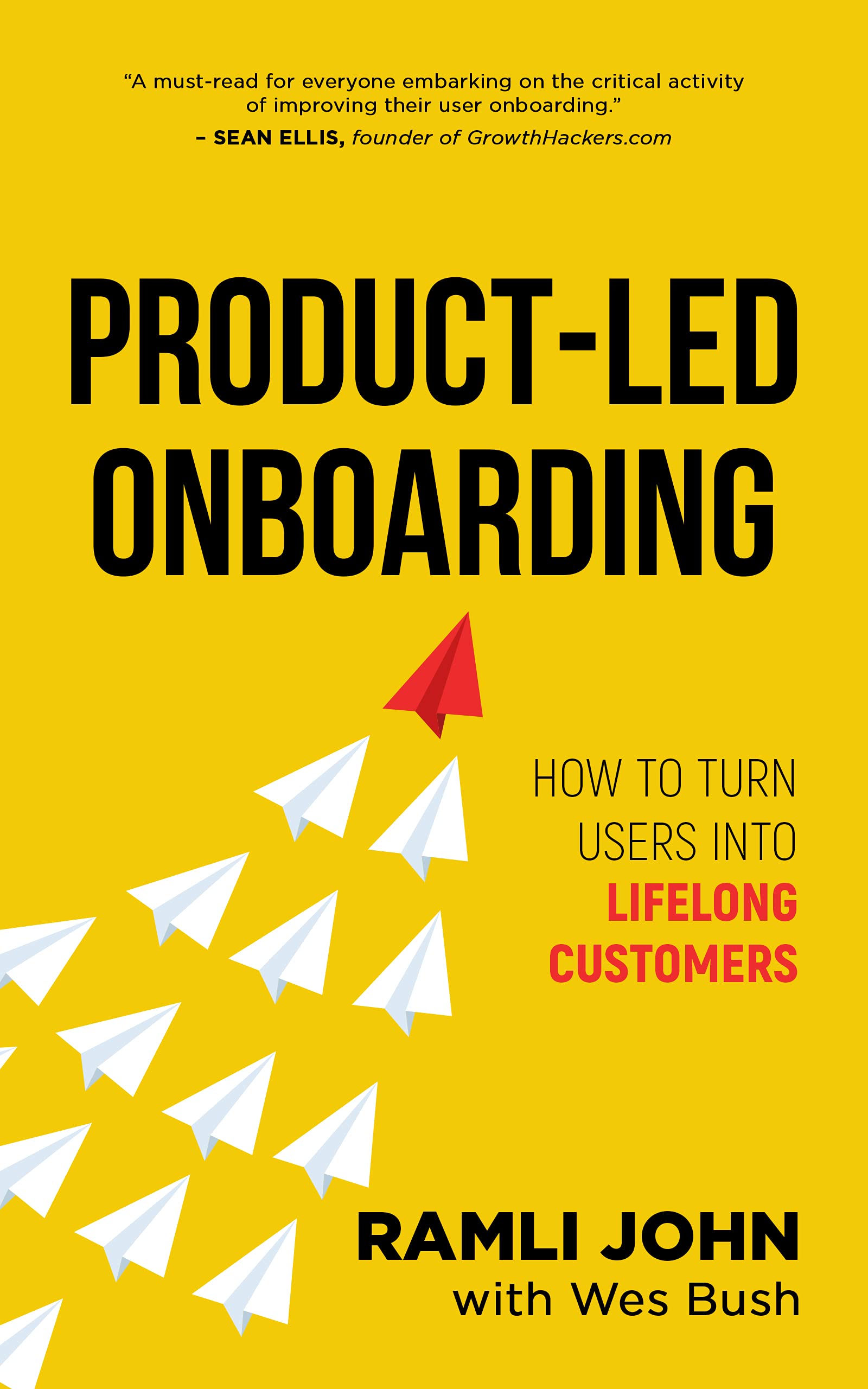
Take {book} with you.
- Download the PDF and EPUB
- Listen to the full audiobook
- Read or listen on your preferred device
Get the complete ProductLed Library for $10 more.
- Product-Led Growth
- The Product-Led Playbook
- Product-Led Onboarding
- All three as PDFs, EPUBs, and audiobooks
- Wes Bush AI to help you apply what you learn
For individual use.
Get all three books
Give your team a shared playbook for growth.
- Everything in the three-book bundle
- Access for everyone on your team
- Each teammate chooses how to read or listen
- Wes Bush AI for every teammate
One purchase. Unlimited teammates.
Get the team bundlePrefer print? Get a paperback on Amazon →