
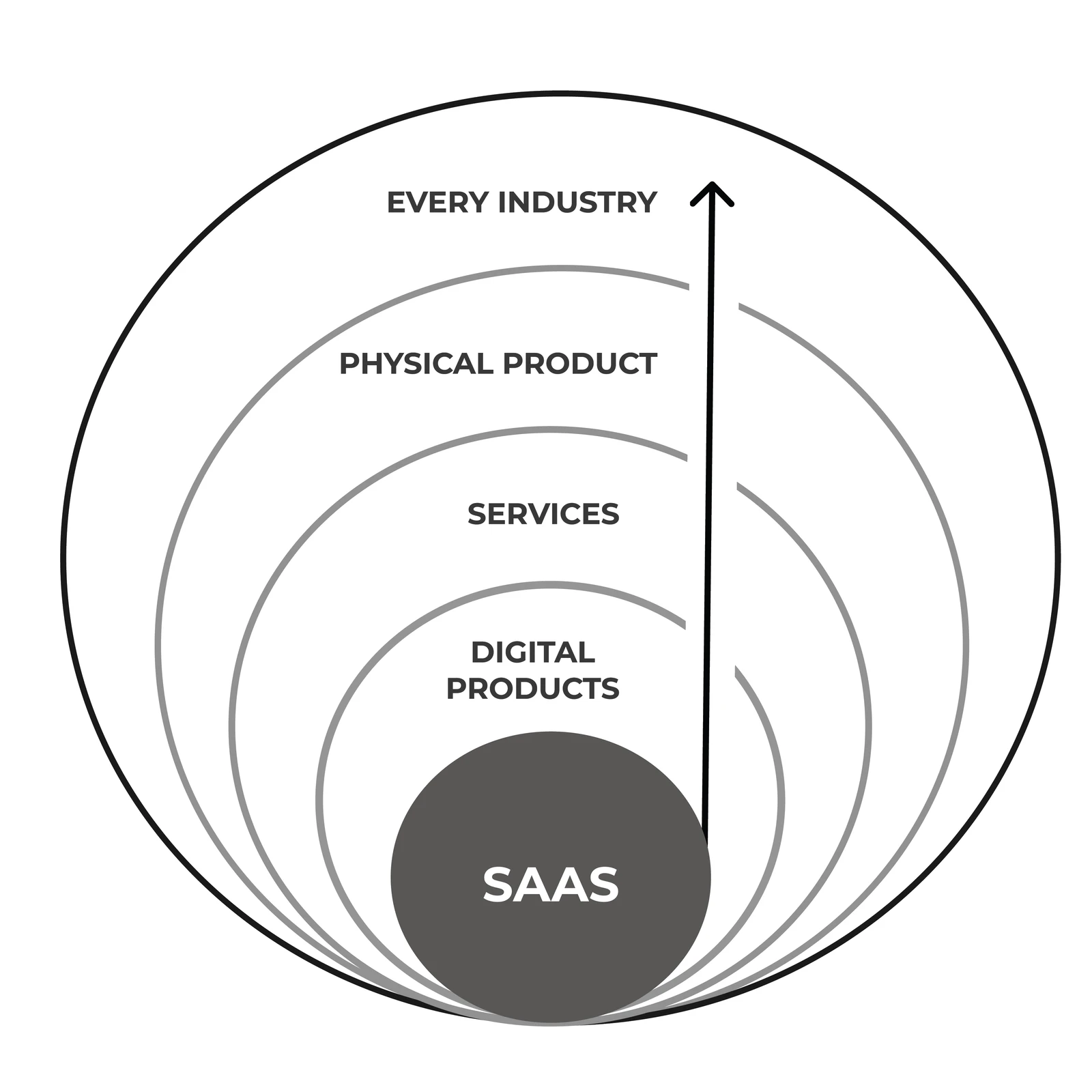
A few years ago, I had an uncomfortable realization about my own company.
ProductLed teaches businesses how to become product-led. We literally wrote the book on it. But when I looked at how we actually sold our services, something didn’t sit right. People had to get on a call with us before they could work with us. That felt sales-led. And if the guy writing the PLG playbook isn’t running a product-led motion, what kind of credibility does that carry?
So I sat with the question for a while. And then I realized I was wrong about what product-led actually meant.
Every single client comes through our content first. They’d read the book and used the frameworks. They’d already implemented pieces of our methodology before they ever spoke to anyone on our team. By the time they showed up to a growth session, they weren’t being sold. They were being shown exactly how we’d scale their business, with a real audit and real recommendations. That session itself was so valuable that people walked away saying, "I need your help to do this."
We weren’t sales-led. We were product-led the entire time.
The call wasn’t the pitch. The call was the product.
That realization cracked something open for me. If a consulting company could run a product-led motion, this wasn’t just a software strategy.
Why the First Edition Was Too Narrow
When I wrote Product-Led Growth in 2019, I focused almost entirely on SaaS. The breakout examples were all software companies, and the research was rooted in software. So I did what most founders do when they’re trying to make an idea stick. I narrowed the scope to make it resonate with a specific audience.
It worked. But it also left a lot of people out.
Over the past few years, I started noticing the same pattern repeating across industries that had nothing to do with software. An industry starts out sales-led because buyers don’t fully understand the product yet, there are few competitors, and trust has to be built through conversation. That’s how most markets begin.
Then the market matures. More competitors show up. Buyers get educated. The category gets crowded, and suddenly every vendor is claiming to be the best. When ten companies make the same promise, persuasion loses its power.
Proof wins.
That’s when product-led growth emerges. Not because some startup invented a clever growth hack. Because competition forces a shift from telling to showing.
Think about an ice cream shop. Nobody buys a new flavor blind. You ask for a sample. You taste it. The product does the convincing, not the person behind the counter describing how creamy it is. In a market with forty flavors, the sample is what closes the sale.
That’s not a marketing tactic. That’s product-led growth.
This shift is happening everywhere. But it doesn’t happen at the same speed in every industry. And the reason comes down to one thing.
The Cost of Proof
Here’s what I missed in the first edition. I drew the line at SaaS versus non-SaaS. The real line is somewhere else entirely.
The reason PLG takes off faster in some industries than others is the Cost of Proof: how much does it cost you to let someone experience value before they pay?
For a software company, the Cost of Proof is close to zero. You flip a switch and a million people can try your product tonight. The marginal cost of one more free user is negligible. That’s why digital products dominate the PLG conversation. The economics are almost unfairly good.
For the cologne counter at the airport, the Cost of Proof is pennies. A spritz from a tester bottle costs the company almost nothing, and it might close a $150 sale on the spot.
For a $1,000 jacket, the Cost of Proof goes up. Someone has to show up to a physical location. You need inventory on the floor. You need a fitting room and probably a salesperson nearby. The proof still happens before the purchase, but delivering it costs real money.
For enterprise software with HIPAA compliance, the Cost of Proof is even higher. You might need a human to walk each prospect through setup before they see any value. It’s still product-led if the prospect experiences value before they pay. But you can’t scale that proof to a million users overnight.
The lower your Cost of Proof, the faster you can scale a product-led motion. The higher your Cost of Proof, the more deliberate you have to be about who gets the proof experience and how you deliver it.
This is why AI is accelerating PLG so fast. AI is collapsing the Cost of Proof in industries where it used to be prohibitively expensive. Think about what Lovable did. Building a working prototype used to require a development team and months of work. Now you write a prompt. The Cost of Proof for "can this tool build what I need?" went from tens of thousands of dollars to close to zero. That’s not a small shift. That’s an entirely new category of product-led businesses that couldn’t have existed five years ago.
The Real Product-Led Test
Here’s where most people get confused.
They think giving something away for free makes them product-led. It doesn’t. Plenty of companies give away free stuff that delivers zero value. A PDF that collects your email but teaches you nothing isn’t product-led. It’s just marketing with a gate on it.
The test has two parts.
First, if you charged for your free experience, would people still pay for it?
If the answer is no, you’re running a lead generation play. If the answer is yes, you’re running something closer to product-led.
That’s the line between a lead magnet and what I call a Proof Experience. A lead magnet captures attention. A Proof Experience proves value. When someone goes through a real Proof Experience, they walk away thinking, "That alone was worth paying for." They don’t feel funneled or teased. They feel like they’ve already gotten something meaningful, and now they want more.
At Canva, its Proof Experience is when you design something using their platform. You’re not looking around their platform, you’re actually producing high-quality designs. That’s by design.
Second, can you deliver that proof at a cost that makes sense for your business?
This is where the Cost of Proof comes in. Your free experience might be genuinely valuable, but if it costs you $5,000 to deliver it to each prospect, you need to be very strategic about who gets it. A SaaS company with near-zero Cost of Proof can offer that experience to everyone. A consulting firm with a higher Cost of Proof needs to qualify first, then prove value. Both can be product-led. The economics just look different.
If your Cost of Proof is astronomical, PLG isn’t your move right now. It doesn’t mean it never will be. Cost of Proof changes as technology changes. Five years ago, the Cost of Proof for AI-generated designs was prohibitively high. Today, Canva does it for free. The question isn’t whether your Cost of Proof will come down. It’s whether you’ll be the one who figures out how to lower it, or whether a competitor will do it first.
What "Product-Led" Actually Means
Here’s where I need to redefine a word that will shape the rest of this book.
In a product-led company, the "product" is not software. It’s whatever mechanism proves your value before the sale.
For a SaaS company, it might be a free trial. For a service business like ProductLed, it’s free IP and high-value consultative sessions. For an education company, it might be a free course that’s genuinely good enough to stand on its own.
The format varies by industry. The principle doesn’t. Founders who build product-led companies obsess over the product because they know that long-term, it’s the only defensible advantage. You can out-market someone for a quarter. You can out-sell someone for a year. But you can’t out-product someone forever unless your product is genuinely better. And the fastest way to prove it’s better is to let people experience it.
"But My Industry Can’t Do This"
That’s the most common objection I hear. And sometimes it’s right.
If your Cost of Proof is so high that letting prospects experience value would bankrupt you, then a fully self-serve PLG motion doesn’t make sense today. If you’re selling software that manages life-or-death outcomes in healthcare, the compliance and setup requirements mean each new user needs real human support before they see value. That’s an expensive Proof Experience. It doesn’t scale the same way a free trial does.
But product-led does not mean self-serve.
Product-led means value before payment.
Self-serve is what happens when your Cost of Proof approaches zero. It’s the ideal state for the majority of your users. But it’s not a requirement. Paubox, for example, still offers every new customer a call with a support specialist to set up their HIPAA-compliant email since it’s a very technical setup. This call is often the difference between success and abandonment. But Paubox customers experience the product’s value before they ever pay for it. The product does the convincing, even when a person helps with the setup.
The real question isn’t whether your industry can be product-led. It’s whether the Cost of Proof in your market is low enough to make it viable, or whether you can find a way to lower it. The companies that figure out how to reduce their Cost of Proof before the competition does are the ones that win.
And right now, AI is lowering the Cost of Proof faster than anyone expected. If your objection last year was "we can’t possibly let people experience our product without a guided setup," it’s worth asking that question again. The answer might have changed.
I wrote the first edition for SaaS companies. I’m writing this edition for anyone who can pass the Product-Led Test.
If someone can experience your value before they pay, and you can deliver that proof at a cost that makes sense, the frameworks in this book apply to you. Whether you run a service business, a marketplace, an education platform, or a SaaS company, the principles are the same.
Every framework from here forward is built on a single idea: the best way to grow is to let your product prove itself.
But knowing that PLG can work for your business doesn’t mean it’s automatically the right move right now. The Product-Led Test tells you whether it’s possible. The next question is whether it’s the right fit for your market, your product, and your stage. That’s what we need to figure out next.

Go all in on product-led growth.
Get three complementary playbooks to turn your product into your biggest growth engine. Read or listen anywhere, on your own or with your team.
Take {book} with you.
- Download the PDF and EPUB
- Listen to the full audiobook
- Read or listen on your preferred device
Get the complete ProductLed Library for $10 more.
- Product-Led Growth
- The Product-Led Playbook
- Product-Led Onboarding
- All three as PDFs, EPUBs, and audiobooks
- Wes Bush AI to help you apply what you learn
For individual use.
Get all three books
Give your team a shared playbook for growth.
- Everything in the three-book bundle
- Access for everyone on your team
- Each teammate chooses how to read or listen
- Wes Bush AI for every teammate
One purchase. Unlimited teammates.
Get the team bundlePrefer print? Get a paperback on Amazon →