
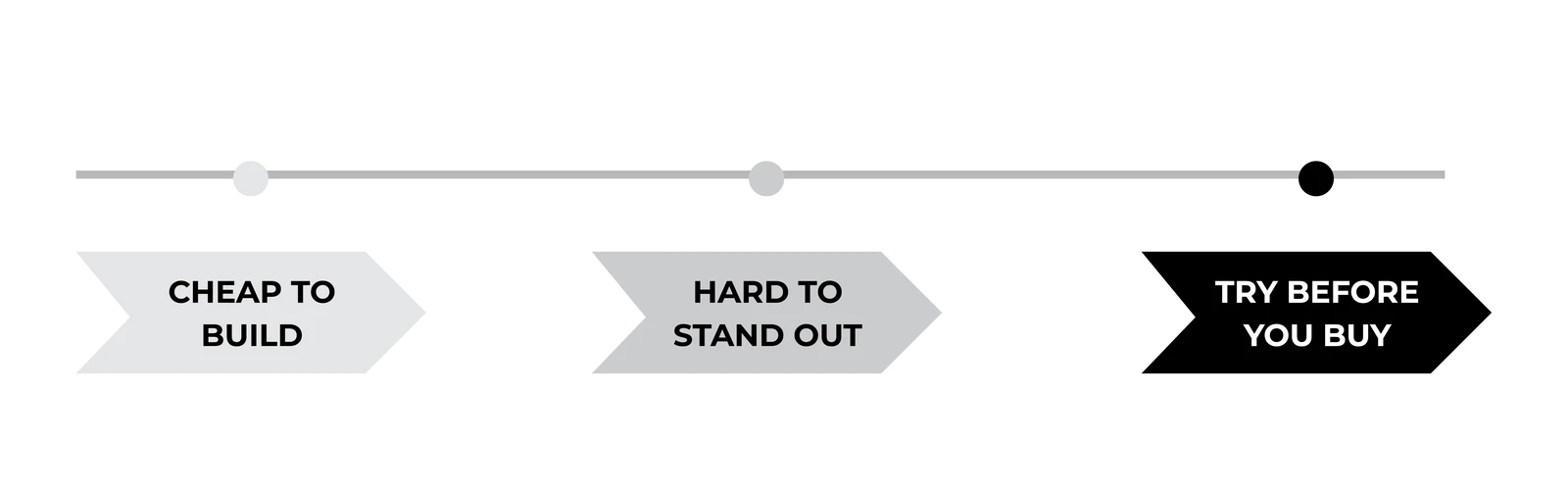
Right now, a tsunami is coming to wipe out thousands of companies.
If you’re reading this book, you already sense something is shifting. Maybe your Customer Acquisition Cost (CAC) keeps climbing. Maybe your sales cycles are dragging. Maybe a competitor just launched a free version of what you charge for, and your pipeline is getting quieter.
You’re not imagining it. The market is changing underneath every business that relies on the old way of selling. And the companies that don’t adapt will be the ones telling war stories about how things used to work.
Three tidal waves are hitting at the same time. And if you’re not on high ground, they will swallow your business whole.
The Three Tidal Waves Coming for Your Business
Here are the three biggest challenges facing businesses today.
Tidal Wave 1: It’s Becoming Easy And Inexpensive to Build a Product
Thanks to AI, it has never been cheaper to build a SaaS company. (HackerNoon even goes so far as to claim that you can now build a SaaS product with $0.) However, because of this low barrier to entry, there’s no shortage of competition. As a result, it’s becoming more expensive to acquire customers.
Across the SaaS industry, the average customer acquisition cost is now roughly $702 per new customer.5 That means companies are spending hundreds of dollars on marketing and sales just to win a single paying customer.
If you have high churn in your business, this tidal wave may be lethal.
Tidal Wave 2: It’s Becoming Harder to Stand Out
As software gets easier to build, differentiation gets harder. Categories are saturated and buyers face more options than they can reasonably evaluate.
The result is brutal math. Only about half of SaaS companies ever reach $1M in ARR within 10 years. Fewer than 10 percent get to $10M. The odds of reaching $25M are closer to two percent.6 For newer companies, the picture is even worse. Since 2019, success rates have declined as faster product creation floods the market while demand and attention remain flat.7
At the same time, buyers are harder to reach and slower to decide. Sales cycles are longer. Buying committees are larger. Most prospects already use hundreds of tools and see little difference between one more and the next.8 What should feel like growth instead feels like shouting into a crowded room.
In a market like this, being “good” is no longer enough. If your product does not clearly stand out, growth stalls long before the business reaches its potential.
Tidal Wave 3: Buyers Expect to Try Before They Buy
In 2024, ProductLed ran a survey asking buyers a simple question: "How do you prefer to buy?" The options were straightforward. Try before you buy, or talk to someone in sales.
97% wanted to try before buying. Only 3% preferred speaking to sales.9
That’s not a preference. That’s a mandate if you want to sell to the modern buyer.
If you’ve used ChatGPT, you’ve witnessed this firsthand. You open it, ask a question, and get answers right away. The entire onboarding experience was handled by the product in less than a minute.
That expectation is now widespread. In 2026, the benchmark for product-led success is delivering value in under 60 seconds. Users should be able to see something useful from your product almost instantly after they start using it, without waiting through long tutorials or complicated setup.
Yet, when we analyzed 568 B2B SaaS homepages, we found 50 percent still only offered a demo. Twenty-eight percent offered a try-before-you-buy experience. Twenty-two percent offered both. Half the market is still forcing buyers through a sales process that 97% of them don’t want.
There’s a massive gap between what buyers want and what companies offer.
These tidal waves aren’t stopping anytime soon. Your business might be able to weather one of them, but do you really want to take a chance on surviving all three?
Why All Three Waves Are Hitting Right Now
These tidal waves didn’t appear independently. One force is driving all of them at once.
AI.
AI is the reason building a product costs almost nothing now. A solo founder with the right prompts can ship a working product in a weekend. That wasn’t possible five years ago. Every month, thousands of new competitors enter markets that used to take years and millions of dollars to break into. The barrier to entry hasn’t just lowered. It’s nearly gone.
That flood of new products is also why standing out is harder than ever. When a competitor can replicate your core feature set in weeks instead of quarters, feature-based differentiation has a shorter shelf life than ever before. Case in point, I know a company that spent years building a low-code app builder watched Lovable come along where users can describe what they want in plain language. Overnight, "the easiest way to build apps" wasn’t a differentiator anymore. AI doesn’t just create more competitors. It makes existing advantages expire faster.
And buyer expectations have jumped from "let me try it" to "do the work for me."
Think about Gamma, which is an AI presentation tool. You don’t open Gamma and start clicking around, dragging slides, or formatting text. You describe the presentation you want and Gamma builds it for you. That’s the new expectation. Users don’t want to learn your product. They want your product to do the job with minimal effort on their part. Every product that still requires users to click through fifteen screens before they see value is now competing against products that deliver results with one prompt.
This is why the timeline for capturing a market has collapsed. Getting to $100M in ARR used to take five to seven years, and that was considered fast. Now every major AI company is hitting $100M ARR in under 12 months or less. The window to become the obvious choice in your category is shrinking from years to months.
If you’re building a product-led company without thinking about how AI changes the game, you’re already behind. AI isn’t a feature to add to your roadmap. It’s the force reshaping every assumption about how fast you need to move, how quickly users expect value, and how long your competitive advantages will last.
The companies that combine a strong product-led motion with AI are growing at rates that were unimaginable five years ago. The ones that ignore it will spend the next decade wondering what happened.
That means the dominant go-to-market (GTM) strategy of the last 30 years is breaking down.
Why the Sales-Led Strategy Is Breaking
If the only way you can sell a product is if someone talks to you, you’re using a sales-led strategy. Even if you have a marketing engine that generates thousands of leads for your Sales team, you’re not off the hook.
That’s because relying on your Sales team to make every sale prevents you from helping your users self-educate. Whether you know it or not, you are adding an incredible amount of friction to the entire buying process. It also keeps your customer acquisition costs (CAC) high. Great Sales teams aren’t cheap.
Sales-led still makes sense in specific situations. If you’re tackling enterprise first with a highly sophisticated solution, the complexities of procurement and implementation may require a high-touch model. If you have a small Total Addressable Market (TAM), relationships will have an outsized impact on growth. And if you’re creating a new category, you need conversations to understand what it takes for customers to succeed before you can build a self-serve model.
But outside of those situations, the downsides are stacking up fast.
The cost alone should give you pause. Most sales-led businesses charge a hefty premium not because the solution is more valuable, but because the acquisition model is more expensive. As Paul Graham, founder of Y Combinator, states, "The more it costs you to sell something, the more it will cost others to buy it." If you currently use a sales-led GTM, you need to watch out for competitors with a more efficient acquisition model. They can steal your market share by offering a comparable product at a lower price.
The acquisition model is also leaky. According to SiriusDecisions, 98% of marketing-qualified leads (MQLs) never result in closed business.10 Think about that. The entire MQL machine encourages marketers to gate content, treats downloading an ebook as a buying signal, and rewards creating friction in the buying process. Does downloading an ebook mean you’re ready to buy? Absolutely not.
And here’s what rarely gets talked about. According to Elie Khoury, CEO of Woopra, the typical sales-led business treats the team that creates the product as a cost center. When your organization leads with sales and follows with product, the product becomes an afterthought. If the Sales team closes a big customer on the condition of a few product tweaks, the Engineering and Product teams have a new project to do.
That’s not just my take. These are the exact words from the CEO of a company that raised a Series C from great investors, is growing rapidly, has strong customer retention, and a top-notch leadership team:
"My biggest regret is that our first customer was $1M ACV. Ever since that first customer, our product, go-to-market, and our support model have all been pulled in one direction: high-end enterprise. We’ve never been able to get off the elephant-hunting treadmill. Our board, our employees, everyone expects us to go after customers as large or larger than our first customer. And I’ve been watching this new competitor emerge that’s going after the same market as we are, except from the low end. They are tiny but growing rapidly. And it’s too hard for us to compete with them."
His words reinforced something I have long believed: truly great companies are built to be product-led.

Go all in on product-led growth.
Get three complementary playbooks to turn your product into your biggest growth engine. Read or listen anywhere, on your own or with your team.
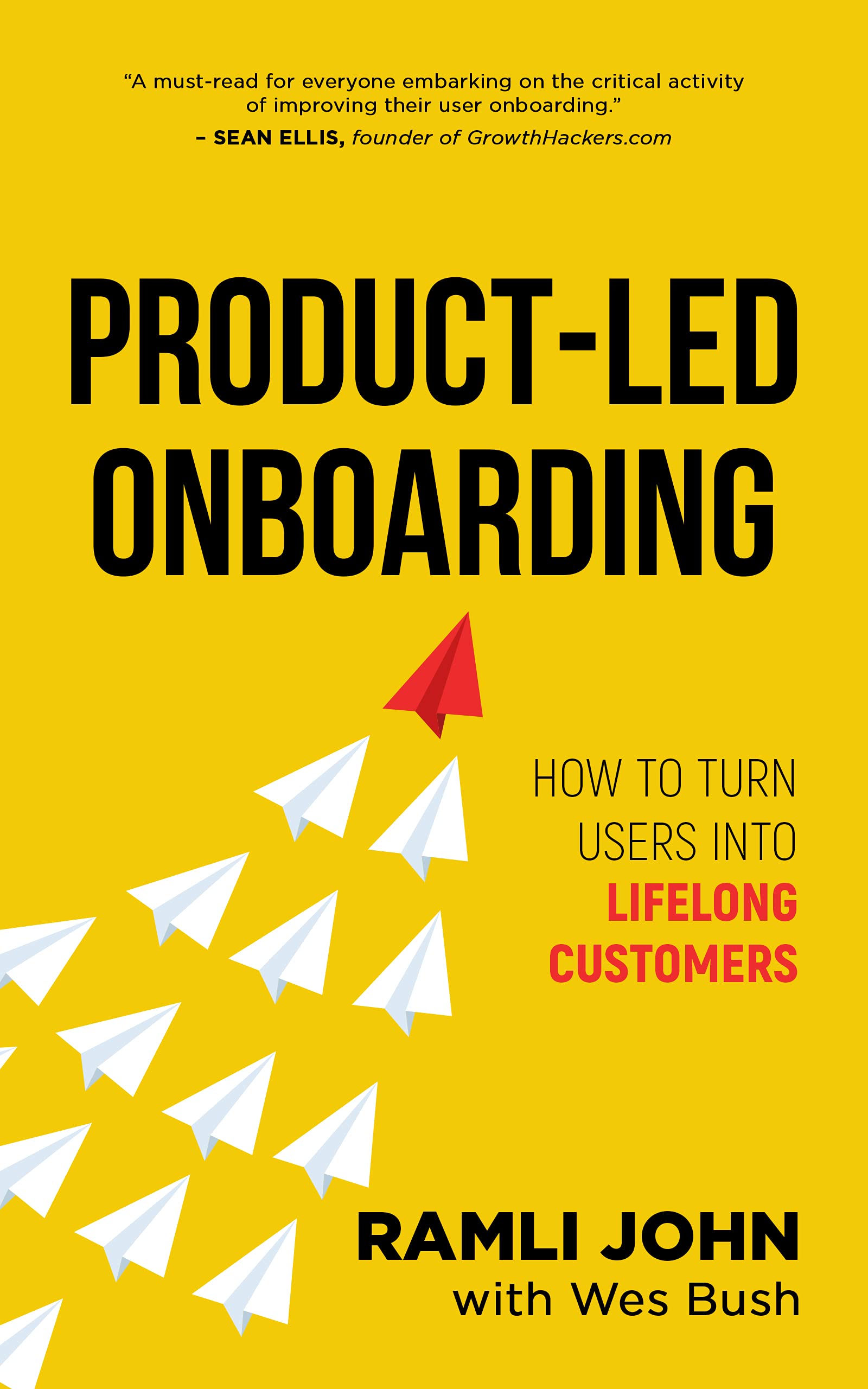
Take {book} with you.
- Download the PDF and EPUB
- Listen to the full audiobook
- Read or listen on your preferred device
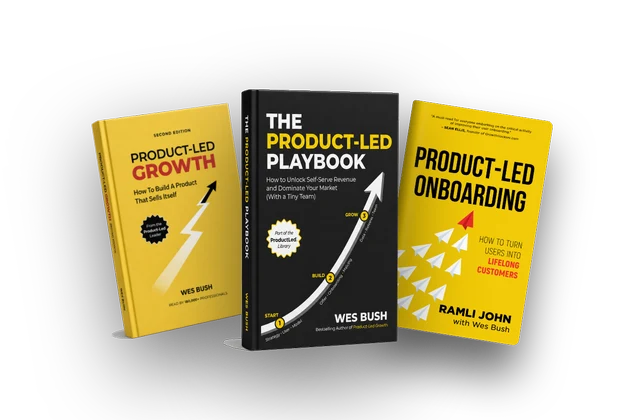
Get the complete ProductLed Library for $10 more.
- Product-Led Growth
- The Product-Led Playbook
- Product-Led Onboarding
- All three as PDFs, EPUBs, and audiobooks
- Wes Bush AI to help you apply what you learn
For individual use.
Get all three books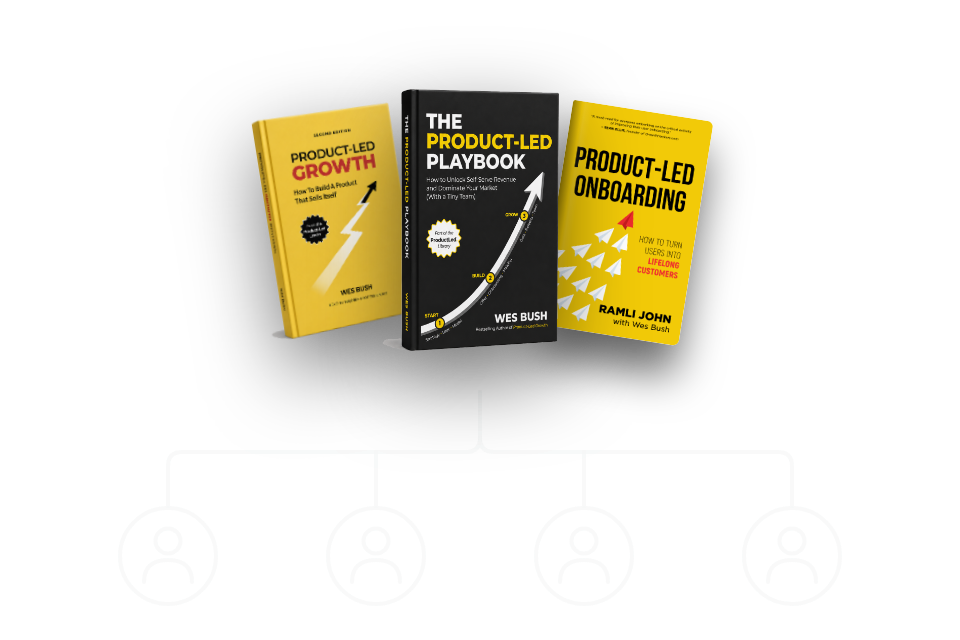
Give your team a shared playbook for growth.
- Everything in the three-book bundle
- Access for everyone on your team
- Each teammate chooses how to read or listen
- Wes Bush AI for every teammate
One purchase. Unlimited teammates.
Get the team bundlePrefer print? Get a paperback on Amazon →