
Introducing The ProductLed System: How It Works
The ProductLed System is your roadmap to scaling your product-led business and becoming the obvious choice in your market.
This isn't another theoretical framework—it's a system grounded in real-world experience, practical methods, and first-principles thinking. More importantly, it works. Over the years, through hands-on work with clients, I've developed a practical approach to help you build a world-class product-led business.
The ProductLed System focuses on nine key components for scaling a product-led business. These components embody the 80/20 Pareto principle: 80% of your results will come from just 20% of your efforts. By mastering these components, you'll realize your vision faster without working harder.
While the system is straightforward to understand, it requires time and effort to implement effectively within your organization. It didn’t appear overnight; it’s the culmination of over 10,000 hours of planning, teaching, coaching, and solving leadership challenges.
This system delivers three core outcomes: Effortless ARR, Lean Scale, and Durable Growth.
It’s structured around three crucial stages, each with three distinct components. These components build on one another in a specific order, ensuring that your efforts yield maximum impact. For instance, optimizing onboarding without a clear offer is futile, and scaling your team without customer traction is a drain on resources.
It’s important to note that this system is not a one-time fix. The ProductLed System is a living, breathing framework designed to evolve with your business. At a minimum, you should go through a full cycle of the system once a year. For fast-growing companies, up to four cycles a year may be necessary.
And it all starts with mastering the fundamentals.
Stage 1: Build an Unshakeable Foundation
You can’t build a skyscraper on a shaky foundation.
During this stage, your job is to fine-tune the fundamentals of your product-led business so it can withstand the strain of significant growth. You’ll craft a winning strategy to stand out from the competition, get to know your ideal users better than anyone in your market, and identify and refine the best product-led model.
You build the foundation by dialing in three critical components.
Winning Strategy
You must be crystal clear on what you do best and align that with market needs. You need a strategy to direct everyone’s energy in one direction. Focus is key.
The Bullseye Strategy Framework will help you:
- Understand how to become the obvious choice in your market.
- Be crystal clear on what your company is really good at doing.
- Get a clear picture of what winning looks like for your business.
- Design a business that is hard to copy.
The next step is to define your ideal user.

Ideal User
The truth is, most companies think they understand their users deeply, but they don't. The ones that do, however, capture the maximum market share by knowing their users better than anyone else.
Users are the lifeblood of any product-led business. You need to know your users well. In this component, you’ll go through how to understand your users better than anyone else in your market. You’ll go beyond just understanding their job-to-be-done and put yourself in their shoes to understand what they think, feel, and do at each stage of interacting with your product.
After installing the User Endgame Roadmap, your entire organization will:
- Know your best users.
- Align on the endgame for your users.
- Know users’ top challenges.
When you know what makes your users tick, you can proactively address challenges and design a product-led model that helps users accomplish something meaningful, albeit for free.

Intentional Model
A product-led model determines what you give away for free and what you gate behind a paywall. A good product-led model gives users everything they need to see incredible value. A bad product-led model typically fails to deliver enough value. The telltale sign of a bad product-led model is a low free-to-paid conversion rate.
I’ll help you identify the right product-led model for your ideal users—one where they can experience the right value and feel tempted to upgrade.
With the DEEP Model Framework, you’ll:
- Gamify your user journey.
- Decide what to give away for free vs. what to monetize.
- Identify what model works best for your business (i.e. freemium, free trial, etc.).
Once you’ve built an unshakeable foundation, you’re ready for users to upgrade without talking to you.
Stage 2: Unlock Self-Serve Customers
The second stage builds a product that sells itself. The monumental shift is changing how you sell. By providing incredible value before monetizing users, you make upgrading a no-brainer.
The goal is to move from high-touch to zero-touch. But that can only happen if users can sign up, get to value, and upgrade without talking to you. That’s how you achieve Lean Scale and Effortless ARR.
To do that, you must craft an irresistible offer.

Irresistible Offer
Crafting an irresistible offers requires understanding three undeniable facts about your product:
- What are the results of using your product?
- Why is there less risk when using your product?
- How is your product better than the competition or alternative solutions?
The tricky part is communicating this quickly so that users immediately understand what you do, especially if you’re not in a well-established category.
The 5-Star Offer Generator ensures you have:
- A compelling core offer.
- More ideal users signing up for your offer.
- A higher free-to-paid conversion rate.
Once you’ve got more motivated users than you can handle, it’s time to improve onboarding.

Frictionless Onboarding
Leverage comes from making it easy for users to sign up, get to value, and upgrade. Eliminating friction is how you do it.
The Bowling Alley Framework will show you how to:
- Create a fast path for users to experience value.
- Add bumpers to make it effortless to get to value.
- Proactively support users when they drop off.
By the end of the Onboarding Component, the percentage of users who experience the full value of your product will skyrocket.
Then, it’s time for them to upgrade.

Powerful Pricing
To turn users into high-paying customers without talking to you, you must offer transparent, strategic pricing that is simple to understand. A strategic pricing model starts at an accessible level and scales as the user derives more value from the product. Costs grow in line with the value the user achieves.
With the Value Ladder Framework, you’ll:
- Have more free users upgrading to a paid plan.
- Unlock higher customer lifetime value.
- Increase net revenue retention (NRR).
Altogether, these three components unlock self-serve customers. At this point, you’re ready for exponential expansion.
Stage 3: Ignite Exponential Expansion
Finally, the third phase is all about structuring your team and processes to 10x their impact, transitioning you from incremental to exponential growth. Actionable data is the starting point.
Actionable Data
Most companies have complex scorecards and track too many metrics. You need simplicity to understand your business' core bottleneck.
With the True North Framework, you’ll:
- Identify the North Star metric to align your entire company.
- Provide a simple scorecard to break down your GTM and financial metrics.
- Pinpoint your #1 bottleneck so you always know where to focus.
Once you know the bottleneck, you must have the growth process in place to eliminate it.
Growth Process
To attain predictable growth, your entire team must translate action into results.
When you install the Predictable Growth Process, you’ll:
- Establish consistent rhythms to evaluate the company’s performance and proactively launch experiments to tackle your biggest bottleneck.
- Turn your entire company into a growth team.
- Accelerate execution.
With this process, you'll gain momentum as a team and grow faster as a byproduct. The final component is all about building an elite team.

Elite Team
In a product-led business, your product is the machine, not your team. That’s what gives you leverage and helps you maintain lean scale with a high revenue per employee (RPE).
With the Elite Team Flywheel, you’ll:
- Increase your RPE by designing a lean team.
- Uplevel the performance of your team.
- Align incentives so everyone rows in the same direction.
Altogether, the Data, Process, and Team Components ignite exponential expansion and profitability through focus. You zero in on high-confidence bets and go all-in with your resources.
Install Your Operating System
The ProductLed System is a GTM Operating System for your business.
Just like your computer runs Windows or macOS, your company has an operating system, too. To stay relevant and protect yourself from threats, you need to update each component throughout the year or, at the very least, review them to ensure they’re still relevant.
When you consistently update the ProductLed System, you’ll stay ahead of market trends, address opportunities sooner, and grow faster. That’s why at ProductLed, we continually refine the ProductLed System, using insights from hundreds of clients to adapt to new market conditions and optimize what works.
One of the most common pieces of feedback I get from founders who implement the ProductLed System for the first time is that they end up working less but have way more impact.
That’s my goal for you—to move from frenetic to focused, with a sustainable pace of execution that provides more bang for your buck. How close are you to that right now?
Define Your Starting Point
Understanding where your company stands is crucial to making the ProductLed System work for you. By pinpointing your current position, you can track the tangible impact the system has on your business. This will help you see the cause and effect as you move closer to becoming the obvious choice in your market.
Benchmark your business in three core areas.
Effortless ARR
How can you build a product that sells itself?
The main metric is self-serve revenue (SSR). SSR is truly effortless ARR because users can sign up, get to value, and upgrade without talking to you.
Benchmark where you are today by placing an X in the column that best describes the current level of your business:
| SSR Ranges | Level 1 | Level 2 | Level 3 | Level 4 |
|---|---|---|---|---|
| $0 to $1M | Tiresome Customers | |||
| $1M to $5M | Sporadic Sales | |||
| $5M to $20M | Predictable Revenue | |||
| $20M to $50M+ | Absolute Leverage | |||
| Current Level | ||||
| Next Level | ||||
Take a minute to reflect on where you want to be in the next three years. Choose at least one level up from where you are today.
If you’re already at Level 4, write down what Level 5 will be for you (e.g., $100M or $200M+ SSR).
After analyzing thousands of businesses, only 5% achieved more than $10M SSR.4 The rest have, at best, sporadic sales.
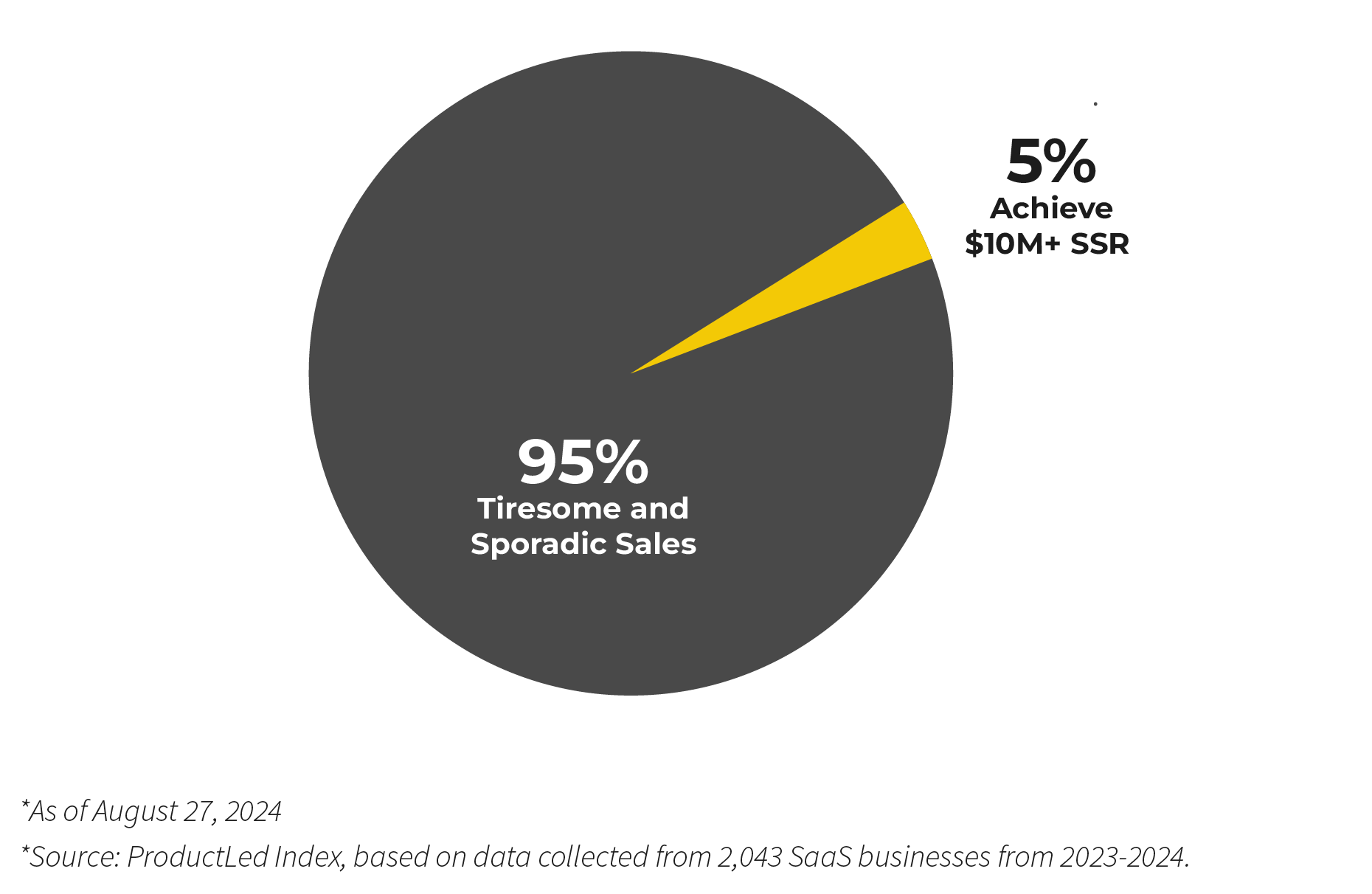
The ProductLed System will help you skyrocket your SSR and get you into the top 5%.
Lean Scale
How can you build a big business with a tiny team?
A tenet of building a product-led business is that your product does more heavy lifting as you scale.
The main metric is your revenue per employee (RPE). Calculate this by dividing your total revenue by the number of employees you have. For example, if your revenue is $1M this year and you have 10 full-time employees, your RPE is $100,000.

A high RPE means you’re efficient and have a product that does the heavy lifting. A low RPE typically means your business is overly reliant on people.
Benchmark where you are today and where you want to be in three years:
| RPE Ranges | Level 1 | Level 2 | Level 3 | Level 4 |
|---|---|---|---|---|
| $0 to $100k | Treading Water | |||
| $100k to $300k | Streamlined Company | |||
| $300k to $700k | Prolific Performers | |||
| $1M to $2M+ | Ace Team | |||
| Current Level | ||||
| Next Level | ||||
If you’re already at Level 4, write down what Level 5 will be for you (i.e., $3 to $5M RPE). Only 4% of companies ever enjoy an RPE of $1M+.5
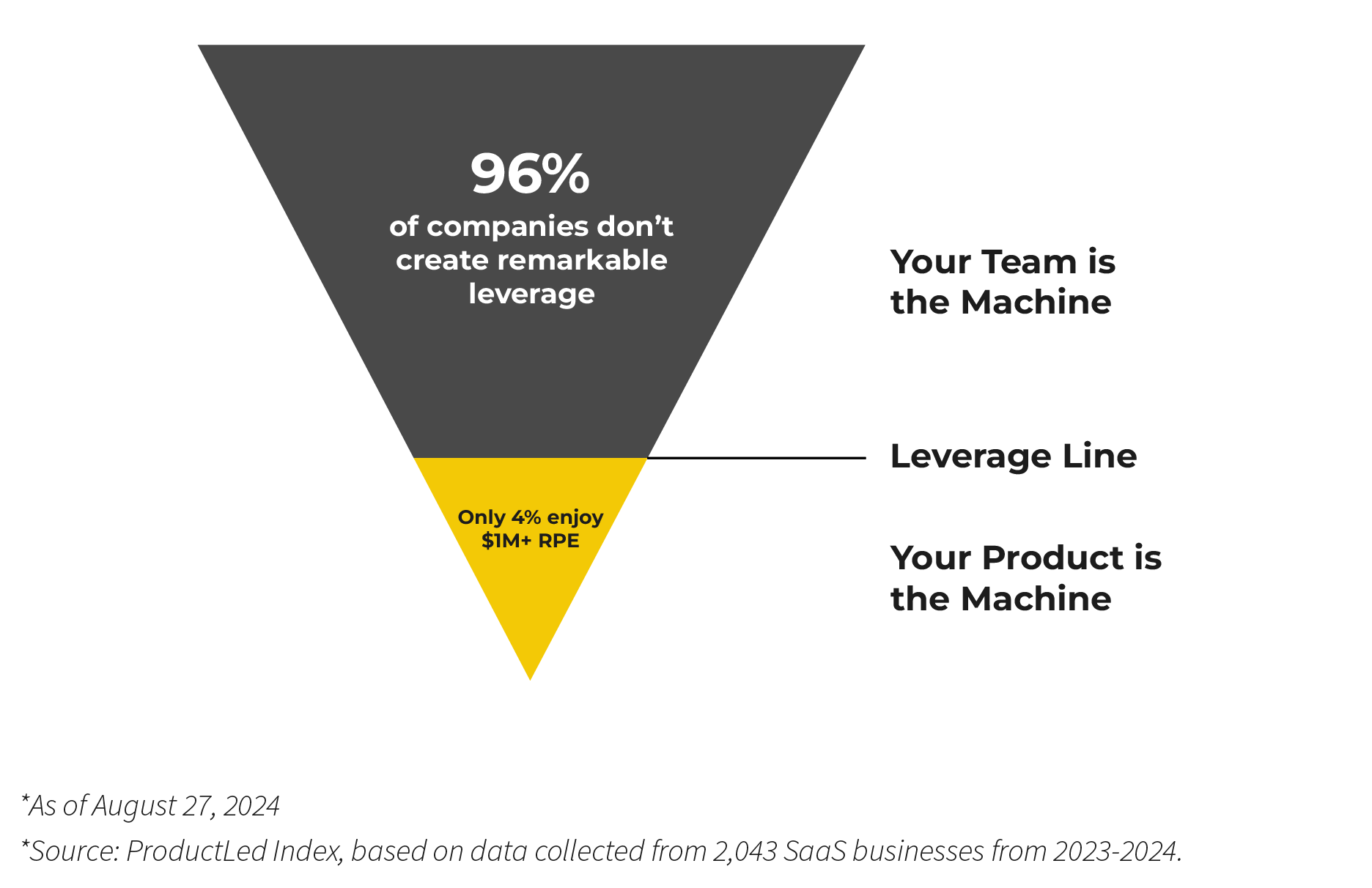
Everything above the “Leverage Line” means that your team, not the product, is the machine.
Companies without leverage often find themselves trapped in a cycle of overwork and inefficiency. Instead of effortless scale, growth demands more resources and manual effort. This not only limits profitability but also stifles innovation. Operational demands consume the team and reduce bandwidth for forward-thinking initiatives.
To break from this cycle, shift your focus from scaling through people to scaling through products. Your product should be your best employee, salesperson, and customer service rep.
It drives revenue, attracts customers, and scales effortlessly—all while your lean team focuses on steering the boat, not rowing it. Companies that achieve this level of efficiency and leverage dominate their markets.
Sustaining that dominance requires durable growth.
Durable Growth
How can you unlock more profits every year?
A lack of profitability makes companies fragile. One little bump in the road can be fatal.
A company with high profitability can withstand many bumps but isn’t invincible. For instance, a CEO could simply harvest profits for short-term gains at the expense of marketing and product development.
You want durable growth—profits that increase every year like clockwork. This requires your business to evolve to cope with ever-changing market demands.
Mark your net profit for today and where you want to be:
| Profit Ranges | Level 1 | Level 2 | Level 3 | Level 4 |
|---|---|---|---|---|
| $0 to $100k | Tiny Profits | |||
| $100k to $1M | Small Reserve | |||
| $1M to $5M | Fair Fortune | |||
| $5M to $10M | Automatic Profits | |||
| Current Level | ||||
| Next Level | ||||
You might be thinking that this metric doesn’t really measure year-over-year profit growth. You’re right.
Most companies we work with start with small profits. We need to help them get to sizable profits before we start worrying about annual profit growth. Tracking these profit milestones is good enough for 95% of founders.
If you’ve already hit “Automatic Profits,” congrats! You can swap out measuring profit for Net Profit Growth Rate. Here’s the formula:

For example, if your company’s net profit was $500,000 last year and increased to $600,000 this year, the Net Profit Growth Rate would be 20%.

Where do you stack up today, and where do you want to be?
| Net Profit Growth Rate Ranges | Level 1 | Level 2 | Level 3 | Level 4 |
|---|---|---|---|---|
| 0 to 10% | Inflationary Growth | |||
| 11 to 20% | Solid Growth | |||
| 21 to 49% | Breakout Growth | |||
| 50%+ | Hypergrowth | |||
| Current Level | ||||
| Next Level | ||||
Only 4% of companies ever generate $10M+ profits.6 Why? Because the market leader becomes the obvious choice and enjoys automatic profits.
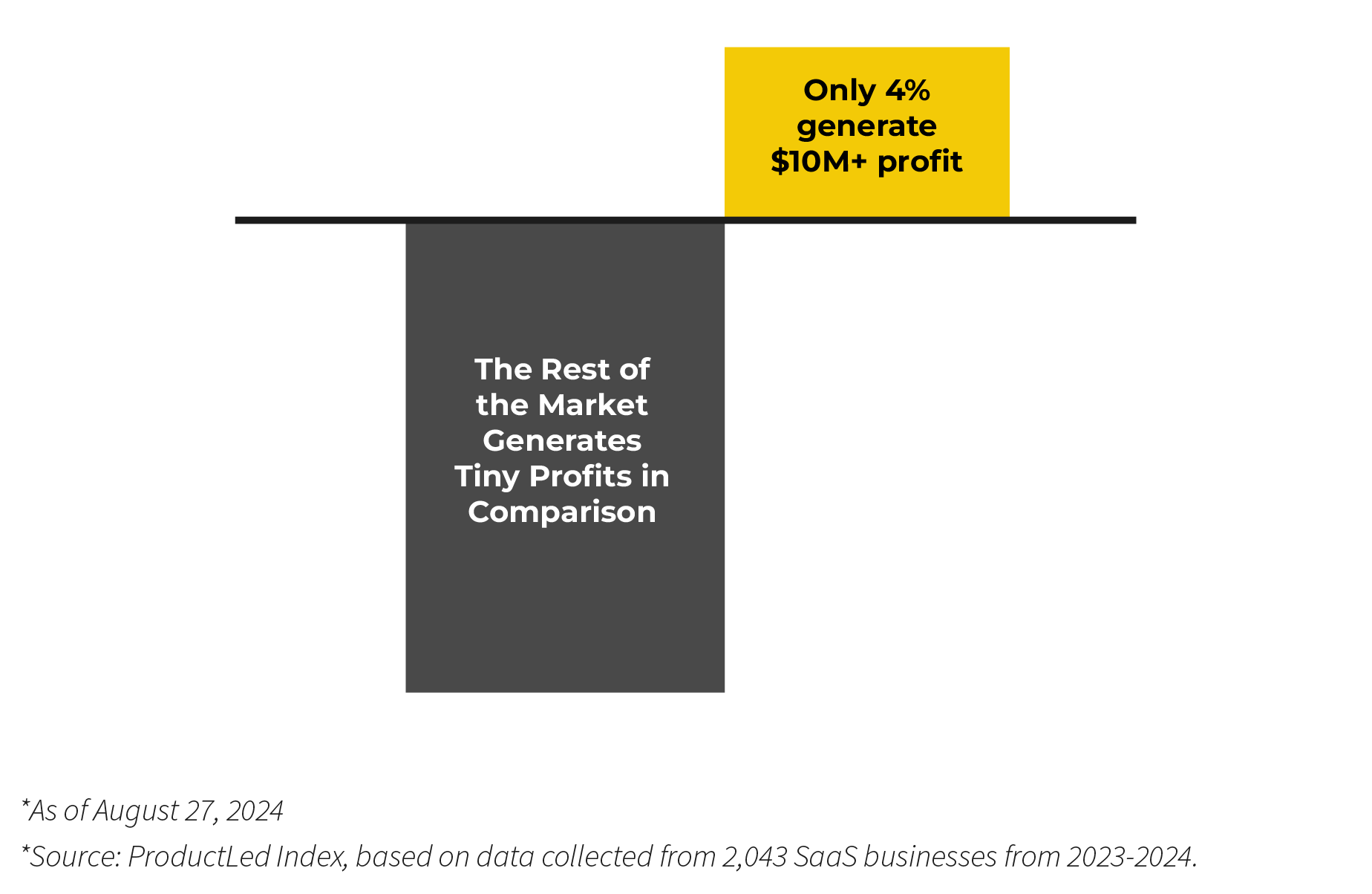
When you become the obvious choice, users and customers all refer your product to their friends and colleagues. That’s the goal.
As a product-led founder, you’ve invested more time and energy in building your product than anyone else. You have a mission to make whatever you do more accessible, affordable, or simple.
Your product deserves to become the obvious choice in your market. Let’s get to work.