
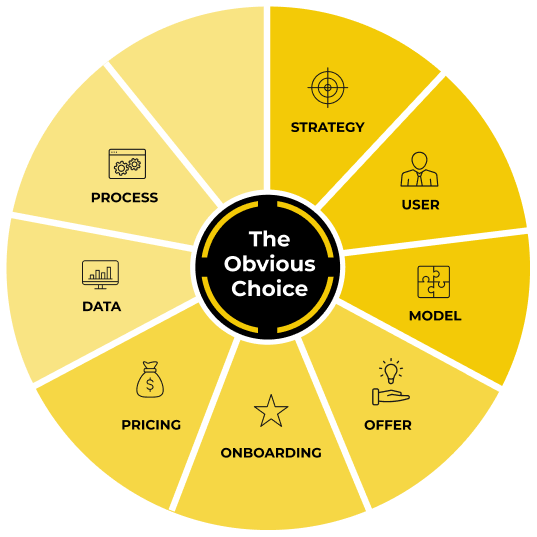
The Predictable Growth Process is a simple framework of recurring meetings that helps your team turn strategy into focused execution. It runs on three core meetings, from a quarterly Strategic Alignment Meeting to a quick Weekly Accelerator Meeting, with a Monthly Focus Meeting in between that points 80% of the team’s effort at one goal.

Rate yourself from 1 to 10.
Execution makes you the best, even if you’re not the first.
Apple didn’t invent the portable music player; they perfected it with the iPod. Google wasn't the first search engine; they provided the best results. Electric vehicles existed before Tesla; Tesla made them desirable.
The same goes for your business. To win, you must out-execute everyone. It takes relentless focus to turn your strategy from theory to practice—and it’s where most companies stumble.
Challenges like unclear goals, team misalignment, and inconsistent execution hold organizations back from reaching their potential. Without a structured process, even the best strategies get lost in the chaos of daily tasks, scattering teams, and stalling progress.
Enter the Predictable Growth Process—a simple framework to help your team stay focused, aligned, and take consistent action that actually makes an impact. It’s not about doing more; it’s about executing the key initiatives that drive growth.
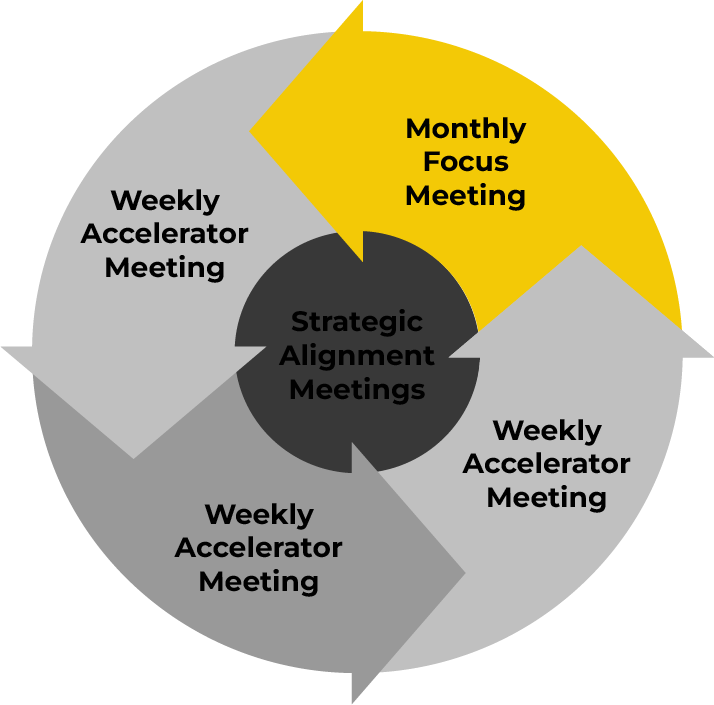
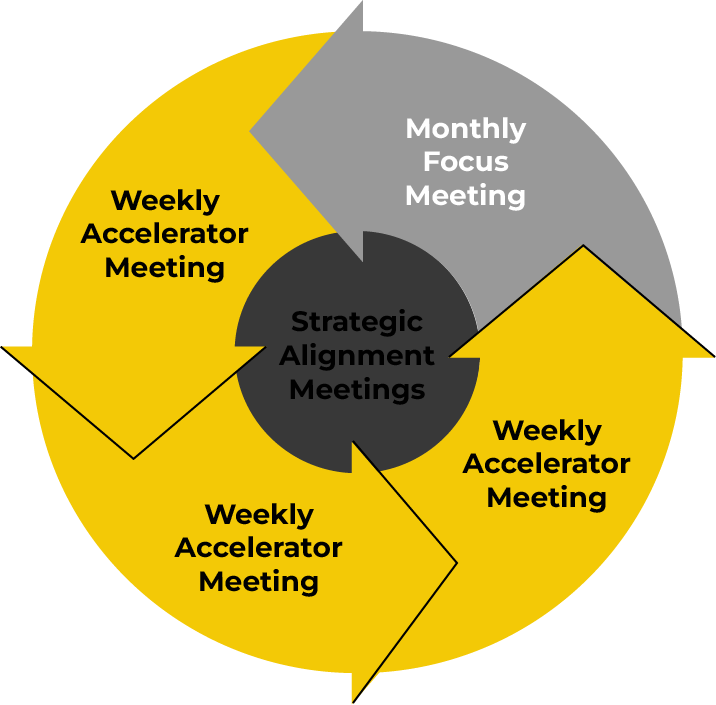
It revolves around three core meetings that transform how your team operates. These meetings create a rhythm that enables your company to move faster, execute better, and stay laser-focused on the goals that will make the biggest impact.
At the top, there are Strategic Alignment Meetings (SAM). These quarterly, high-level sessions sharpen your long-term strategy and ensure every department—from product to marketing—is on the same page. They are about stepping back to assess your progress, refine your strategy, and ensure that the entire leadership team aligns with the upcoming quarter’s goals.
Next, there are Monthly Focus Meetings (MFM). This is where strategy becomes action. You’ll break down your quarterly goals into a focused, 30-day plan that ensures 80% of your team’s efforts drive toward one goal.
Note: I highly recommend not facilitating these two meetings yourself. When planning your quarter and month, you want to be laser-focused on identifying your top priorities—not managing the process. Don’t dilute your focus when it counts.
Finally, Weekly Accelerator Meetings (WAM) keep the momentum going. These quick, high-energy check-ins provide the accountability and clarity needed to make every week a step toward your monthly goals. These meetings help identify bottlenecks, resolve issues, and ensure your team is executing with precision.
🎁 Action Tool: High-Impact Meeting Templates
Grab your free templates at ProductLedPlaybook.com to run these high-impact meetings with your team.
Together, these meetings generate disciplined execution, tight alignment, and consistent progress. They’re the backbone of the Predictable Growth Process, and they’re how you translate action into results—fast.
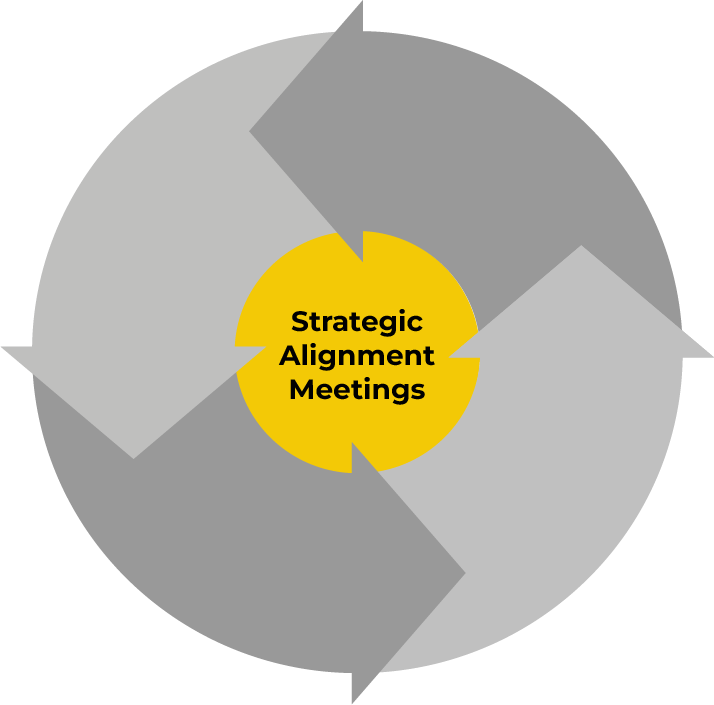
Strategic Alignment Meetings
These quarterly and annual meetings provide a strategic overview and ensure the leadership team aligns on long-term objectives while setting the focus for the upcoming quarter. SAMs allow for a broader review of progress against the One-Page Endgame (OPE), ensuring that all departments, including product and engineering teams, are synchronized with the company’s long-term goals.
Here’s the meeting structure:
Who: The leadership team and department heads (including Product, Engineering, Marketing, Sales, etc.). Ideally, there should be no more than 10 team members.
Facilitator: ProductLed Implementer (so the leadership team is 100% focused on discussions)
Duration: Full-day
Frequency: Quarterly. Please note this quarterly meeting will replace your MFM (i.e., you won’t hold a SAM and MFM in the same month).
Prep: Review the OPE, update the ProductLed Scorecard with quarterly results, and list strategic priorities and issues.
Here’s a typical agenda:
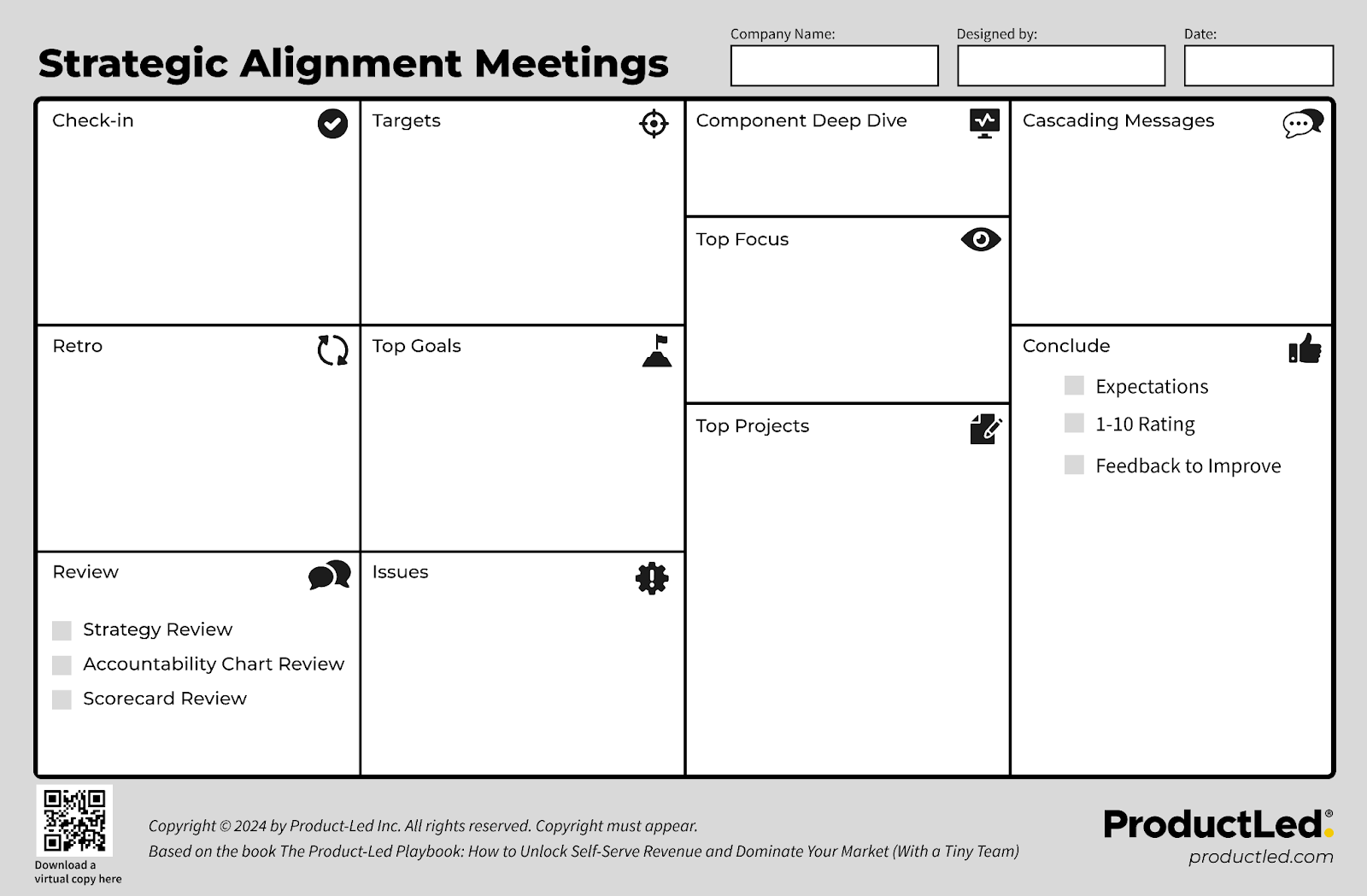
Check-in (15 minutes): To kick off the meeting, jot down everyone's expectations for this planning session. You’ll get honest feedback here, and often, you’ll get a clear idea of issues or goals for the quarter ahead.
Retro (30 minutes): This is a reflection on the past quarter. It combines a general retrospective with a focused review of your top initiatives. Start by asking your team these three key questions:
- What went well? Reflect on the successes of the past quarter. What initiatives, strategies, or actions led to positive outcomes? Celebrate the wins and recognize the efforts that contributed to achieving them.
- What didn’t go well? Identify the challenges and obstacles that hindered progress. Were there any missed opportunities or areas where the team fell short? Understanding what didn’t work is crucial for learning and improvement.
- What to do differently? What strategies, processes, or actions should change in the upcoming quarter to better achieve your goals? Based on the above reflections, determine the adjustments needed to improve moving forward.
This combined reflection helps the team gain insights from the past quarter and sets the stage for more informed decision-making in the upcoming quarter. Any issues that arise can be added to the issues list to discuss further (more on that below).
Strategy Review (30 minutes): Review your OPE. After every section, ask your team if they still believe this is the best path forward. The first few times you review your strategy, you might change your moats, clarify your ideal user, and nail down some strategic choices. This is completely normal. Your OPE is a living document that will evolve as your company scales.
Accountability Chart Review (30 minutes): You’ll build this out in the Team Component (up next), but this is where everyone is clear on who’s responsible for what and where the gaps are. Go through at least one cycle of your growth process before adding in the review of the accountability chart.
Scorecard Review (15 minutes): Review the ProductLed Scorecard you built in the Data Component. Every team member should fill out their metrics before the meeting and mark them with one of five statuses:
- On Track
- Trending on Track
- Off Track, Have a Plan
- Off Track, No Plan
- Off Track, No Plan, Target Unreachable
If there’s a plan, the expectation is that they link to it, create an issue, and review it with the team. Great (or up-and-coming) leaders will showcase how they can own a metric by creating a plan of attack when it’s off track. If the metric is off track with no plan or the target is unreachable, note it as an issue to discuss later in the meeting.
This is peer-to-peer accountability at the highest level.
Targets (10 minutes): Clarify the targets for the upcoming quarter. Start with your 1-Year Picture and Quarterly Picture. Decide on the Top Outcomes (typically, your revenue, revenue per employee (RPE), and profit).
Review each metric in your ProductLed Scorecard and set targets to make your 1-Year Picture and/or Quarterly Picture inevitable. This gets everyone on the same page. For instance, if you had only 100 customers in the past quarter but set a new target of 200, make sure marketing is also in agreement to double the number of ideal users.
Top Goals (20 minutes): Once you’ve got a good handle on the main issues and where to focus, list out the top goals for the quarter. Make these SMART goals. Aim for no more than 3 to 5 quarterly goals, as each additional goal slows down your team. It’s better to have less and complete them early than try to do too many things simultaneously.
Once a year, you’ll set annual goals as well. But for the rest of the SAMs, you’ll need to set just your quarterly ones.
Issues (90 minutes): At this point in the meeting, you will have consistently identified issues to address. For instance, if you’re not getting many customers and don’t have a plan, add that as an issue. If some mission-critical projects weren’t completed last month, that’s an issue. If your team hasn’t been able to address its top bottleneck in the past month, note it here.
This is your time for discussion and to plan the best path forward.
Component Deep Dive (30 minutes): This is a deep dive into one of the ProductLed System components. For example, has it been 12 months since you updated your strategy? Refresh it by going through the Strategy Component again. Lacking clarity on your ideal user? Review the User Component. Not getting enough signups despite strong traffic? Tackle the Offer Component again.
The ProductLed System is not a set-it-and-forget-it method. Think of each component as a plant. You need to water and maintain it to reap fruit.
Top Focus (30 minutes): Now that you know exactly what you’re doing for the upcoming quarter, you can set one Top Focus for the month ahead—the highest-leverage opportunity in your business. It might be:
- Improve customer retention.
- Improve the first-time user experience.
- Increase signups.
The top bottleneck from your scorecard is a big hint. But uncovering your highest-leverage opportunity isn’t formulaic. You need to look beyond the numbers. Sometimes, what’s not being done is holding back your growth.
For instance, if fewer users are signing up, why? Because your offer isn’t positioned correctly? Because it’s confusing? Whatever you decide is your highest-leverage opportunity is only a guess, albeit a data-backed one.
Top Projects (30 minutes): Identify the Top Projects for the month ahead, starting with those that directly address the Top Focus. These are the projects that, when executed, will make reaching your targets inevitable. Ensure these projects have a clear path to impact your business' highest-leverage opportunity.
Additionally, any other projects not directly tied to the Top Focus should still contribute to achieving your quarterly targets. It’s crucial that every project contributes to measurable outcomes and is aligned with the organization's broader goals.
Go one step further and quickly break down success for each:
- Who will own it?
- Who’s responsible for executing each aspect?
Add these projects to your project management tool. Everyone should aim to have no more than five Top Projects.
Cascading Messages (5 minutes): Reinforce the focus for the next month so the rest of the company is aligned. Consider hosting an all-hands meeting, sending a recap email, or using another method to ensure everyone is informed. Redundancy is beneficial as it reinforces top priorities.
Conclude (5 minutes): To wrap up, ask:
- Were expectations met?
- How would you rate the meeting on a scale of 1 (terrible) to 10 (outstanding)?
- Any feedback to improve next time?
Jot down the answers.
Don’t skip this step, even if folks are tired. You’ll gain valuable feedback on how to improve these meetings next time.
You can use our template to host your Strategic Alignment Meetings.
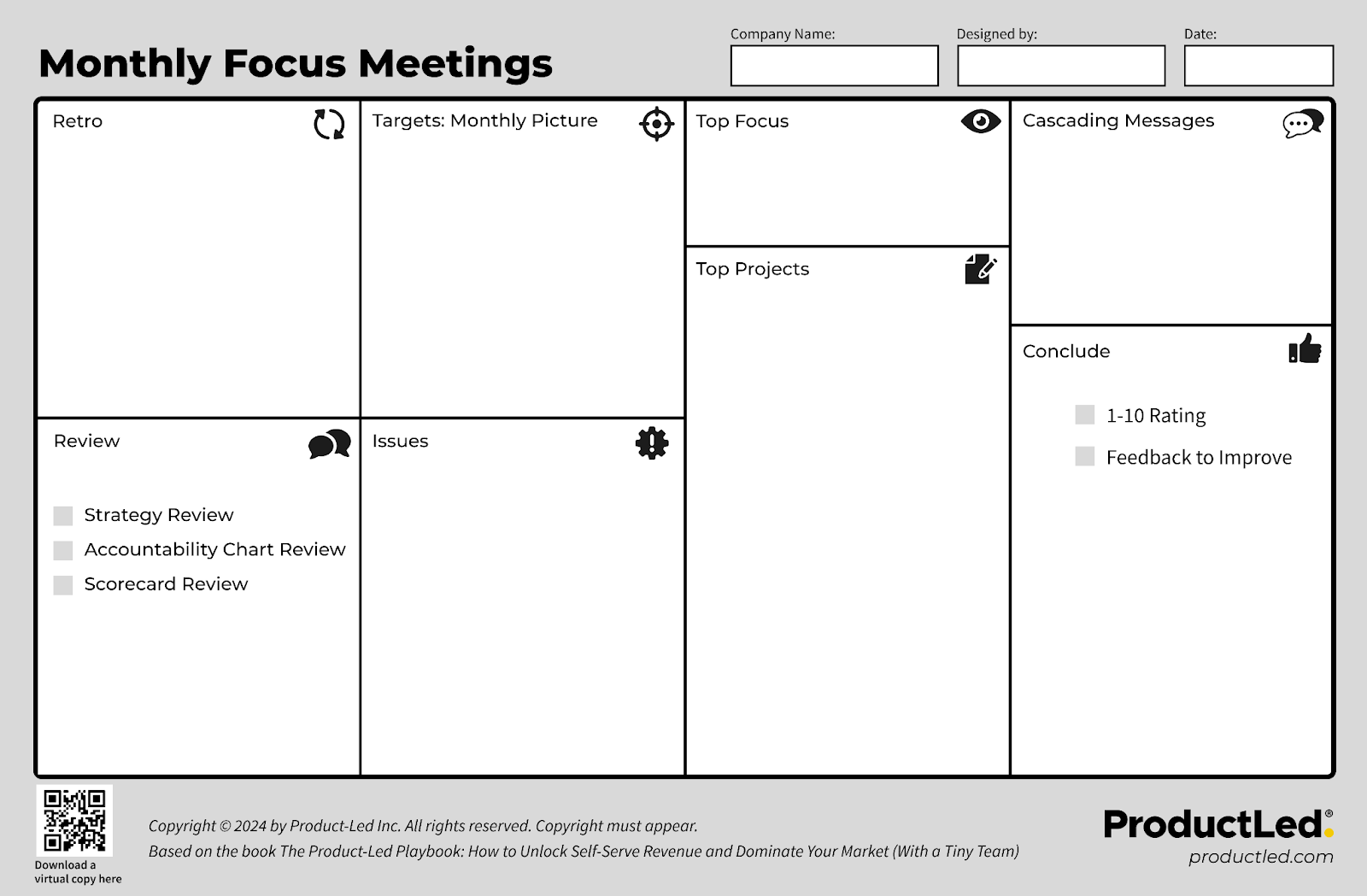
Monthly Focus Meetings
These are fantastic meetings to step out of the day-to-day, examine your business' performance, and decide what to do next. MFMs give everyone on your leadership team time to work on the business, not in it.
Planning is a muscle. Holding these meetings every month ensures the team stays focused on achieving their targets, driving consistent progress toward business goals. By maintaining this cadence, you can tackle short-term challenges while keeping your long-term strategy on track.
Here’s the meeting structure:
Who: The leadership team
Facilitator: ProductLed Implementer (so the leadership team is 100% focused on discussions).
Duration: Half-day
Frequency: Monthly.
Prep: Strategic Alignment Meeting, update the ProductLed Scorecard, list out Projects & Issues to discuss.
Here’s what a typical agenda looks like:
Retro (15 minutes): This is a critical reflection on the past month and should not be skipped. It’s an opportunity for the team to have an open and honest conversation about what worked, what didn’t, and how confident everyone feels about hitting quarterly targets.
Ask your team to answer these three questions before the meeting and add them manually on the call. It sounds like extra work, but it shows your team you recognize their ideas.
- What went well?
- What didn’t go well?
- What to do differently?
The Retro isn’t a formality—it’s where the team can extract valuable learnings from the past month and identify adjustments for the upcoming month.
Top Focus & Project Review (30-minutes): Go through each project you defined the month before to ensure it’s done (unless this is your first time). If something isn’t done by the end of the month, it’s off track. It sounds obvious, but you’d be surprised how many teams still mark tasks as on track when they’re weeks late.
Also, review if you’ve made a dent in your quarterly Top Focus. If not, add it to the issues list. You want to dissect whether or not you identified the right highest-leverage opportunity or if you’re simply not executing well.
Scorecard Review (15 minutes): Review the ProductLed Scorecard and ensure every team member fills out their metrics before the meeting and marks them with one of the five statuses discussed above. If the metric is off track with no plan or the target is unreachable, it should also be noted as an issue.
Targets (10 minutes): Start by updating what your Monthly Picture looks like in your OPE. Then, go through each metric in your ProductLed Scorecard and set targets that make your Monthly Picture inevitable. If there are any issues, add them to the issues list for discussion.
Issues (45 minutes): This is your chance to address any issues that will hold you back from hitting your targets and making your 1-Year and Quarterly Pictures a reality.
Top Focus (10 minutes): This one will look familiar since you’ve already completed a cycle of this during the SAM. Set one Top Focus for the month—the highest-leverage opportunity in your business.
Remember, your scorecard's top bottleneck offers a clue, but you need to look beyond the numbers. For instance, if fewer users are upgrading, is it because your pricing is confusing?
Top Projects (20 minutes): Again, this will look familiar since you’ll have done this during a SAM meeting. Each team member should bring a list of projects that they believe are key to roll out for the upcoming month. Each one should support your monthly Top Focus.
To prioritize projects, ask:
- Which projects will have the biggest impact on our Top Focus?
- Which projects will best help us hit our Targets?
Once the projects are identified, prioritize them based on cost and impact. Go one step further and quickly break down success for each:
- Who will own it?
- Who’s responsible for executing each aspect?
- What’s involved with rolling out each project?
Add these projects to your project management tool. No one should have more than five. Let your team know it’s okay to pivot or kill projects that become irrelevant.
Cascading Messages (5 minutes): Consider hosting an all-hands meeting, sending a recap email, or using another method to ensure everyone outside of your leadership team is informed of the company’s Top Focus and Projects for the month.
Conclude (5 minutes): To wrap up, ask:
- How would you rate the meeting on a scale of 1 (terrible) to 10 (outstanding)?
- Any feedback to improve next time?
Meetings, not just KPIs and products, need to get better, too.
You can use our template to host your Monthly Focus Meetings.
Weekly Accelerator Meetings
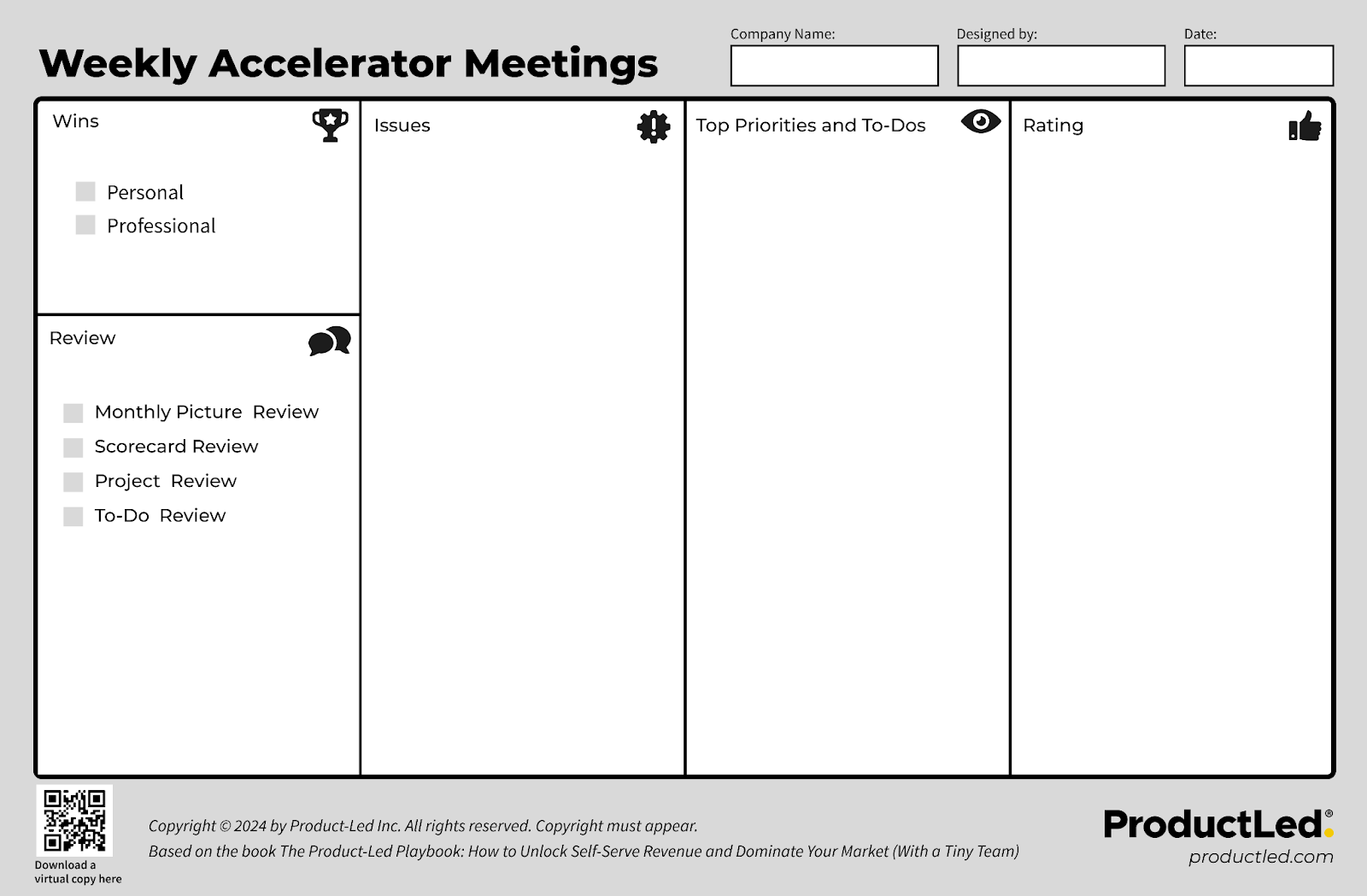
These are weekly meetings that give everyone a chance to check on alignment, track their progress, and address any issues. They are crucial to ensuring everyone stays on track.
Here’s a quick rundown of the meeting structure:
Who: The leadership team
Duration: 90 minutes
Frequency: Weekly
Prework: Monthly Focus Meetings, update the ProductLed Scorecard and Top Project progress
Here are the main agenda items you’ll cover in the WAM:
Wins (5 minutes): Share one personal and professional win. This starts the meeting off on a high.
Monthly Picture Review (3 minutes): Take a few minutes to review the Monthly Picture and see if you are on or off-track. This aligns everyone on the team with the company’s top focus and the outcomes for the month before getting into tactical details.
Scorecard Review (3 minutes): Be quick. Ask everyone who owns a metric whether it's on or off-track. If anything is off-track and there’s not already a solid plan in place, add it to the issues list.
Project Review (3 minutes): Review everyone’s projects by asking them for a simple on or off-track update. If a critical project is off-track, add it as an issue to discuss.
To-Do Review (3 minutes): If you identified specific to-do’s in a previous WAM, review them to see if all are marked as done. Most to-dos don’t get done because people forget. Putting this on the agenda increases peer-to-peer accountability and ensures that what’s planned is executed.
Issues (60 minutes): Before your meeting, you should have jotted down specific issues to discuss. As you go through the first five items above, you’ll often find several issues. Triage which are critical and use the same format in the MFM to identify the root cause.
Top Three Priorities & To-Do’s (10 minutes): This is a simple check-in to review everyone’s top three priorities for the week and helps the entire team know who’s doing what, increasing collaboration and accountability. Ideally this is captured in your project management application for reference at the next WAM.
Rating (3 minutes): Rate the meeting from 1 to 10 and share feedback on how to improve it.
You can use our template to host your Weekly Accelerator Meetings.
Now that you know the three key meetings for driving predictable growth, schedule them to recur weekly, monthly, and quarterly. This creates an unstoppable rhythm that keeps your team aligned on the long-term vision while being laser-focused on executing today’s most impactful projects.
Make Speed Your Key Differentiator
In today’s competitive markets, it's not the big that eats the small—it’s the fast that eats the slow.
Companies that drag their feet on execution lose their edge and get copied. It’s not just about turning strategy into action. You need speed to win. You need speed to capitalize on your strategy.
The Predictable Growth Process empowers your team to swiftly turn strategy into focused execution and stay ahead of the competition.
By aligning on the vision each quarter, locking in key projects monthly, and making massive progress every week, you gain the edge to outpace competitors, adapt quickly, and unlock predictable growth.
Actionable Takeaways
- Execution is the ultimate differentiator. It’s not enough to have the best strategy in your market. You must become the best at capitalizing on it.
- Your meeting rhythms control the pulse of your business. During tough times, your business should pulse faster. During smooth sailing times, you can slow down the pulse rate to focus on initiatives that take longer to execute.
- Your Strategic Alignment Meetings (SAMs) are the most important meetings in your entire company. They shape your company’s future and chart the best path to reach your goals.
- Monthly Focus Meetings (MFMs) keep your team focused on the top priority and ensure 80% of work aligns with it.
- Weekly Accelerator Meetings (WAMs) align your team on what the main focus is for the rest of the week and help address any hairy issues head-on.
- Although you can host your own Strategic Alignment and Monthly Planning Meetings, it pays dividends not to. A ProductLed Implementer can facilitate these meetings for you so you can focus your mental energy on what the highest-leverage opportunity is and the most effective way(s) to address it.
- Speed is the ultimate long-term competitive advantage.

Go all in on product-led growth.
Get three complementary playbooks to turn your product into your biggest growth engine. Read or listen anywhere, on your own or with your team.
Take {book} with you.
- Download the PDF and EPUB
- Listen to the full audiobook
- Read or listen on your preferred device
Get the complete ProductLed Library for $10 more.
- Product-Led Growth
- The Product-Led Playbook
- Product-Led Onboarding
- All three as PDFs, EPUBs, and audiobooks
- Wes Bush AI to help you apply what you learn
For individual use.
Get all three books
Give your team a shared playbook for growth.
- Everything in the three-book bundle
- Access for everyone on your team
- Each teammate chooses how to read or listen
- Wes Bush AI for every teammate
One purchase. Unlimited teammates.
Get the team bundlePrefer print? Get a paperback on Amazon →