
Why PLG IS Only Half the Story — and What to Do About It
In 2015, Forrester conducted a groundbreaking study on B2B buyer preferences.1 They asked a straightforward question: "Do you prefer talking to a salesperson or self-educating?"
Three out of four preferred to self-educate.
That was eight years ago. Have buyer preferences evolved? In 2024, ProductLed ran a survey with an even simpler question: “How do you prefer to buy?”
The options were:
- Try before you buy.
- Talk to someone in sales.
Only 3% of buyers preferred speaking to sales, while a whopping 97% wanted to try before buying. This is a seismic shift, not a trend.2
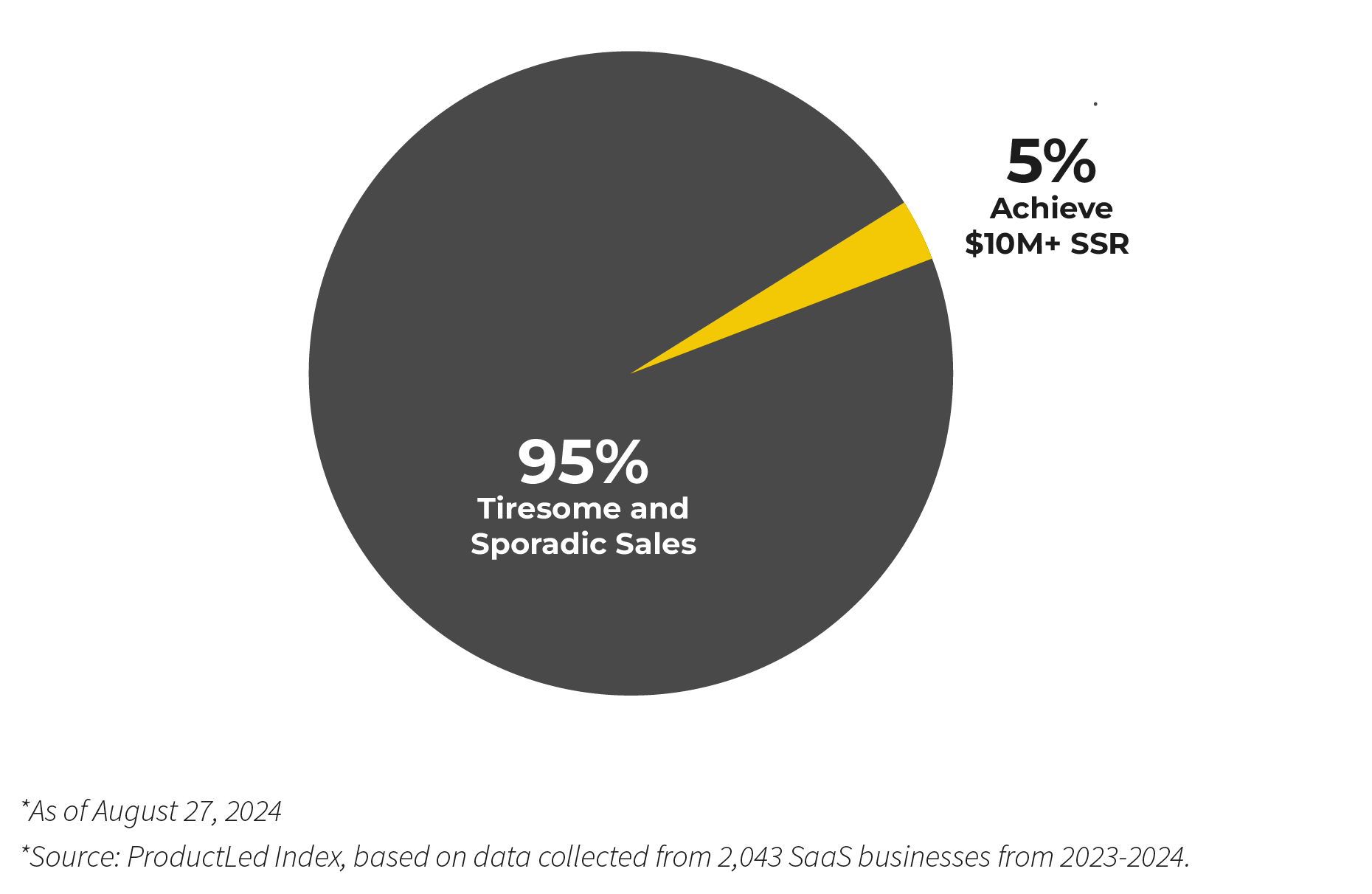
Most users in your market want to try before they buy, too.
Yet, when we analyzed 568 B2B SaaS homepages for their primary call-to-action (CTA), here’s what we found:
- Demo only – 50%
- Try before you buy only – 28%
- Hybrid (has both a demo and try-before-you-buy option) – 22%
Fifty percent of SaaS companies are still sales-led. There’s a massive delta between what buyers want and what SaaS companies offer.
If you want to sell to a modern buyer, you must have a try-before-you-buy experience—and it’s got to be great.
Of the companies offering it, only 7% of users say it’s a great experience.3
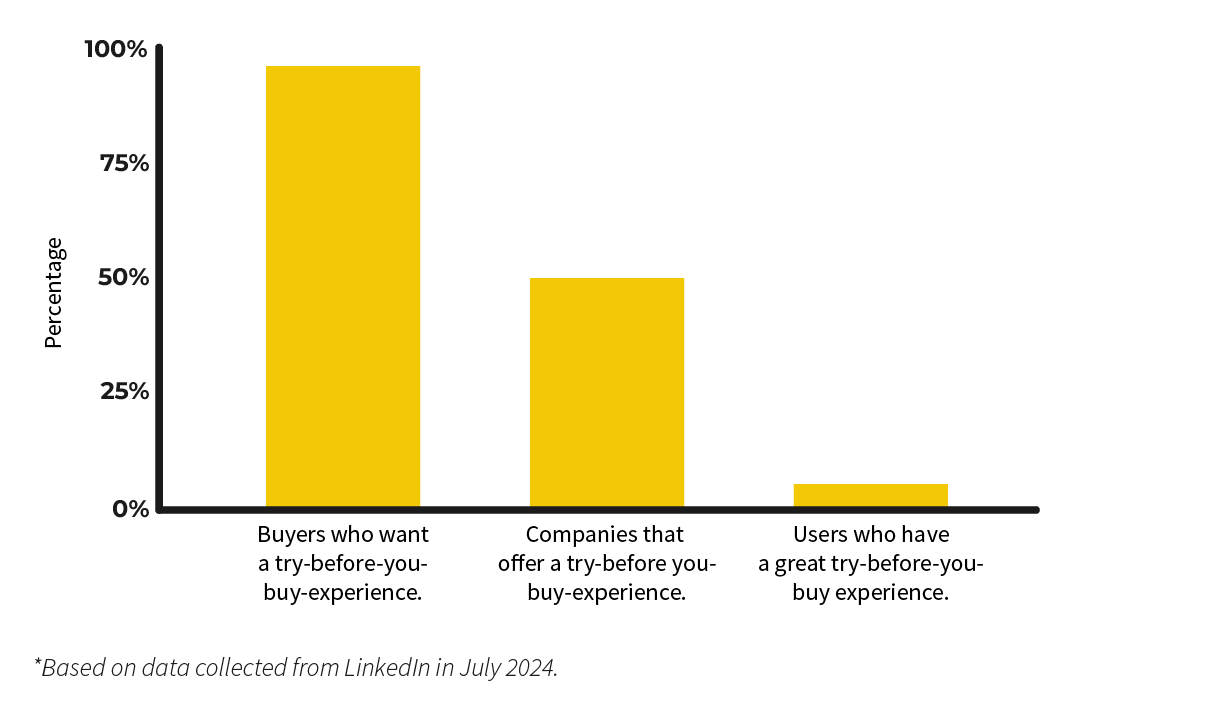
So why doesn’t every company just launch one, given the low bar? Or why don’t the 93% of companies with a mediocre try-before-you-buy experience optimize it?
Because building a product-led business is hard.
Why do so few companies excel with PLG? Why do most struggle to achieve meaningful scale despite overwhelming customer demand? That is the (multi) million-dollar question we’ll unpack throughout this book.
The companies that crack the code don’t just capture most of the market—they disrupt entire industries, leaving competitors scrambling. If you're not prepared to evolve, you risk being disrupted.
This book will show you how to thrive in this new era. The future of your business depends on it.
What’s Standing Between You and PLG Success?
While we've all heard of PLG success stories like Slack, Dropbox, and Canva, too many product-led companies fall far short.
After helping more than 400 companies implement PLG, these are the three most common pitfalls:
Pitfall 1: Approaching PLG as a “Product” Thing
This one is understandable. It’s called “product-led growth," indicating that the product is a big piece of the puzzle. Where companies get themselves into trouble is thinking that PLG is solely a "product" initiative when, in reality, it needs to be a "company-wide" strategy.
A year ago, I was curious to know which of our clients were most successful, so I manually went through all 324 of them at the time. I analyzed the job titles of those we worked with, who brought their team along to learn, who rolled out a free motion, and who had a free motion that generated great results.
It was a lot of digging, but it was worth it.
At that time, our ideal customers—and 80% of our clients—were senior product executives. SaaS founders represented less than 20%.
Yet, when I analyzed who was most successful, I found that it was the SaaS founders. This blew my mind. The tiny 20% of SaaS founders were generating 80% of the results with their PLG motions.
Why weren’t product executives as successful? What they often lacked was leadership buy-in. When we worked with SaaS founders, they implemented PLG as a company-wide initiative; it wasn’t just for the product team.
When done right, PLG aligns how your entire company creates and captures value. Without organizational buy-in and a unified strategy, you risk treating PLG as just another product feature rather than a company-wide growth engine.
PLG is a go-to-market (GTM) motion, not a product strategy.
Pitfall 2: Not Providing Meaningful, Timely Value Before Monetizing
When you sign up for a free product, you make a snap decision on whether or not to move forward. If the product experience is clunky and frustrating, users won’t come back. You do the same thing when you pilot products.
Some 40 to 60% of your first-time users sign up and never come back. You need to showcase value quickly. If you don’t, customers will never upgrade without talking to you, if at all.
Pitfall 3: Not Executing Effectively
Most of us are terrible at new things. When I first learned to ski, I wiped out so often that I almost gave up—I wasn’t having fun. As we get older, we expect to magically be great at new things and, more often than not, avoid them entirely and stick to what we already know. But the truth is, growth occurs when we make mistakes.
The same is true for PLG. An awkward learning phase is made worse by focusing on advanced steps like “nailing your product data” before you’re even clear on your ideal user.
I recently chatted with a client about their low free-to-paid conversion rate. The founder confidently stated that he was going to invest the entire next quarter to improve his user onboarding with the Bowling Alley Framework. (I cover this in the Onboarding Component.) I was delighted to hear that he was putting the book into practice; however, I had a realization when I went to his site. I had zero clue what his company did. It was something AI-enabled if that gives you a hint.
I quickly pointed out that if users couldn’t understand what his product did and the main value proposition, optimizing the onboarding would only offer a marginal improvement on his free-to-paid conversion rate, at best. But he could see a 10x impact by simplifying his offer on the homepage.
It was a deer-in-headlights realization for him.
These stories are all too common. We’re so close to our business that it’s easy to drink the jargon Kool-Aid and forget that what seems simple to us is puzzling to others.
It’s normal to do stuff in the wrong order. There’s no playbook for building and scaling a product-led business and no guarantee that the best product will win.
Far too often, sales-led companies capture more market share with an inferior product and user experience. The product-led founder, meanwhile, has invested far more to build a powerful product but can’t get much traction because of a rickety GTM motion.
Whenever I see a product-led business lose to a sales-led company, it motivates me even more. Product-led businesses should win every time.
You’ve invested more time and energy. You care about delivering a fantastic experience. You believe serving users matters more than selling. You have a mission—to make your product better, faster, and cheaper.
As Jeff Bezos says, “The best entrepreneurs are missionaries instead of mercenaries. The mercenaries are just trying to make money, and paradoxically, the missionaries always end up making more money.”
Product-led founders create enormous leverage through their products, build lean companies, and are highly profitable. This book will show you how to become a successful product-led founder and change the way you sell, forever.
To do that, you need to avoid one big trap.
“It’s a Trap!”
Star Wars nerds know what I mean.
You arrive with your entourage of allies only to find out you’re outgunned 10 to one, with no escape. You need to fight it out. Arghh!
Say you start rolling out PLG. You…
- Focus on launching a free trial or freemium model.
- Build out transparent pricing.
- Improve onboarding to get users to value more quickly.
- Update your homepage to get more free signups.
While these are all important aspects of PLG, they’re only half the story.
This fundamental oversight is precisely why many fail to make PLG work.
I call this “surface-level PLG.”
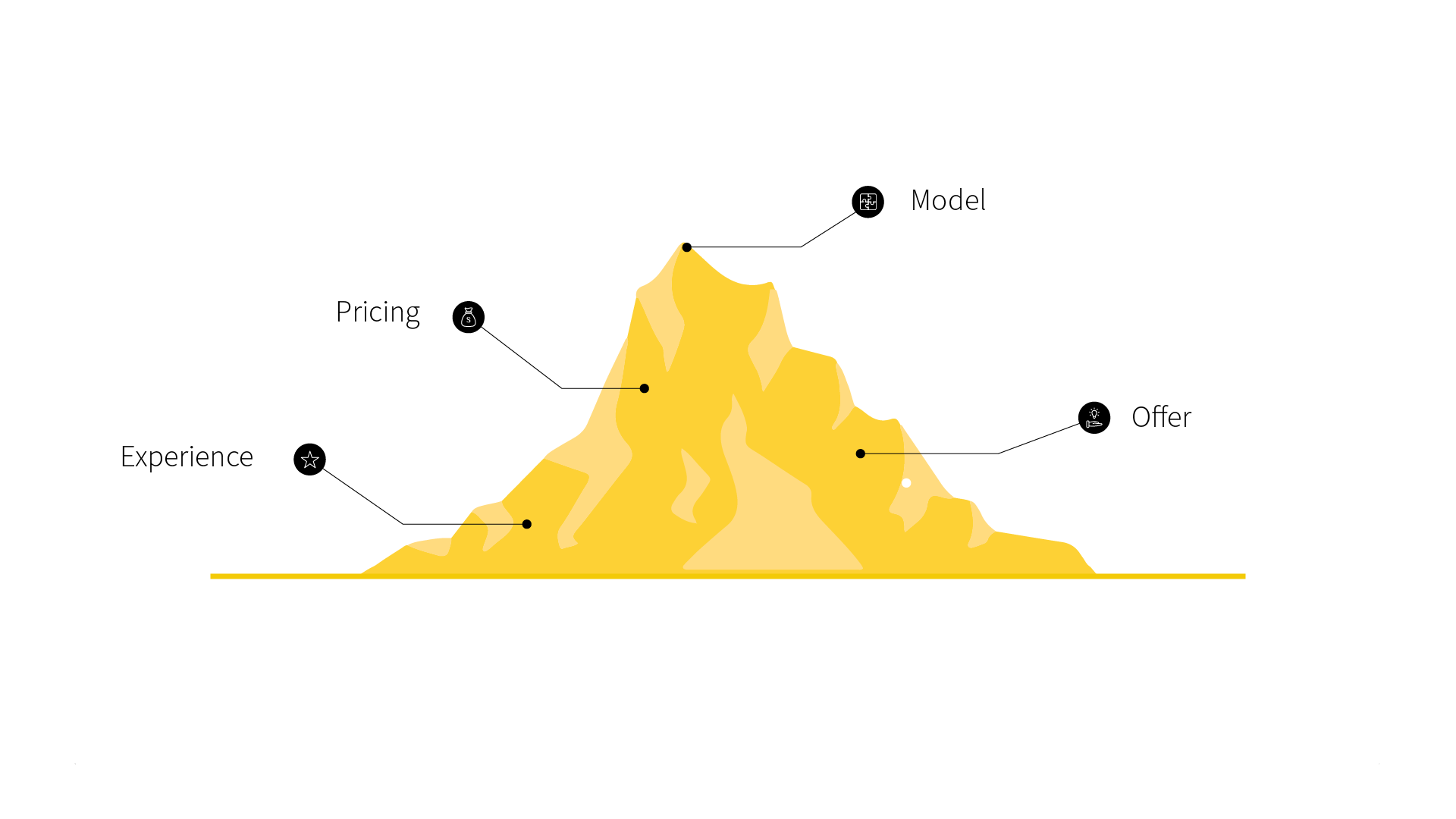
This leads to treating PLG as "a product thing," with:
- No organizational buy-in.
- Lackluster results.
- Unfocused execution.
- Not enough value before monetizing.
Businesses doing surface-level PLG often kill the motion entirely because it doesn't work.
This is what happened to us at Vidyard back in 2016.
We were trying to grow fast but had only a sales-led motion. Some of our competitors had a free trial, so we thought it was a good idea to try one ourselves. We created a landing page, funneled visitors to it, and gave them access to the product.
At first, the results were promising. We saw a surge of signups and thought we were on the right track. Three weeks later, not a single user upgraded without talking to sales. We even wondered if something was wrong with our product.
By the time we saw the problem, it was too late. We hit the hidden part of the iceberg at full speed. The free trial bombed. So we killed it.
What we lacked at Vidyard was everything below the surface that supports PLG.
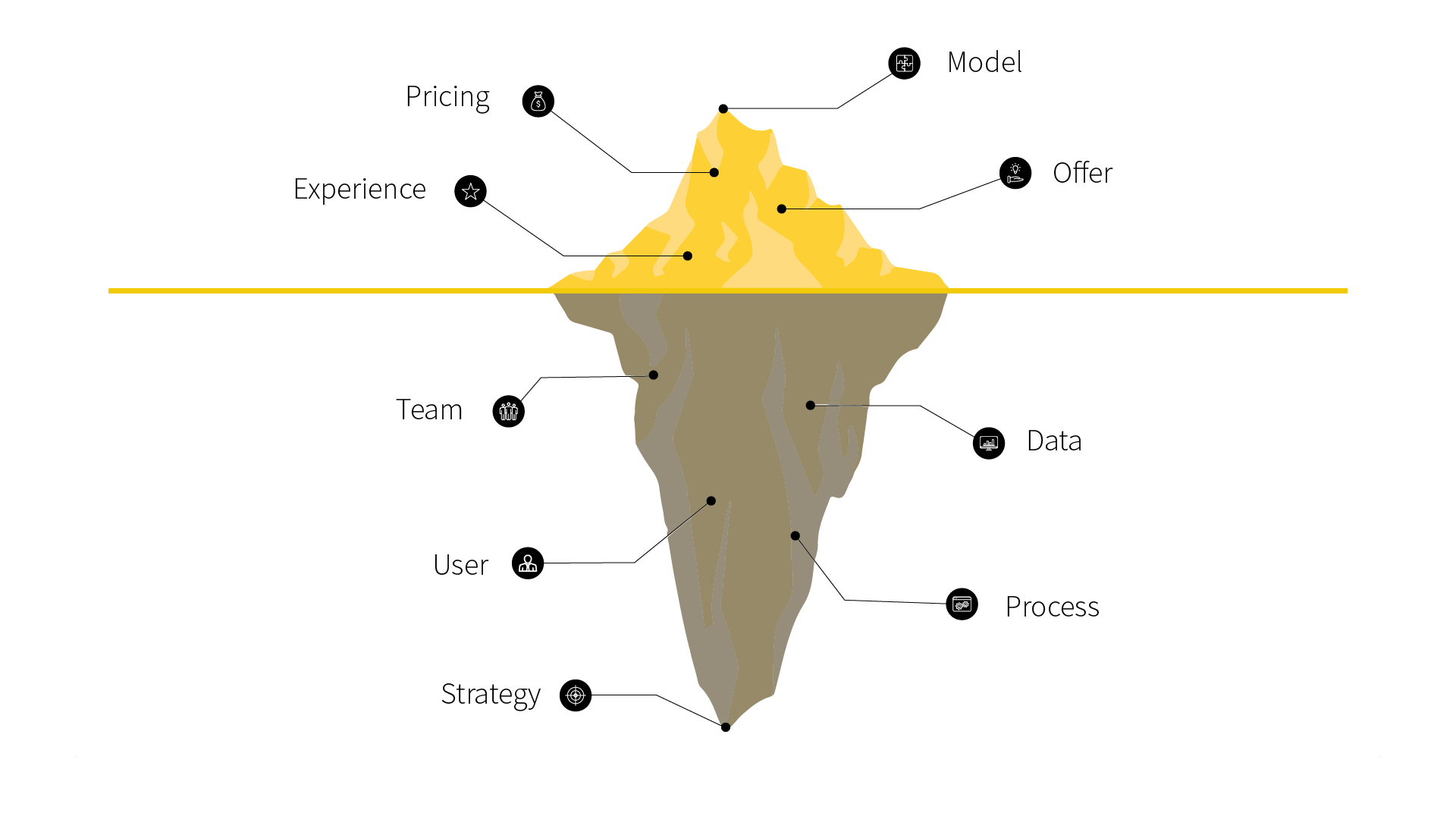
PLG needs the right environment to thrive.
When trying to salvage our free trial experience at Vidyard, I approached key leaders with our plan of attack. Their answers were simply that the company had other priorities. It wasn’t on the roadmap.
It’s frustrating when there isn’t alignment around how to approach PLG.
It can’t thrive without:
- A company-level strategy in which PLG is a key part of winning in the market.
- Clarity on your ideal user. Most sales-led businesses know their ideal buyers well, but the ideal user—who is that?
- The faintest idea of what those users are doing in your product.
- The weekly rhythms in the business to identify what’s bottlenecking users.
- An effective growth process to launch regular experiments to improve your experience.
- An elite team with the right capabilities to take PLG to the next level.
All that below-the-surface support is your product-led organization (PLO).
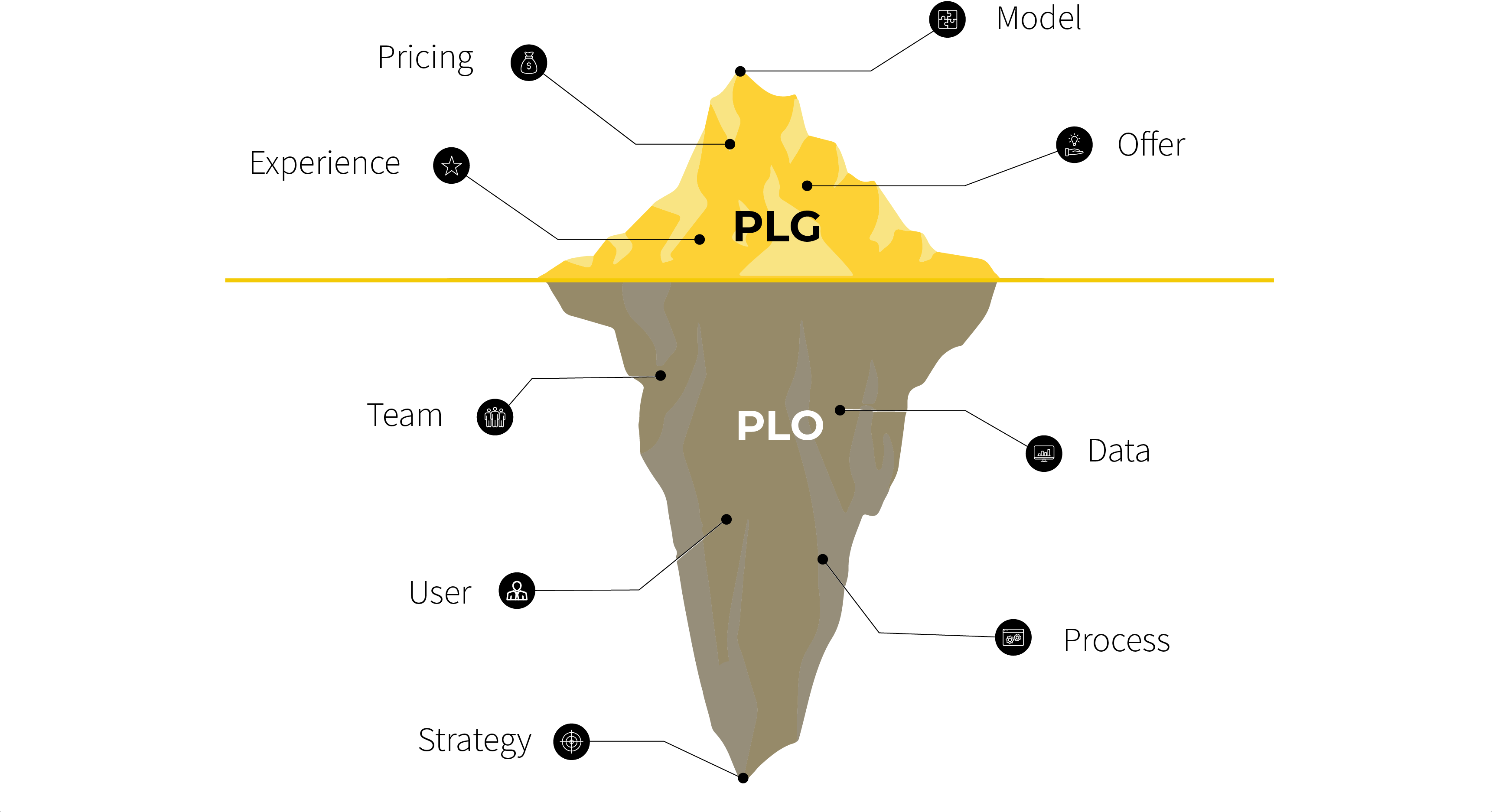
PLOs are the company-focused backbone that makes PLG happen. Simply put, PLG is everything the user interacts with on the front end, while your PLO ensures your company is aligned and firing on all cylinders on the back end.
Many companies try to deploy PLG without building a PLO. They launch a free trial, hoping it transforms how they sell, and then they notice it’s not working. The reason is because they don’t have a strong PLO to back it up.
Just like what happened at Vidyard.
To fully embrace PLG, you must transform how you sell and how you run your organization.
Instead of focusing solely on optimizing your PLG motion, ask: How can I design an organization so that PLG succeeds?
Becoming product-led is the integration of the two.
This book will help you become product-led.
When you do that, you can expect three outcomes.
- Effortless Annual Recurring Revenue (ARR): Your product sells itself. Users can sign up, get value, and upgrade without talking to anyone.
- Lean Scale: You generate substantial revenue with a tiny team. Your revenue per employee remains high because the product does the heavy lifting.
- Durable Growth: You unlock more profits every year. Your lifetime customer value increases as users return to your product and use it more frequently.
If achieving these outcomes was easy, I wouldn’t have written this book. And you wouldn’t be reading it.
But you’re here because you’re ready to become product-led. In the next chapter, you’ll discover the system that will empower you to do just that.